



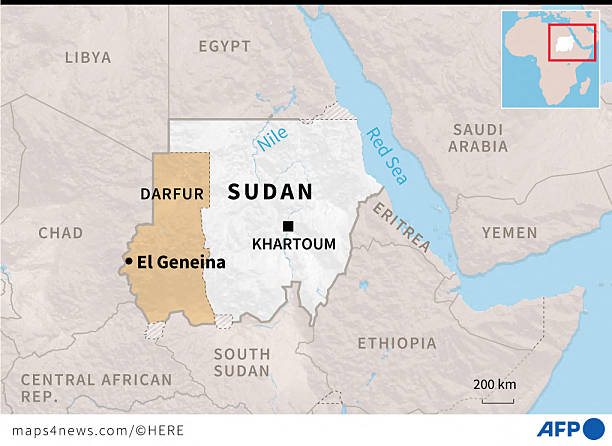
Money transfer fees through Bankak, the electronic banking application operated by the Bank of Khartoum, have risen sharply in El Geneina, the capital of Sudan’s West Darfur State, reaching around 50 percent, according to traders and residents.
The increase has affected trade, contributed to rising commodity prices, and disrupted commercial activity in the city.
The US dollar was trading at around 4,600 Sudanese pounds, while 1,000 Chadian francs were selling for approximately 39,500 Sudanese pounds in cash, compared with around 70,000 pounds when transferred through Bankak.
Omar Ibiylih, a currency trader in El Geneina market, attributed fluctuations in exchange rates to movements in global markets, including the Dubai market and the value of the UAE Dirham and US dollar, as well as fluctuations in the Sudanese pound amid high inflation.
“Traders rely heavily on the Chadian franc for commercial transactions because of the close trading links between West Darfur and neighboring Chad,” he said. “Traders sometimes exchange Chadian francs for gold or other commodities of equivalent value because of the scarcity of Sudanese pounds.”
According to Ibiylih, the rising value of the Chadian franc relative to funds held through Bankak is driven by supply and demand, as well as the absence of functioning banks in the state, which has contributed to a decline in the value of electronic transfers compared with cash.
Yousif Razaz, a resident of the city, described the practices in El Geneina’s market as “usurious,” saying that deducting half the value of a transfer sent through Bankak places a heavy burden on residents.
“You cannot send me money and have nearly half of it deducted,” he said, describing the practice as exploitative and unfair to customers and families.
Razaz added that the cost of transferring money through Bankak has continued to rise since the outbreak of war in El Geneina.
Another resident, Abdelmoneim Zakaria, described the increase in commodity prices in El Geneina as “frightening and outrageous,” saying prices had risen further with the onset of the rainy season and reduced rainfall, compounded by the difficult living conditions created by the war.
Zakaria said West Darfur’s geographic location had made the state heavily dependent on Chad for trade through the Adré border crossing, resulting in extensive circulation of and transactions between different currencies.
He said the Chadian franc had reached record levels against the Sudanese pound, with 1,000 Chadian francs fetching around 40,000 Sudanese pounds, adding that residents and traders were facing “various forms of financial speculation” amid continued instability in the foreign-exchange market.

 and then