



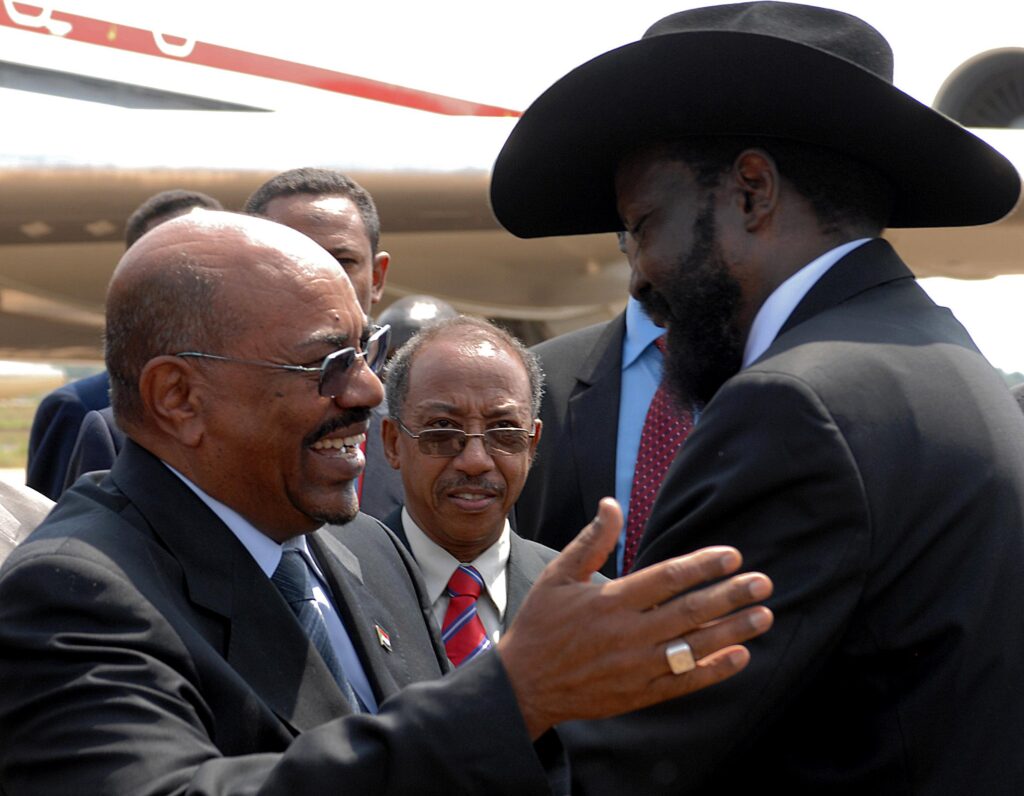
May 16 has once again exposed the growing disconnect between liberation memory and political reality in South Sudan. The recent claim by President Salva Kiir that he rejected more than $500 million allegedly offered by former Sudanese President Omar al-Bashir is not an isolated remark; it is part of a broader pattern in which liberation history is invoked to manufacture legitimacy in the present. The statement, made during the 43rd Sudan People’s Liberation Army (SPLA) Day commemorations, reflects a political strategy that relies less on verifiable governance performance and more on repeated revolutionary narratives to sustain authority ahead of the regime’s staged December 2026 elections.
In this context, May 16 is no longer simply a remembrance of struggle. It has increasingly become an arena in which contested claims of patriotism, sacrifice, and moral authority are performed, even as public trust continues to erode under unmet promises and deepening political disillusionment.
“They called me and offered $505 million, but I refused. No one appreciates himself, but I can appreciate myself because I did not accept the money offered. If I had taken it, our country would not have become independent,” Kiir said at Juba Stadium.
Kiir’s claim that he rejected the supposed bribe and that independence would otherwise not have been achieved is not only unconvincing but also represents a textbook false dilemma. It reduces a complex liberation struggle, shaped by decades of collective sacrifice, armed resistance, and regional diplomacy, into a binary narrative in which national independence supposedly depended on one man’s moral choice between money and statehood. While Kiir may, like any individual, take pride in rejecting corruption, extending this personal claim into the assertion that he single-handedly safeguarded independence distorts history by inflating individual agency and erasing the collective forces that made statehood possible.
If taken at face value, the claim also exposes a contradiction: how does a leader who frames independence through personal incorruptibility preside over a system in which allegations of entrenched corruption persist within his inner circle, including family members and close allies? This tension does not reinforce the statement—it undermines it.
Let us assume the bribery allegation was true and that Salva Kiir refused to accept it. Then what happened to the rational version of him that existed between August 2005 and July 2011 after South Sudan seceded from the very Sudanese government that allegedly tried to bribe him?
It is both puzzling and troubling that a self-proclaimed ethical leader would later resort to practices widely perceived as corrupt, in which key national ministries, especially the Ministry of Finance and Economic Planning and the Ministry of Petroleum, though run by officially appointed ministers, are indirectly managed and controlled by the so-called Presidential Office of Special Programs, including close allies and family members.
Some may dispute this characterization. Yet dismissing these widespread perceptions requires ignoring the extent to which informal power networks are believed to shape the management of key state institutions.
Political systems facing declining legitimacy often retreat into mythology. When governments lose the ability to inspire citizens through accountable governance, economic stability, justice, or national cohesion, they increasingly rely on historical narratives designed to manufacture emotional loyalty.
The past becomes political theater, repeatedly revived to sustain authority in the present. In such moments, propaganda shifts from information to survival strategy.
Kiir’s claim about rejecting more than $500 million allegedly offered by Omar al-Bashir fits squarely within this pattern. It is not credible historical reflection but a political performance aimed at reinforcing moral authority and reviving liberation-era symbolism at a time when governing legitimacy is under strain.
The timing of the claim further underscores its political function. At a moment of economic hardship, insecurity, institutional paralysis, and growing public disillusionment, liberation nostalgia is again being used as a substitute for governance. Citizens are asked to invest in unverifiable stories portraying the president as uniquely patriotic and morally exceptional, even as lived conditions point in the opposite direction.
The political anxiety surrounding legitimacy appears increasingly visible behind the scenes as well. In this same pre-election context, a confidential senior government official with ties to national security disclosed that Kiir panicked on April 26, 2026, over whether elections would proceed and instructed the Speaker of Parliament to remove the unilateral peace amendments debate from the agenda. The same source further alleges that the regime was later encouraged on May 1, 2026, by Uganda’s President Yoweri Museveni to proceed with the December 2026 elections despite ongoing peace violations. According to the same source, Museveni also suggested that the 2026–2031 period could be politically significant for both leaders and encouraged deeper diplomatic outreach to China and Russia for support at the United Nations Security Council.
This reflects a deeper crisis in post-liberation politics in South Sudan. Revolutionary legitimacy once rested on collective sacrifice and the promise of dignity for marginalized populations. Yet it erodes when liberation movements transform into systems characterized by patronage, repression, militarization, and elite accumulation. History cannot indefinitely shield governments from accountability, especially when their practices contradict the ideals they claim to represent.
May 16, in this sense, no longer carries its original meaning for many South Sudanese citizens. What was once a symbol of collective struggle has increasingly become a state-managed ritual of self-glorification. Rather than honoring the people who bore the burden of liberation, it now often elevates those accused of presiding over its betrayal. The gap between liberation memory and lived reality has become not only visible but central to how the day is perceived.
For many citizens facing insecurity, economic collapse, and political exclusion, such commemorations increasingly appear detached from reality. Heroic self-praise in the midst of national hardship deepens public cynicism, as claims of personal moral sacrifice are weighed against everyday experiences of hardship and corruption. Increasingly, these narratives are interpreted not as leadership, but as political theater designed to sustain legitimacy ahead of the regime’s upcoming theatrical elections.
The deeper tragedy is that the language of liberation itself has lost much of its political credibility. The ideals of sacrifice, justice, accountability, and collective dignity have gradually been replaced by self-preservation, patronage, and elite entitlement. Those once seen as custodians of national aspirations are increasingly perceived as distant from the realities facing ordinary people.
Political mythology can persist in societies shaped by prolonged conflict and historical trauma, but it eventually collapses when consistently contradicted by lived experience. Citizens ultimately judge governments not by liberation stories or commemorative speeches, but by material conditions, institutional credibility, and the protection of basic rights and dignity.
Revolutionary nostalgia is no substitute for the widening gap between the promises of independence and the realities of governance today. The crisis is not merely about the credibility of a single claim—it is about the erosion of post-independence credibility. History belongs to the people collectively, not to political elites seeking to repackage it as electoral capital.
If the liberation of South Sudan was truly secured through collective sacrifice rather than individual moral choices, what does it mean when today’s legitimacy is repeatedly grounded in personal heroism instead of the institutions and freedoms that liberation was meant to produce?
The deeper issue, therefore, is not only the contested claim of a $505 million offer. It is that May 16 has become a recurring stage on which liberation history is recast as political legitimacy, even as that legitimacy continues to erode. What is presented as remembrance increasingly functions as substitution: history in place of governance, memory in place of accountability, and narrative in place of performance. In that substitution lies the core of the ongoing crisis of liberation credibility.
Duop Chak Wuol is an analyst, critical writer, and former editor-in-chief of the South Sudan News Agency. He is a graduate of the University of Colorado and writes on geopolitics, security, and social affairs in South Sudan and the broader East Africa region. His work has appeared in leading regional and international outlets, including AllAfrica, Radio Tamazuj, The Independent (Uganda), The Arab Weekly, The Standard (Kenya), The Chronicle (Ghana), Addis Standard (Ethiopia), and Sudan Tribune. In 2017, the Ethiopian Broadcasting Corporation highlighted his article on Meles Zenawi’s role in Ethiopia’s economic transformation. He can be reached at duop282@gmail.com.
The views expressed in ‘opinion’ articles published by Radio Tamazuj are solely those of the writer. The veracity of any claims made is the responsibility of the author, not Radio Tamazuj.

 and then