



I rarely write about military matters; however, when one sees the armed forces of one’s country losing their spine, one ought to speak up rather than remain silent. For this reason, I have to bring to the fore a few lapses in recent and current times by raising these pertinent concerns.
I am among those who are still asking questions. Why was Gen. Kong Thou hurriedly sent to the Army Reserves with an inactive, non-participating status? Was that a witch-hunt, a design of internal sabotage, targeting him as a person and weakening the armed forces that act as the shield of the nation? In the eyes of senior commanders who are now settling personal scores, are individuals’ targeting aimed at capable cadres not seen as a debilitation of key institutions like the military?
With the current fluctuating military operations characterized by short stints of victories that are, in most cases, relapsing, can H.E. Salva Kiir Mayardit look elsewhere to source a competent, ready-to-build-the-army senior command? If the command castrates the upcoming commanders by removing them from the existing command chain, then what is its worth for?
My military science classes during my years in high school taught me memorable lessons, but the leadership of Commander Sa’d Ibn Abi Weqqas stood out: his strategy was impeccable in multiple parameters, ranging from strategic patience, reliable intelligence, innovative adaptation, and establishment of permanent, sustainable military infrastructure, and a command hard to challenge even by a disaster.
Gen. Paul Nang Majok’s command is reactive, not proactive, as expected, and is never pragmatic. The true example is its inability to respond promptly. He was not able to rescue Gen. David Majur Dak, who managed to protect himself for nearly five days, only for his boss to rely on the United Nations. What was Paul Nang’s rescue strategy in that case?
Until today, his command has never satisfied the country with the right information on who truly killed citizens in Khor Khaltan, and he was unable to update the country on the events about the capture of Akobo, giving through the military spokesperson an excuse that they need time to connect the dots before they could conduct a press briefing.
This operational blindness on matters of Akobo can be speculated as only a quest for time to doctor false information and feed the country with it, like the case of Khor Khaltan. This scenario is a good example of a command failure. The command is never aware of military operations happening in the country against itself.
The president needs to render the army vibrant by detaching it from internal vengeance and unnecessary politicization. Gen. Paul Nang is more into the politics of vengeance and appointments. He is never focused on his role but on the suppression of his enemies.
H.E. Salva Kiir Mayardit, the Commander-In-Chief, has a long list of cadres, for example, senior generals like Malek Reuben Riak, Rin Tueny Mabor, Kong Thou, Aboud Stephen, Jok Riak Makol, Bor Wutchok Bor, Lual Wek Guem, Marial Chanuong Yol, Makal Kuol, James Hoth Mai, and Santino Deng Wol, among many others, to look up to when he needs an illustrious command that would prop up the gasping army. The mentioned commanders are a few examples of decorated generals at his disposal, shaped with discipline and skills. They do not just command forces; they have the ability to help the leadership in stabilizing the country.
Since the purge in the security sector a year ago, the country has remained in total darkness, with a security sector that is never vigilant but is fighting with itself. The government has become less vibrant and completely aloof in many matters of great importance.
It goes without saying that the government badly needs urgent reinvigoration. Lobbyists and cartels have dampened it. Regrettably, incompetence is now the outlook. A good government ought to be proactive and pragmatic because a fragmented government cannot achieve a strategic goal of national stability and growth. Citizens who are killed in darkness without being protected by the army, which they consider their shield against all sorts of aggressions, internal or external, are never productive and cannot pay taxes.
Gen. Nang seems to be interested in the orchestration of unnecessary wars that he even fights in swings, with never-ending losses in men and equipment. Where does he expect to get resources, both in humans and equipment, when the country is writhing in pain of economic collapse and an arms embargo?
A powerful military command can opt out of military action, especially in a senseless war against locals, and talk the warring factions into understanding that war was unnecessary. Akobo is a strategic town in matters of defense of the Republic of South Sudan.
I suppose many of the current military wars are geared towards the accumulation of wealth through the diversion of military budgets. A commander of a hunger-stricken army, with no reinforcements and a strategic exit in case of defeat, cannot win a vicious war against notorious militia forces.
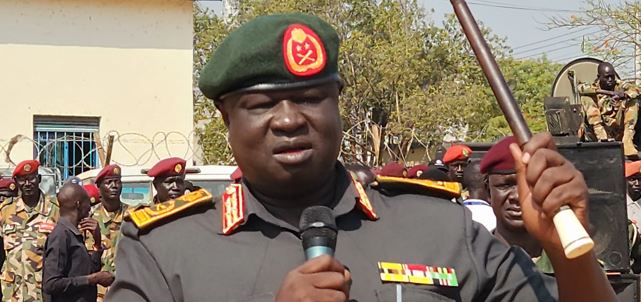
If the army does not straighten up, it will always be disrespected, and that disrespect can translate to that of the country and its leadership. Gen. Paul Nang looks tough on camera, but he doesn’t have the ability to defend the country to the total extinction of aggressors. He might be the most educated Chief of Defense Forces (CDF), but his strategies are not superior to those of the militias. Therefore, he needs to be rested in time to control the damage. The damage is huge and insulting.
Till then, yours truly, Mr. Teetotaler!
The writer, Dr. Sunday de John, holds an MBA and a Bachelor of Medicine and Bachelor of Surgery (MBChB) from the University of Nairobi, Faculty of Business and Management Sciences and Faculty of Medicine, respectively. He is the current Chairman of the South Sudan United Front-Progressive and can be reached via drsundayalong4@gmail.com
The views expressed in ‘opinion’ articles published by Radio Tamazuj are solely those of the writer. The veracity of any claims made is the responsibility of the author, not Radio Tamazuj.

 and then