



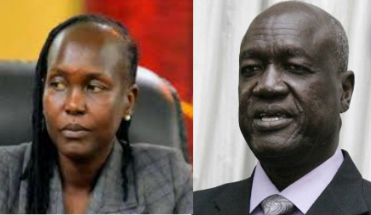
There are moments in the life of a nation when leadership is tested not by war, not by policy, but by something far simpler and far more revealing – the discipline of speech. South Sudan, a country forged through sacrifice and sustained by fragile hope, now finds itself confronting a different kind of failure—one not of strategy but of judgment, restraint, and respect.
Recent remarks attributed to presidential advisor Kuol Manyang Juuk—suggesting that South Sudanese youth should not complain about hunger because alternative sources of food exist—have ignited a wave of anger that is both immediate and justified. This is not because the statement was merely provocative. It is because it appeared to mock the lived reality of a nation where hunger is not an abstract concern but a daily, grinding truth.
Hunger in South Sudan is not a matter for careless rhetoric. It is the quiet desperation of households stretched to breaking point. It is the visible exhaustion of communities trapped between scarcity and survival. For a senior figure in government to address such suffering with language perceived as flippant is not simply a lapse in tone—it is a rupture in the moral contract between leader and citizen. And yet, this is not an isolated rupture.
In a separate but equally incendiary episode, Trade and Industry Minister Atong Kuol Manyang—daughter of Kuol Manyang Juuk—was widely condemned for remarks on social media in which she allegedly described people of Lakes State as “barking dogs.” The comments came in response to public outrage over the announcement, delivered by Vice President Hussein Abdelbagi Akol, during the 2nd graduation ceremony of Rumbek University of Science and Technology, that the historic Rumbek Senior Secondary School would be transferred to Rumbek University of Science and Technology.
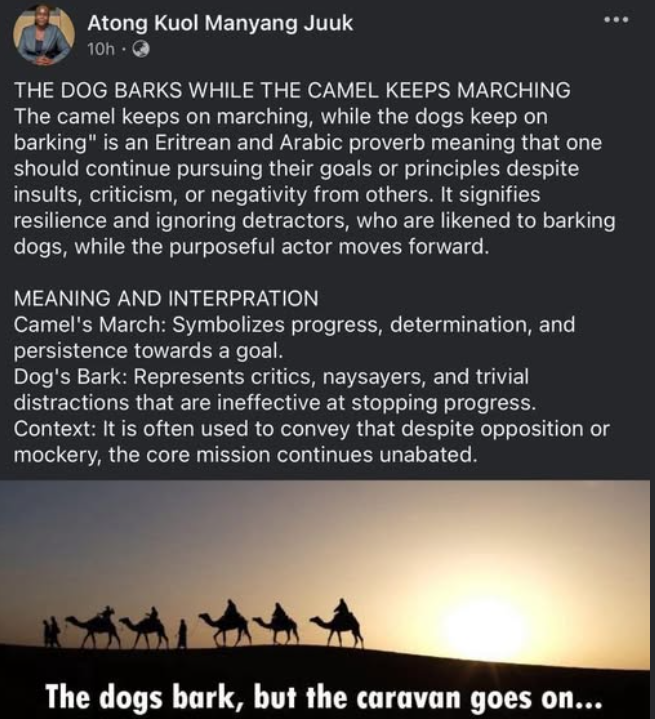
Here, the context is not incidental—it is central. The anger expressed by citizens was rooted in concern over a decision affecting education, heritage, and community identity. It was the reaction of a public that felt excluded from a process that directly impacted its future. To meet that anger with language perceived as dehumanizing is to cross a line that no public official, in any functioning system, should approach.
Taken together, these incidents form a pattern that can no longer be dismissed as a coincidence or misinterpretation. They point to something more entrenched and more troubling – a leadership culture in which words are deployed without care, without empathy, and without an apparent awareness of their consequences.
This is where the phrase “a government of loose tongues” ceases to be a rhetorical flourish and becomes a serious indictment. Words in governance are not neutral. They are instruments of power. They signal priorities, define relationships, and shape public trust. When those words carry the scent of contempt—whether toward the hungry or toward aggrieved citizens—they do not simply offend, they corrode.
And that corrosion does not remain confined to the individuals who speak. It spreads, inevitably, to the administration they represent.
The government of Salva Kiir Mayardit cannot insulate itself from the conduct of its senior officials. Every statement, every outburst, every moment of rhetorical recklessness becomes part of the broader narrative through which citizens judge their leaders. When that narrative is one of detachment, insensitivity, and insult, the political cost is not theoretical—it is immediate and cumulative.
Trust, already fragile, begins to fracture. Authority, already contested, begins to erode. Legitimacy, already under strain, begins to slip. This is not hyperbole. It is the predictable consequence of leadership that appears to speak above the people rather than to them. There is a dangerous arrogance in believing that words do not matter. That citizens will forget. That outrage will dissipate. That power, once secured, is immune to the slow but relentless pressure of public discontent.
History suggests otherwise. No government, however entrenched, can afford to alienate its people indefinitely. And no leadership, however powerful, can sustain itself on a foundation of eroding trust. The question, then, is no longer whether these statements were appropriate. That debate has already been settled in the court of public opinion. The question is whether there will be consequences.
Accountability, in this context, is not an abstract ideal. It is a practical necessity. When senior officials repeatedly engage in conduct that undermines public confidence, the integrity of the offices they occupy is brought into question. And when that integrity is compromised, the system itself is weakened.
This is why calls for resignation are no longer peripheral—they are central. Resignation is not vengeance. It is not humiliation. It is a recognition that leadership carries standards, and that those standards must be upheld if institutions are to retain credibility. When officials can no longer command the public’s respect, their continued presence in office becomes a liability, not an asset.
The responsibility does not end with those who have spoken. It extends to the highest level of leadership. Salva Kiir Mayardit faces a defining choice: whether to tolerate a pattern of conduct that undermines his administration, or to act decisively in defense of its credibility.
To do nothing is, in itself, a decision. It is a decision to accept the normalization of careless speech. A decision to risk further alienation of the public. A decision to allow the perception of indifference to harden into belief.
South Sudan deserves better. It deserves leaders who understand that power is not a license. That authority is not immunity. That words, once spoken, cannot be recalled—and that their consequences cannot be wished away.
The country stands at a point where silence is no longer sufficient, and explanation is no longer enough. What is required is action—clear, visible, and decisive. A government that cannot discipline its words will struggle to command its future. And a leadership that cannot respect its people will, sooner or later, be rejected by them.
The writer is a South Sudanese political analyst and commentator on governance, leadership, and state-building in post-conflict societies and lives in Adelaide, South Australia. He can be reached via johnaliap2021@hotmail.com.
The views expressed in ‘opinion’ articles published by Radio Tamazuj are solely those of the writer. The veracity of any claims made is the responsibility of the author, not Radio Tamazuj.

 and then