



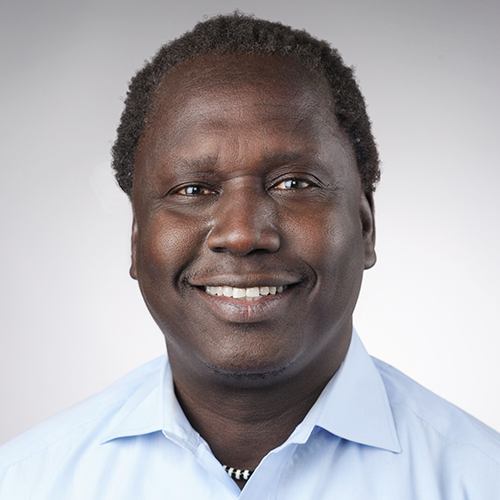
South Sudanese scholar and Syracuse University professor Jok Madut Jok has questioned President Salva Kiir’s health and governance practices, warning that key decisions may increasingly be made by officials around him rather than through formal state institutions.
In an exclusive interview with Radio Tamazuj on Thursday, Prof. Jok also raised concerns over the growing role of presidential family members, particularly Adut Salva Kiir, alleging a lack of transparency in her official position and links to a company involved in collecting government taxes and levies.
He said the First Family’s reported travel to Akon was described as a private visit for a family homecoming and blessing ceremony amid concerns over the President’s health, but added it was also seen as a possible opportunity for political discussions, including succession and broader governance issues.
Jok said recent detentions of senior officials were more likely driven by internal power struggles than formal corruption cases, citing a lack of court proceedings and due process.
He said planned African Union-led talks were unlikely to succeed without government commitment, and cautioned that upcoming elections could lack credibility if basic legal and logistical conditions are not met.
Below are the edited excerpts:
Q: Professor Jok, you have recently been critical of the situation in South Sudan and the First Family. What is going on within the First Family?
A: The First Family is made up of individuals who are very different from one another.
The President is the central figure, and the main issue surrounding him recently has been growing public concern about his health and fitness for office. This is based on observations of his physical mobility, including his reliance on support when walking, as well as concerns about his cognitive capacity and ability to articulate himself in public.
These concerns have triggered wider questions about his ability to continue running the country, and this is widely discussed, including within family and political circles.
The First Lady is seen as a humble and gracious person, who plays a stabilising role within the family and tries to maintain unity among its members.
The children have different personalities and ambitions. The most scrutinised is Adut Salva Kiir, who serves as Presidential Envoy for Special Programs—a position whose constitutional basis, mandate, and limits of authority remain unclear.
She has attracted attention due to alleged involvement in a company called Crawford, which reportedly has multiple subsidiaries, including those linked to e-government services and a platform known as Capital Pay, which is involved in collecting taxes and government levies.
This arrangement has raised concerns domestically and internationally. It was referenced in a UN Human Rights report and by the United States Department of Commerce as potentially corrupt and possibly subject to sanctions.
The core concern is the lack of transparency in how the company was contracted. There is no clear public procurement process, no parliamentary oversight, and no publicly known contractual framework.
It is also unclear whether Crawford is paying the government or the government is paying Crawford for tax collection services.
This has placed the First Family at the centre of corruption-related controversy, alongside broader issues of power and political influence.
There are also reports that Adut is being discussed in political circles as a potential candidate for Vice President in place of Wani Igga and possibly as First Deputy Chair of the SPLM, which would place her in a potential succession trajectory.
Q: Professor Jok, does this have confirmation or evidence that Adut is claiming or trying to seek the position of Vice President and second in command in the party?
A: There is no written, recorded, or official evidence of her making such declarations.
However, people who work closely with her and within her networks have heard her express such ambitions. These accounts remain informal and unverified.
There are also reports that the First Lady herself is uncomfortable with her daughter entering such a highly politicised and publicly exposed space, which attracts significant scrutiny and criticism.
All of this information comes from individuals within the presidential circle and others close to the family, many of whom speak anonymously due to fear of losing their jobs or positions.
Therefore, the evidence is circumstantial and not concrete.
Q: Professor Jok, we have seen today the First Lady travel to the hometown of Akon via Aweil. What do you know about their travel? The President is also expected to travel to Akon. Why is the First Family travelling to the hometown together for the first time?
A: We are hearing that this is a private trip and not a state visit.
It is described as a homecoming aimed at reconnecting with family and conducting a blessing ceremony, particularly in light of concerns about the President’s health. Religious and spiritual leaders are expected to pray for him.
However, there is also public expectation that this gathering could be used to raise political issues, including succession and the broader state of the country’s economy, insecurity, and national unity.
Local leaders and community members may also take the opportunity to ask difficult questions about governance, including why the country remains in economic hardship and instability.
At the same time, there is heightened tension on social media involving communities from Awan (the President’s area) and Aweil, following inflammatory remarks by a social media figure. Some believe this individual may be linked to political actors seeking to inflame tensions.
This comes amid wider controversy surrounding businessman and outspoken critic Garang Deng Aguer from Aweil, who has raised strong concerns about corruption, including the allocation of oil cargoes to individuals and opaque financial practices.
He has questioned how government funds are released, arguing that corruption involves not only lower-level officials but also senior figures who authorise such transactions.
He has also raised concerns about the reported killing of young people from Aweil in the Jebel Kaltan area, where youth were allegedly rounded up and brought to Juba for recruitment into the army and possible deployment to Jonglei.
Following his statements, there were rumours of his arrest, prompting young people from Aweil to gather at his residence for protection.
All of this has created a potentially volatile situation between Aweil and Awan or Gogrial communities. The President may be asked to address these tensions, particularly given his historical association with both communities and his past remarks that he is originally from Aweil. It would therefore be inaccurate to assume deliberate hostility by him or his family toward Aweil, given the historically close relationship between these communities.
Q: What do you know about the President’s health status?
A: He is able to stand and walk with support from a cane, but he walks slowly and with difficulty.
He has a history of knee injuries sustained during a plane crash in Kenya in the 1990s, and the effects of that injury have worsened with age.
He is physically limited in performing some presidential duties.
There was also public attention to video footage of him walking at the African Union headquarters in Ethiopia, where efforts were reportedly made to shield cameras from clearly capturing his movement.
In my view, his physical mobility alone should not be politicised given his age and medical history. The more serious concern would be his cognitive ability to think, speak, and make decisions effectively, although this is not publicly verifiable.
In a properly functioning democratic system, he would be expected to undergo an independent medical assessment of fitness for office. However, South Sudan lacks strong institutions to enforce such a process.
Parliament is not independent, and the separation of powers has largely broken down.
As a result, the President may remain in office as a symbolic figure, while real decision-making may be exercised by individuals around him who benefit from maintaining the status quo.
Some Cabinet members, including Adut herself, and Vice President Hussein Abdelbagi, may have an interest in sustaining this arrangement, even if they are aware of his limitations.
Q: Professor Jok, what do you know about political detainees, including those recently detained and others held for some time? Who is behind these detentions and what is their status?
A: Many detainees, including former senior officials and security figures, appear to have been arrested due to internal power struggles within the Presidency.
These include figures such as former Vice President Benjamin Bol Mel, former aides in the President’s office such as Ambassador Ajing Deng Ajing and Dominic Juk, as well as activists brought back from abroad, including from Dubai via Kenya.
Others, including former security personnel like Manasseh Machar Bol Yai, and former Finance Minister Marial Dongrin, have also been detained. I understand that Marial Dongrin has since been released to go home but remains under restriction in Juba.
Publicly, these arrests are justified on grounds of corruption. However, if corruption were the genuine basis, formal charges should be announced, followed by court proceedings, investigation, and trial.
South Sudanese law is clear: arrests must be carried out under judicial authority, and detainees must be presented before court. This is not happening.
There is no transparency on charges or legal process.
This suggests these are internal political rivalries driven by competition over shrinking state resources. Those in power may be using detention as a tool to eliminate rivals and prevent their return to political competition.
The silence of the state further indicates weakening institutions and the use of extra-legal practices.
Q: Professor Jok, there is concern over spending on the 43rd anniversary of SPLA Day and the First Family’s travel to Akon. Do you know how much was spent on SPLA Day or will be spent on the private visit?
A: I do not have exact figures, but it is clear that public funds are being used.
Financing comes through a combination of wealthy individuals benefiting from opaque government contracts, including oil cargo allocations, supply contracts for vehicles, food, and other goods to the army and state institutions.
These business actors contribute to state celebrations, but a significant portion of funding is also directed through state institutions such as the Ministry of Finance, the Revenue Authority, and the Central Bank.
The scale of spending is clearly substantial.
At the same time, this occurs while infrastructure continues to collapse. Roads from Uganda to Juba are deteriorating, oil-financed projects in Bahr el Ghazal remain incomplete, and basic services are failing.
More than 90% of South Sudanese are significantly poorer than at independence. Violence remains widespread, and many children continue to die from preventable diseases, especially as donor support has declined and the government has not filled the gap.
In this context, spending large sums on celebrations instead of healthcare or infrastructure is deeply problematic.
Even major institutions like Juba Teaching Hospital are in such poor condition that people risk their health simply by entering them.
It is unacceptable and reflects a failure of governance.
Q: On SPLA Day celebration, SPLM Secretary General Dr. Akol Kordit said anyone who dislikes SPLM will suffer in South Sudan. What is your comment?
A: It reflects a long-standing pattern of rhetoric from SPLM officials and government figures, including statements implying that critics will “suffer” or should accept hardship.
We have heard similar remarks from senior officials across government, which reflect a lack of policy vision.
The SPLM continues to rely on liberation history rather than governance performance or a clear development agenda.
Independence was achieved through the collective sacrifice of many South Sudanese—not the SPLM alone—and that history cannot be used as a permanent justification for political dominance.
Q: Professor Jok, do you think the recent AU-led consultations in Dar es Salaam by envoy and former Tanzanian President Jakaya Kikwete will succeed after the failure of the Tumaini Initiative?
A: No dialogue can succeed if the government is not genuinely willing to engage.
If the SPLM-led government is not committed to inclusive talks with all political stakeholders, then no external actor, including the African Union or regional leaders, can compel it.
A sustainable solution requires a genuine national dialogue leading to a constitutional settlement that addresses the root causes of conflict.
The current reliance on military solutions will only deepen poverty and instability, because the conflict cannot be resolved militarily.
Q: Do you see elections happening in December this year?
A: Yes and no.
Yes, in the sense that the government may proceed regardless of whether technical and legal conditions are met, including electoral laws, constituency demarcation, voter registration, and logistical readiness.
If elections are rushed, partial, or exclude conflict-affected areas, they may still take place, but with limited participation.
No, in the sense that a credible, fully legitimate election is likely not possible at this stage due to lack of preparation.
However, many citizens still want elections because they want representative institutions and accountability, which they currently lack.
Q: Finally, what is your message to South Sudanese and the government given insecurity, hunger, displacement, lack of salaries and state dysfunction?
A: The government must abandon the use of violence and military solutions and commit instead to genuine dialogue on the country’s political and security crisis.
It must take a serious look at the suffering of its people and the collapse of the national promise that accompanied independence.
South Sudan has become deeply impoverished, with mismanagement of resources and growing inequality.
The country’s wealth is increasingly captured through opaque deals that benefit a small elite and external actors, rather than ordinary citizens.
In many urban spaces, South Sudanese are increasingly marginalised even within their own economy, while outsiders dominate commerce and trade.
This reflects a system that resembles colonial-era hierarchies, where citizens feel like outsiders in their own country.
The government is increasingly governing through division, which is unsustainable.
Leaders must urgently rethink their approach, for the sake of the country’s future and their own legacy.

 and then