



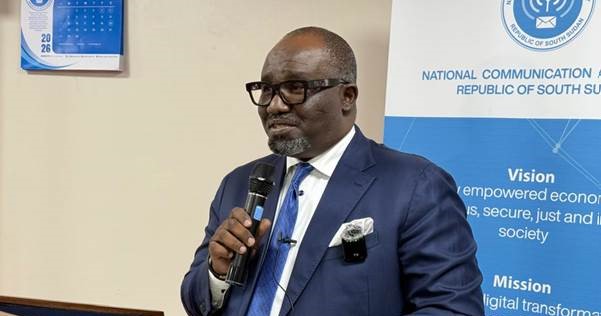
South Sudan’s National Communications Authority (NCA) has approved a phased adjustment to the telecommunications tariff exchange rate effective Thursday midnight, saying the measure is intended to prevent financial strain on mobile network operators and avert potential service disruptions.
NCA Director General Rizig Dominic Samuel said the decision was aimed at ensuring the sustainability of telecom services, which he warned were under pressure due to a widening gap between regulated and market exchange rates.
He said mobile network operators currently pay taxes directly to the South Sudan Revenue Authority (SSRA) and do not remit revenue to the regulator.
According to NCA data, the sector generates between 18 billion and 25 billion South Sudanese pounds annually, depending on consumer usage.
Samuel said international telecom traffic is globally benchmarked at about $0.04 per minute, which he noted would translate to roughly 181 SSP at the official central bank exchange rate. However, he said operators have been required to calculate tariffs using an outdated rate of 4,526 SSP per dollar, while commercial market rates stand at about 27,000 SSP per dollar.
He said the disparity has resulted in significant foreign exchange losses for operators, estimating losses of more than 22,000 SSP per dollar spent on operations. He added that some operators had seen monthly revenues fall sharply in dollar terms in recent years due to higher costs of sourcing foreign currency.
“The gap has placed operators under severe financial pressure,” Samuel said, warning that some companies had considered scaling back infrastructure, particularly in remote areas where operating costs are higher.
Under the new arrangement, the NCA said an additional adjustment of about 70 SSP per minute would be applied on top of the existing baseline tariff. It said the measure would be reviewed depending on macroeconomic conditions.
Samuel said the regulator would continue to oversee pricing of data packages, adding that any changes would require technical review and approval by the authority.
He acknowledged widespread public complaints over poor network quality and connectivity but said improvements would depend on operators’ ability to import equipment, which requires access to foreign currency.
The NCA said it was engaging with the central bank and financial institutions to explore improved access to foreign exchange for the telecom sector, arguing this was necessary to support network upgrades and expansion to higher-capacity technologies.

 and then