



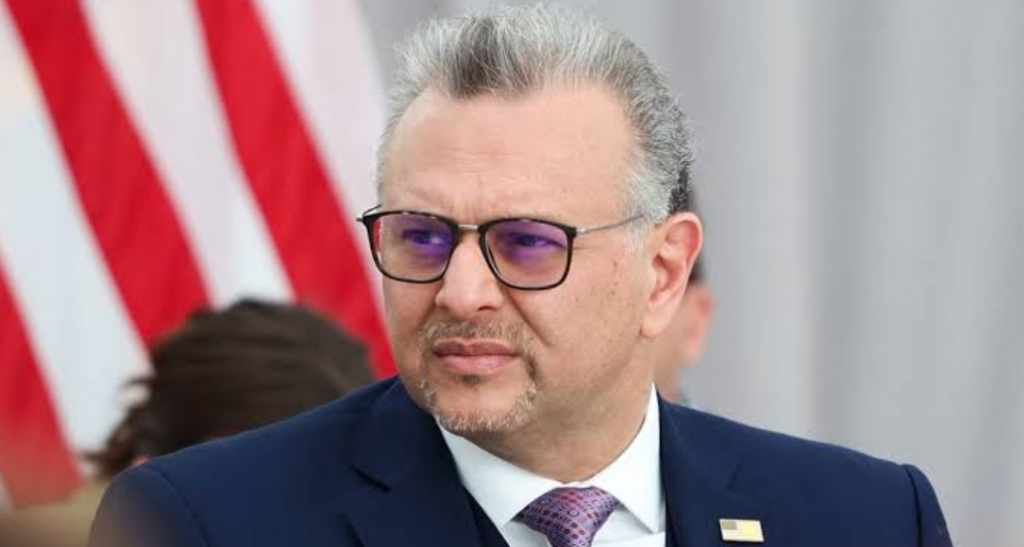
The United States is working with regional and international partners to secure a humanitarian truce in Sudan and does not formally recognise the government aligned with the country’s army, a senior adviser to President Donald Trump said.
Massad Boulos, Trump’s senior adviser for Arab and African affairs, said Washington was working with Egypt, the United Arab Emirates and Saudi Arabia, which together with the United States make up the so-called Quad on Sudan, as well as Qatar, Turkey and European countries.
“Today we are striving, together with our brothers in the Quad … as well as our brothers in Qatar and Turkey and in Europe, towards a new peaceful path,” Boulos said in an interview with Sky News Arabia broadcast on Saturday.
The United States has maintained contacts with Sudan’s army-aligned authorities as a de facto entity but does not formally recognise them as the country’s government, Boulos said.
“At the same time, we do not recognise any parallel governments and we oppose partition,” he said, adding that Washington supports a unified Sudan.
Sudan has been engulfed in a war between the SAF and the paramilitary Rapid Support Forces (RSF) since April 2023. The conflict has killed tens of thousands of people, displaced millions and created one of the world’s worst humanitarian crises.
Boulos said Washington’s immediate objective was to secure a humanitarian truce that would allow greater access for aid, followed by a permanent ceasefire and a political transition to a civilian-led government.
He reiterated U.S. support for a five-point peace plan announced in February, centred on an immediate humanitarian truce, sustained humanitarian access and civilian protection, a permanent ceasefire, a transition to civilian rule and postwar reconstruction.
“There is no military solution in Sudan,” Boulos said. “The only solution is a peaceful solution.”
Nationwide arms embargo
Washington is also seeking to expand an existing United Nations arms embargo on Sudan’s Darfur region to cover the entire country, amid concerns over increasing use of drones and foreign military support to both sides.
The UN Security Council on Sept. 11 unanimously extended the existing sanctions regime for one month to allow more time for negotiations over the U.S. proposal. Russia and China have opposed expanding the embargo beyond Darfur.
Boulos said the United States did not regard the delay as a failure and would use the additional time to negotiate with Security Council members.
The proposed expansion would cover weapons and related technology across Sudan, including unmanned aerial systems, according to Security Council documents and officials.
“It is fundamentally a war of drones,” Boulos said.
The United States has also imposed sanctions on individuals and entities accused of supporting the warring parties and has sought to disrupt financial networks linked to the conflict.
A UN fact-finding mission has reported that both the SAF and RSF have received foreign military support and that foreign-supplied weapons and technology have contributed to attacks on civilians. The mission has also reported evidence that SAF operations involving foreign-supplied drones caused civilian harm.
Boulos said Washington wanted to end foreign military support to both sides.
No role for warring generals
The Trump administration has also said neither Burhan nor RSF commander General Mohamed Hamdan Dagalo, known as Hemedti, should have a role in governing Sudan after the war.
Boulos said the future political system should ultimately be decided by Sudanese people and that the U.S.-backed process should include broad participation by civil society, political parties and other groups.
He said extremist groups, including elements associated with the Muslim Brotherhood, should not be part of the political process.
Washington’s position that neither of the two military leaders should govern Sudan forms part of its wider push for a civilian-led transition, Boulos said.
The United States has warned against Sudan following the model of Libya, where rival authorities have competed for control, and has opposed the establishment of parallel governments or the partition of Sudan.
The RSF has said it is prepared to accept a 90-day humanitarian truce but has rejected some proposed arrangements for the withdrawal of its forces. Burhan has repeatedly said the army will continue fighting until the RSF is defeated.
Boulos said the United States would continue working with regional and international partners to bring the two sides towards a ceasefire and a political process.
“Sudan must remain united,” he said.

 and then