



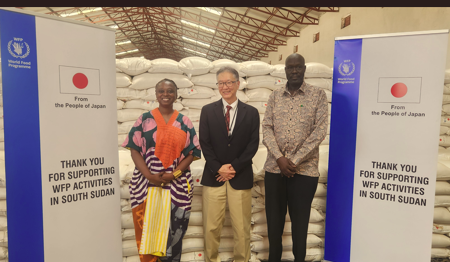
Japan has contributed 350 million Japanese Yen, equivalent to about $2.2 million, to the World Food Programme (WFP) to provide nutrition assistance to vulnerable women and children in South Sudan.
The funding is expected to support nearly 40,000 women and children in areas severely affected by acute malnutrition, including Greater Jonglei, Upper Nile, Unity, Warrap and parts of Greater Bahr el Ghazal.
Speaking during the signing ceremony in Juba on Wednesday, Hiromoto Oyama, Chargé d’Affaires of the Japanese Embassy in South Sudan, said the contribution comes at a time when more than 7.8 million people are facing acute food insecurity across the country.
“Without urgent support, more than 222,000 children and pregnant and breastfeeding women could lose access to humanitarian assistance from October,” he said.
He said conflict, displacement, flooding, rising food prices and disease outbreaks continue to worsen the humanitarian situation, while funding shortages threaten the continuity of essential nutrition services.
Mutinta Chimuka, WFP Country Director in South Sudan, said the agency’s resources are increasingly stretched as humanitarian needs continue to rise.
“More than 7.8 million people are facing acute food insecurity, and there is malnutrition among women and children, which remains a very serious concern,” she said.
She said the Japanese contribution would help WFP provide critical nutrition assistance to nearly 40,000 women and children, including pregnant and breastfeeding women and girls suffering from acute malnutrition.
The assistance will also focus on preventing malnutrition among mothers and young children before their conditions become more serious.
Chimuka described the Japanese support as a “lifeline of hope” as millions of South Sudanese face severe hunger and humanitarian resources reach their limits.
Japan has provided more than $37.7 million to WFP’s operations in South Sudan since 2021, according to Chimuka.
The South Sudan government welcomed the contribution but appealed to other donors to provide additional funding.
William Chan Achuil, Undersecretary in the Ministry of Humanitarian Affairs and Disaster Management, said WFP had warned the government that food and funding for internally displaced people, refugees and vulnerable host communities could run out from October 1 if more resources are not urgently mobilised.
“We welcome Japan’s contribution while appealing to other partners and donors to join this effort and help prevent vulnerable people from being left without essential food assistance,” Achuil said.
Oyama said international assistance alone cannot address South Sudan’s food crisis, calling on the government and political parties to make food and nutrition security a national priority.
“Food and nutrition security must be a national priority, properly resourced and sustained,” he said, stressing the need for peace and safe humanitarian access.
Japan also urged the transitional government and all parties to pursue political de-escalation through genuine and inclusive dialogue, protect humanitarian workers and ensure safe and unhindered access for humanitarian operations.
Oyama further condemned attacks on UN peacekeepers, saying such attacks “can never be accepted under any circumstances.”
Chimuka said continued support from the government, donors and humanitarian partners remains essential, saying no single organisation can address South Sudan’s humanitarian challenges alone.

 and then