



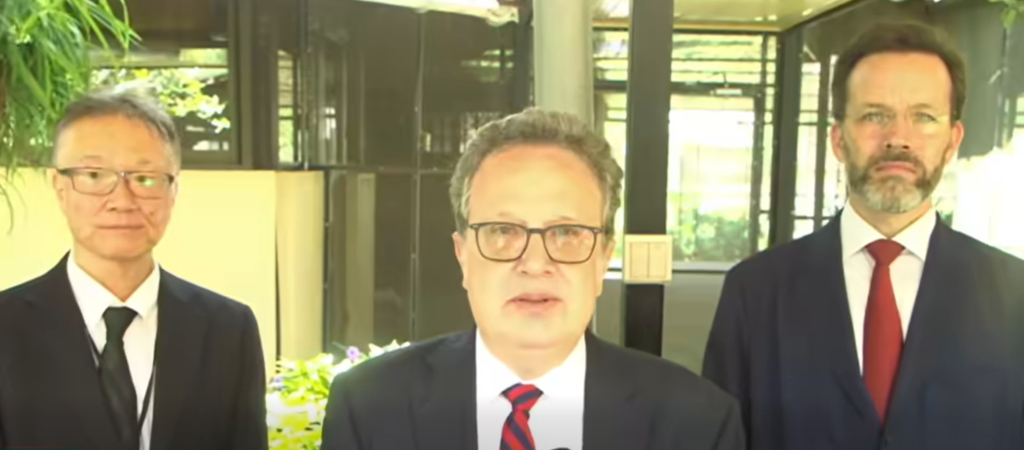
The ambassadors of Germany, Japan, Norway and the United States have urged South Sudan’s leaders to revive political dialogue, renounce violence as a tool of political competition and strengthen accountability, following a meeting with Vice President Rebecca Nyandeng de Mabior amid a public dispute between her and President Salva Kiir’s office.
In a joint statement issued on Wednesday, the four chiefs of mission said South Sudan’s path to peace requires “urgent action”, including the start of what they called authentic inter-party dialogue.
They also urged political leaders to abandon violence as a means of resolving political differences and called for public revenues to be used to provide services and strengthen accountability, saying this would help create conditions for private investment, security and the rule of law.
“We discussed our shared hopes for a future of peace and prosperity in South Sudan,” the diplomats said after their Aug. 25 meeting with Nyandeng, adding that South Sudanese people had waited “far too long” to see such a future.
They said the country’s long-delayed hopes for peace and prosperity could still be achieved “if the right decisions are made by the country’s leaders.”
The statement comes at a politically sensitive moment, days after an unusually public exchange between Nyandeng and the presidency and as South Sudan prepares for elections scheduled for December.
Rift comes into public view
The latest tensions emerged after Nyandeng, a vice president in Kiir’s government and widow of late Sudan People’s Liberation Movement leader John Garang de Mabior, delivered a pointed speech at a requiem Mass in Juba for veteran politician Kosti Manibe Ngai on Aug. 21.
Nyandeng questioned whether the current leadership was receiving the same level of oversight and advice that surrounded Garang during the liberation struggle.
She also questioned the value of senior government positions if they did not improve the lives of ordinary South Sudanese and said she could sometimes go for as long as two years without meeting Kiir.
The remarks prompted a response from Kiir’s office two days later.
Although the presidency did not name Nyandeng, its statement defended Kiir’s record in the liberation struggle and rejected what it portrayed as an attempt to attribute the movement’s achievements to a small group of individuals.
The presidency said the liberation struggle was collective and stressed Kiir’s role as a senior member of the movement and a longstanding comrade of Garang. It also rejected the suggestion that the departure or death of individual liberation-era figures had left the country without experienced leaders.
The presidency then turned to the December elections, saying those who believe the government had failed should present their case to voters and that the people, rather than political elites or government positions, should determine the country’s political direction.
Kenya trip adds to scrutiny
The public disagreement was followed by controversy over Nyandeng’s planned trip to Kenya.
Her office had sought presidential authorization for her to travel for official engagements in Kenya, including a scheduled public lecture at Murang’a University of Technology on Aug. 25, ahead of the university’s graduation ceremony.
The travel request was submitted to the Office of the President on Aug. 13, according to an official in Nyandeng’s office.
The official said the required clearance had not been received by the time Nyandeng was due to leave Juba on Monday, Aug. 24, and that she therefore did not proceed with the trip.
Neither Kiir’s office nor Nyandeng has publicly said that the delay in the travel clearance was connected to her remarks.
Elections loom
The tensions come as the government presses ahead with preparations for elections intended to mark the end of South Sudan’s prolonged transitional period.
The presidency has repeatedly presented the December vote as the route to a new political phase. But critics, including the Sudan People’s Liberation Movement in Opposition (SPLM-IO), and some members of the international community have questioned whether the political and security conditions needed for credible elections are in place.
The foreign diplomats’ call for “authentic inter-party dialogue” comes against that backdrop, with political divisions remaining a major challenge as the government moves toward the scheduled vote.

 and then