



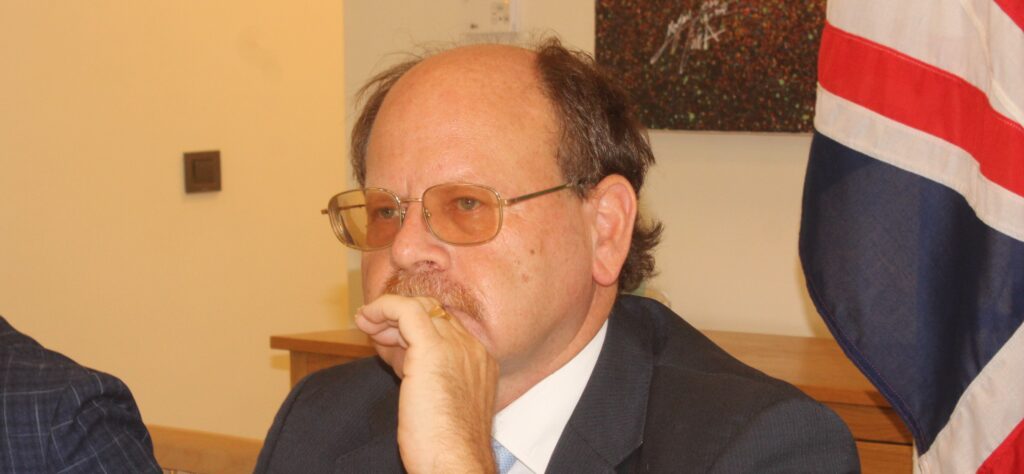
The outgoing British ambassador to South Sudan, David Ashley, has urged the government to invest in health, education and young people rather than spending about $85m on vehicles for members of the outgoing parliament.
Speaking during his farewell remarks in Juba on Thursday, Ashley said he was disappointed by the reported allocation of 900 vehicles for MPs while the government had yet to fulfil a $10m funding pledge to a major health programme.
South Sudan had pledged $10m to the World Bank-led Health Systems Transformation Project, which supports about 85% of functioning health facilities in the country, Ashley said.
He said the South Sudan government had not yet provided the promised funding.
“So that made it even more disappointing when that evening, Monday evening of last week, we heard that the government had pledged to provide 900 vehicles for Members of Parliament, for the outgoing Parliament, which we understand would cost $85 million,” Ashley said.
“South Sudan can genuinely benefit from that young population, but it needs to invest. It needs to invest in the health, in the education and in the opportunities for the children and youth of this country.
“So if South Sudan has $85 million to spend, surely it makes sense to invest that in the children and the youth, not in vehicles for outgoing MPs.”
Aid decline
Ashley also called for lasting peace and better management of public finances as international aid to South Sudan declines while humanitarian needs increase.
He said the reduction in international assistance since early 2025 had affected the country and warned that the situation could become more difficult in the coming months.
Hundreds of thousands of South Sudanese have been displaced by conflict and insecurity, while flooding, drought and crop failures have added to humanitarian needs.
“So aid is reducing and the needs are, if anything, increasing,” Ashley said.
He said peace is needed to prevent further displacement and deaths and to allow people to farm in safety.
He also urged South Sudan to make better use of its own resources.
“And for South Sudan to use more of its own resources for the benefits of its people. And indeed, longer term, this is the only way that South Sudan will move beyond perpetual crisis towards sustainable development, which is what we all hope to see,” he said.
“South Sudan is, as we know, earning billions per year in oil revenues.”
Warning over elections
Ashley also warned that poorly prepared elections could fuel further violence, urging South Sudan to ensure an inclusive, peaceful and credible electoral process.
The elections are currently scheduled for December.
“The UK wants to see elections in South Sudan. The people of South Sudan have waited long enough for the opportunity to choose their representatives and to hold them to account. But democracy is a process, it’s not an event,” he said.
Ashley said the UK supports calls by the African Union and regional actors for genuinely inclusive, peaceful and credible elections.
“As I’ve seen elsewhere, winner-take-all elections can, if poorly prepared, lead to more violence, not less, especially when the constitutional rules of the game are not decided,” he said.
The diplomat called for greater political and civic space ahead of the vote in South Sudan, saying voters should have a genuine choice and candidates should be able to campaign freely.
“We sincerely hope that the elections, if they happen in December, will be credible, that the campaign will be open, and that candidates will be able to speak, campaign, engage with the media, hold meetings and so on,” he said.

 and then