




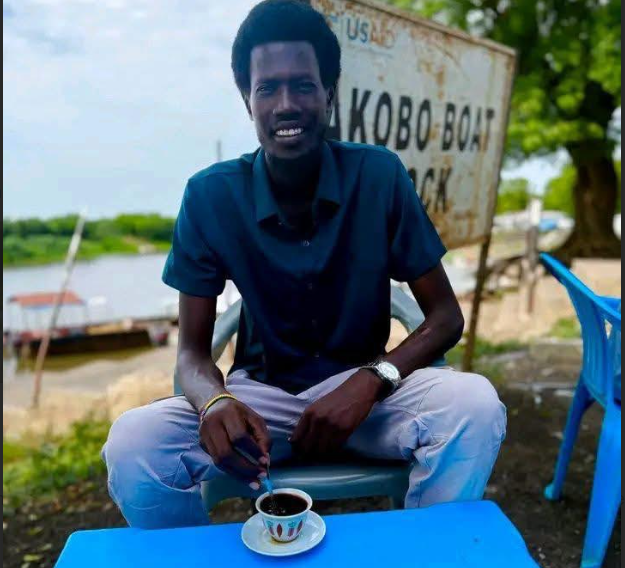
On the banks of the Pibor River in South Sudan’s remote Akobo County, the aroma of freshly brewed coffee drifts through a small shop where young people and local professionals gather each afternoon.
Just months ago, many of them crossed into neighboring Ethiopia for the same experience.
Today, they stop at the coffee shop run by 25-year-old entrepreneur Nyaruon Tang Yuel.
In a county recently shaken by armed confrontations between government troops and opposition forces, Nyaruon has built a thriving business that is changing local habits while creating opportunities for herself and others.
Akobo, one of South Sudan’s most isolated counties, witnessed fighting and insecurity between the South Sudan People’s Defense Forces (SSPDF) and the Sudan People’s Liberation Army-in-Opposition (SPLA-IO) between March and April 2026. The area remains under the control of the opposition movement led by detained First Vice President Dr. Riek Machar.
Despite the challenges, Nyaruon has steadily expanded her business ventures.
“I started my business in 2025 by mending fishing nets and selling them,” she said.
The profits from mending nets used by women for decoration enabled her to branch out into other activities. She later opened a food business, followed by a salon, and most recently a coffee shop that has become one of Akobo’s most popular meeting places.
Nyaruon says she never attended business school and comes from a family with no background in entrepreneurship.
“I reached Grade 12 in secondary school, but now I am doing small-scale business here in Akobo,” she said.
The idea for the coffee business came from a simple observation.
While crossing the river to collect firewood or purchase supplies for her food business, she frequently met people traveling to nearby Ethiopian villages.
“I used to ask them why they were going there,” she said. “They told me they crossed to the Ethiopian side to drink coffee.”
The answer surprised her.
Many residents were spending time and money traveling across the border simply to enjoy a cup of coffee prepared in the Ethiopian style.
Since she already knew how to make coffee herself, she saw a business opportunity.
“I decided to start making and selling coffee here in Akobo so that people would not have to cross the river just to drink coffee,” she said.
Earlier this year, she repeatedly met young men returning from Akobo Tiergol, a town across the border in Ethiopia.
“When I asked them where they had been, they said they had gone there to drink coffee,” she recalled. “That is when I decided to start the coffee business in Akobo.”
The response was immediate.
Residents embraced the new business, drawn by both the quality of the coffee and the convenience of finding it locally. Nyaruon says the venture now earns her about 200,000 South Sudanese pounds (SSP) a day.
“Some of the profit goes back into the business again to buy the things required for the business,” she said.
Beyond earning an income, Nyaruon hopes her success story will encourage more women to pursue entrepreneurship.
She says many women remain excluded from economic activities because of cultural stereotypes and suspicion from family members.
“I want to tell our men that there are women who are interested in working, but they are denied the right to engage in business because of the stereotype that they might run away with other men,” she said. “Please do not prevent women from working. Women deserve the right to work and own businesses. We should all engage in business for a better tomorrow.”
Customers say the coffee shop has transformed a long-standing local trend of traveling to Ethiopia for coffee.
“The coffee tastes very delicious,” said customer Changkuoth Dak. “Young people who used to travel to the Ethiopian border to drink coffee have stopped going there because now I can finally sip my favorite coffee here at Nyaruon’s coffee shop. The taste is the same as that made by Ethiopian businesswomen.”
Another customer, Changkuoth Deng, said the coffee’s quality rivals what he has tasted in Ethiopia.
“This coffee shop is newly opened and has a very beautiful aroma,” he said. “The coffee tastes exactly like that prepared in Addis Ababa and Gambella.”
At just 1,000 SSP per cup, the coffee is affordable for many residents, he said.
“The taste is excellent and the price is cheap. The quality and quantity are amazing,” Deng said.
He added that the shop has become a popular gathering spot for intellectuals and professionals who stop by after lunch to enjoy coffee and conversation.
Its location along the river only adds to its appeal.
“People enjoy coming here because of the beautiful river view and the fresh breeze,” he said.
For Nyaruon, the coffee shop represents more than a successful business venture. In a region affected by conflict, isolation and limited economic opportunities, it stands as a symbol of resilience and determination.
One cup at a time, she is proving that entrepreneurship can flourish even in the most challenging circumstances.

 and then