



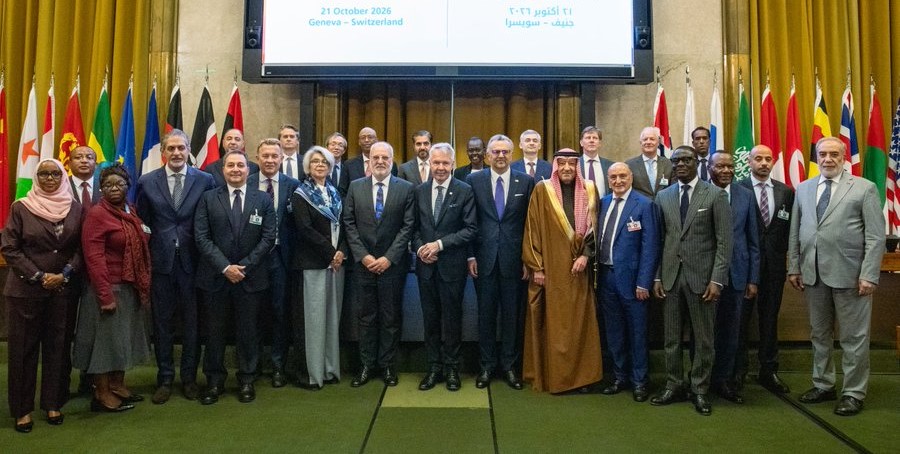
Talks aimed at halting the fighting in Sudan and easing the humanitarian crisis resumed in Geneva on Wednesday, with representatives of 21 countries and five international institutions discussing possible ceasefires, security arrangements and political solutions to the conflict.
The two-day meeting brought together international and regional partners to coordinate peace initiatives and explore a path towards a ceasefire and a peaceful political transition that reflects the aspirations of all Sudanese people.
“Our first session, devoted to de-escalation, will offer an opportunity to explore practical ways forward,” said Pekka Haavisto, the United Nations secretary-general’s personal envoy for Sudan, urging delegates to identify practical measures and use their “respective channels of engagement to build confidence and help create conditions conducive to a comprehensive ceasefire”.
The conflict, now in its fourth year, began in April 2023 between the Sudanese Armed Forces (SAF) and the paramilitary Rapid Support Forces (RSF), former allies who jointly seized power in a 2021 coup.
Deadly drone attacks targeting civilians and public infrastructure have become a feature of the war and have been repeatedly condemned by humanitarian and human rights officials.
“The war in Sudan has become a drone war; it kills mostly civilians,” said Alexandre Fasel, Switzerland’s state secretary, whose country is co-hosting the meeting with the United Nations.
“Famine-like conditions persist in Darfur, the Kordofan state and elsewhere in the country; it is the war that drives this hunger,” Fasel said.
Highlighting the protections afforded to civilians under international law, Fasel said the Geneva Conventions “are very clear: the protection of civilians and humanitarian access must not wait for a ceasefire and a political solution. Civilians are suffering and dying today.”
Millions in need
Nearly 34 million people across Sudan need humanitarian assistance, according to the United Nations Office for the Coordination of Humanitarian Affairs (OCHA), Fasel said. He also cited warnings from the United Nations Children’s Fund (UNICEF) that eight million Sudanese children are out of school.
“This is not only a violation to the right of education but an immense risk factor for a future stable Sudan. Conflict-related sexual violence has re-emerged as a tactic to terrorise and humiliate the civilian population, often targeted along ethnicity or perceived affiliations,” he said.
Alongside efforts to secure a ceasefire, delegates are expected to discuss a Sudanese-led transitional political phase that reflects the aspirations of the country’s people through an inclusive and credible dialogue, Haavisto said.
“Our role is to support the Sudanese in shaping their country’s shared future, with due regard for the diversity of their voices and experiences,” he said.
Coordinating peace efforts
The talks, officially known as the Consultative Meetings on Enhancing Coordination of Peace Initiatives and Efforts in Sudan, are intended to help mediators coordinate their approaches to ending the conflict.
Previous meetings have been held in Cairo in June 2024 and January 2026, Djibouti in July 2024, Nouakchott in December 2024 and Brussels in June 2025.
Neither the Sudanese government nor the RSF is represented at the Geneva meeting, as the mechanism was established to coordinate the efforts of mediators and international partners.
On the sidelines of Wednesday’s meeting, Haavisto was also expected to engage with key regional and international partners from the so-called Quad mechanism, comprising the United States, Saudi Arabia, the United Arab Emirates and Egypt, and the Quintet, which includes the African Union, the Intergovernmental Authority on Development (IGAD), the United Nations, the European Union and the League of Arab States.
The Geneva talks followed a day of humanitarian-focused discussions involving delegations, senior United Nations officials and international non-governmental organisations operating in Sudan, including the International Committee of the Red Cross (ICRC) and the Sudan INGO Forum.
Haavisto highlighted intensified coordination between the Quad and the Quintet, describing the increased cooperation as “maybe the most important fact”.
He said the discussions aimed to link security negotiations with political planning for the period following a possible ceasefire.
Swiss Ambassador Tim Enderlin, head of the Swiss Foreign Ministry’s peace and human rights division, also stressed the need for coordinated international efforts and an inclusive, Sudanese-led peace process.
“We tried these two days to come up with coordinated efforts that will help to establish a peace process that can be inclusive, that involves the people of Sudan, where their voices are heard,” Enderlin said.
He said the aim was to establish a process that “in the end, is Sudan-owned and Sudan-led”.
Enderlin warned that the consequences of the conflict extended beyond Sudan to neighbouring countries.

 and then