



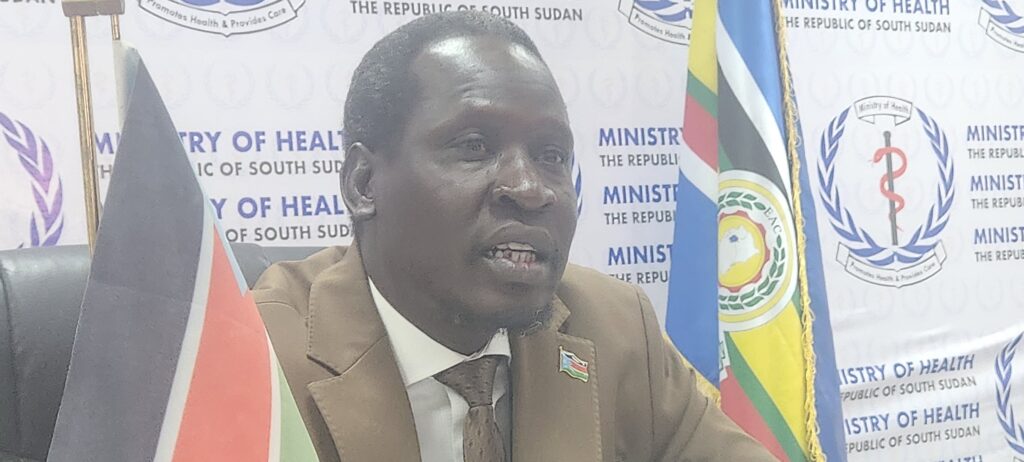
South Sudan has recorded a decline in cholera cases in recent months following intensified interventions to contain an outbreak that has infected more than 110,000 people nationwide, Health Minister Luke Thompson Thoan Teny said Wednesday.
The country has recorded 110,574 cholera cases and 1,721 deaths since the current outbreak was first recorded in September 2024, making it the largest cholera outbreak in South Sudan in terms of both case burden and geographical spread.
“Despite the scale of the outbreak, we are encouraged by the decline in cases in recent months,” Thoan said, attributing the improvement to coordinated interventions led by the Ministry of Health, the National Public Health Institute, WHO and other partners.
The interventions included oral cholera vaccination campaigns as well as water, sanitation and hygiene measures.
Despite the decline, the minister warned that cholera transmission remains active in Rubkona, Leer, and Mayom counties in Unity State and Renk County in Upper Nile State, where displaced people, returnees and refugees remain particularly vulnerable because of inadequate water, sanitation and hygiene conditions and declining population immunity.
Thoan said 210 new cholera cases and one death were reported in the seven days preceding the latest update. He called on communities, local authorities and humanitarian partners to maintain vigilance and strengthen preventive measures, including safe water practices, sanitation and hygiene, as well as early care-seeking when symptoms develop.
South Sudan remains on high alert for Ebola.
Despite not reporting any confirmed Ebola cases, South Sudan remains at high risk of importing the disease from the Democratic Republic of Congo (DRC), where Thoan said the outbreak had recorded more than 4,000 confirmed cases and over 2,000 deaths as of 11 Aug. He said South Sudan’s vulnerability is heightened by porous borders, cross-border trade, population movements, humanitarian displacement and major transport corridors linking the country with the DRC.
The minister said the government has strengthened surveillance and preparedness measures and updated its six-month Ebola readiness plan, estimated to require US$30 million to implement.
“No confirmed Ebola case has been reported in South Sudan to date,” Thoan said, while urging continued vigilance as the country remains at high risk of importation.
Readiness measures include regular coordination meetings, surveillance reporting, prepositioning of essential supplies and establishing holding and isolation areas. The Office of the President has also donated 10 vehicles to support coordination of the Ebola response, according to the minister.
Mpox outbreak spreads to nine counties
South Sudan has recorded 128 confirmed Mpox cases since declaring its outbreak in February 2025, with the disease spreading from Juba to eight additional counties, according to Thoan.
Yambio and Ezo are currently the main epicenters, with 50 cases reported in Yambio and 30 in Ezo. Juba has recorded 36 cases, while Malakal, Rumbek Centre, Rumbek East, Yei, Tambura and Nzara have also reported cases.
The Ministry of Health and its partners are implementing multisectoral interventions to control the outbreak, including developing and implementing a national Mpox vaccination plan, Thoan said.
The minister’s briefing comes as South Sudan continues to respond to multiple public health threats, including the prolonged cholera outbreak, while strengthening preparedness against potential Ebola importation from neighbouring countries.
For his part, WHO’s Health System Development Team Lead in South Sudan, Moses Ongom, said the persistence of transmission in the affected areas was largely linked to water and sanitation challenges and waning immunity following oral cholera vaccination.
He said South Sudan was normally expected to administer two doses of the oral cholera vaccine, but global shortages meant that only single doses could be provided during the current response.
Ongom said protection from a single dose generally lasts about six months before immunity begins to wane, contributing to continued vulnerability in communities with inadequate water and sanitation conditions.
He added that the initial cholera case was associated with an influx of refugees and returnees from neighboring Sudan, with population movements contributing to the prolonged outbreak.

 and then