



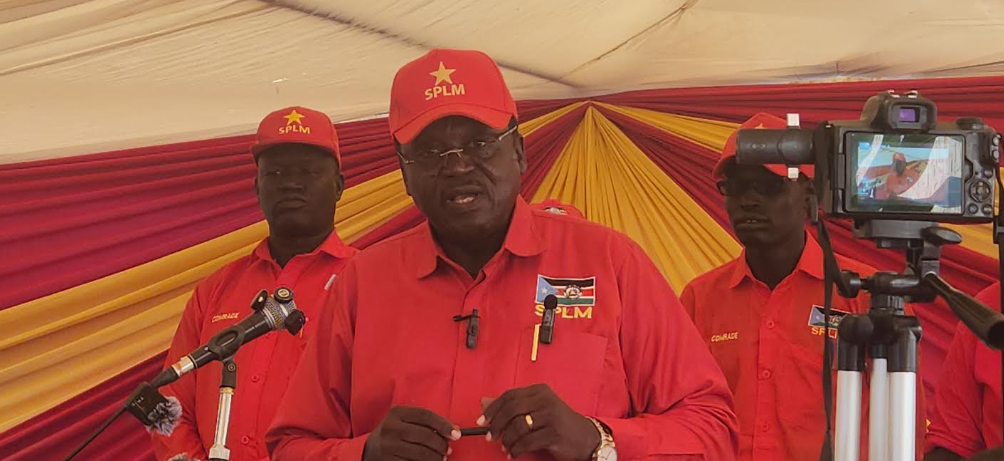
Rabi Mujung Emmanuel, an aspirant for the SPLM chairmanship in Central Equatoria State, has pledged to prioritise reconciliation and address internal divisions within the ruling party if elected, ahead of its primaries for the December general elections.
Speaking at a news conference in Juba on Wednesday, where he presented his manifesto for the SPLM state chairmanship, Rabi said the party needs renewed political direction, stronger institutions and greater unity to strengthen its organisational capacity and reconnect with grassroots supporters.
He said reconciliation, dialogue and the restoration of trust among party members and leaders would be central to his proposed leadership, adding that factionalism, political intolerance and divisive tendencies should be discouraged.
“Unity should remain the foundation of our political strength. We will prioritise reconciliation, dialogue and the restoration of trust among party members and leadership structures,” Rabi said.
He argued that the movement’s collective interests should take precedence over individual political ambitions, urging members to respect differing opinions and work towards strengthening the party.
Rabi described the SPLM as a historic political institution founded on the principles of freedom, equality and justice, saying it needed to renew its organisational structures and restore internal cohesion to meet the expectations of South Sudanese.
He said his vision is to build a united, disciplined, inclusive and institutionally strong party capable of competing politically and maintaining public confidence.
Beyond reconciliation, the aspirant outlined proposed reforms targeting the party’s administration, grassroots structures and internal accountability.
He pledged to strengthen the operational capacity of the state secretariat, improve coordination among party organs, clarify institutional responsibilities and introduce effective reporting mechanisms.
Rabi also proposed regular assessments of party structures, merit-based appointments and improved accountability in the administration of party affairs, saying leadership should be measured by performance and results rather than personal entitlement.
On grassroots mobilisation, he pledged to revitalise SPLM structures across Central Equatoria’s six counties, strengthen membership registration and improve coordination between the state secretariat and county offices.
He said regular engagement with grassroots representatives would help build a party that remained active and responsive to community needs.
The aspirant also identified youth empowerment and women’s participation as key components of his proposed reforms, pledging to strengthen the SPLM Youth League and Women’s League.
He said young people should have greater opportunities to participate in decision-making and leadership renewal, while women should receive meaningful representation in party structures in accordance with party regulations and applicable affirmative action provisions.
Rabi further pledged to promote political education and strengthen understanding of the SPLM constitution and regulations, saying respect for institutional decisions and party discipline should become central to the movement’s political culture.
With South Sudan preparing for the December general elections, he said the party needs to improve its electoral preparedness through stronger campaign structures, voter engagement and political mobilisation.
He also called for credible, transparent and peaceful internal electoral processes, saying the party’s political messaging should reflect its ideology, historical achievements and future aspirations.
On public engagement, Rabi proposed establishing a coordinated communication framework to strengthen relations with traditional and digital media, improve information-sharing between state and grassroots structures and ensure timely communication of official party positions.
He also pledged to promote peaceful coexistence and dialogue by engaging traditional authorities, community leaders, civil society organisations and other stakeholders, saying Central Equatoria’s diversity should be treated as a source of strength rather than division.
Rabi said his bid for the state chairmanship is driven by the need for inclusive leadership, institutional discipline and political maturity, adding that he viewed the position as an opportunity to serve rather than a personal entitlement.
He urged SPLM members and supporters to put aside individual interests and work towards building a stronger movement, saying the interests of Central Equatoria State should come before personal political ambitions.
Background
Rabi previously served as governor of Central Equatoria State from June to November 2025. President Salva Kiir appointed him on June 16, 2025, replacing Augustino Jadalla Wani, before removing him on November 17 and reinstating Emmanuel Adil Anthony.
A career military officer, Rabi received military training in the United Kingdom, including at the Royal Military Academy Sandhurst in 1981–1982. He initially served in the Sudanese army before joining the SPLA after being captured by its forces in Nasir in 1989.
He later held senior military positions during the liberation struggle and served as commander of the SSPDF Air Force from April 2022 before his appointment as governor. He also represented the military in ceasefire monitoring and verification arrangements under the 2018 peace agreement.

 and then