



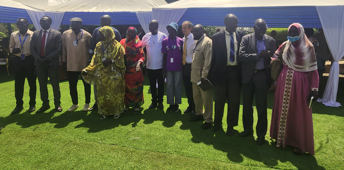
The South Sudanese government and the United Nations on Friday called for greater investment in durable solutions for refugees, emphasizing self-reliance, economic inclusion, and integration as the country continues to host hundreds of thousands of people displaced by conflicts across the region.
The call was made during World Refugee Day commemorations in Juba, where officials, refugees, humanitarian agencies, and development partners gathered to mark the 75th anniversary of the 1951 Refugee Convention under the theme, “Until Everyone is Safe.”
Speaking at the event, John Dabi, Deputy Commissioner at the Commission for Refugee Affairs, said South Sudan remains committed to its open-door policy for refugees and is increasingly focused on helping displaced people rebuild their lives through long-term solutions.
“The policy one is open door. The second policy is we must make sure there is a durable solution,” Dabi said. “We don’t want to create a situation where refugees come here, and they want to go to Europe. The best option is wherever you are, you’ll be creative, innovative, and you’ll make your life and achieve your dreams right here.”
“The government policy is really focused on making sure we move from camp into settlements where the people live within the villages together with their host communities,” he added.
He also urged humanitarian agencies to focus more on empowering refugees rather than maintaining long-term aid dependency.
“Let us move away from assistance, humanitarian assistance, into development and empowerment of the people; give them skills, give them knowledge, give them potential,” he said.
UNHCR Representative in South Sudan, Mathew Brook, said humanitarian assistance remains critical but should not be viewed as the ultimate goal for refugees.
“Humanitarian assistance remains essential, but it cannot be the end goal. People need the opportunity to rebuild their lives, support their families, and contribute to the communities that have welcomed them,” he said. “One of the main elements that we discussed is the importance of durable solutions. We are working together with refugees to enable them to generate their own economic activity and be self-reliant.”
Brook cited agricultural projects in Maban County, where refugees have been allocated land and supported with farming inputs to produce food and generate income.
Meanwhile, Ramanathan Balakrishnan, Deputy Special Representative of the UN Secretary-General and UN Resident Coordinator in South Sudan, said durable solutions require stronger collaboration among governments, humanitarian agencies, development actors, and communities.
“Durable solutions require sustained political commitment, strong national ownership at all levels, and coordinated action between humanitarian, development, and peace actors,” he said. “South Sudan’s displacement landscape is one among the most complex in the world.”
“Earlier this week, the Government of South Sudan, the United Nations, and other stakeholders came together for the second steering committee meeting on durable solutions and reaffirmed our shared commitment to helping displaced people move beyond displacement and rebuild their lives,” Balakrishnan added.
Refugee leaders also used the occasion to advocate for greater opportunities and rights for displaced populations.
Mahdi Anur Daud, chairman of urban refugees in Juba, called on the government, donors, and humanitarian organizations to strengthen efforts toward lasting solutions.
“We need expanded pathways for resettlement, greater opportunities for local integration, a stronger protection mechanism, and enhanced freedom of movement that enable refugees to rebuild their lives, dignity, and self-reliance,” he said. “Empowering refugees is not charity. It is an investment in peace, stability, and shared prosperity.”
South Sudan currently hosts more than 600,000 refugees and asylum seekers, while also receiving people fleeing the conflict in neighboring Sudan. According to UNHCR, more than 1.4 million refugees, asylum seekers, and returnees have entered South Sudan since the outbreak of war in Sudan in April 2023.

 and then