



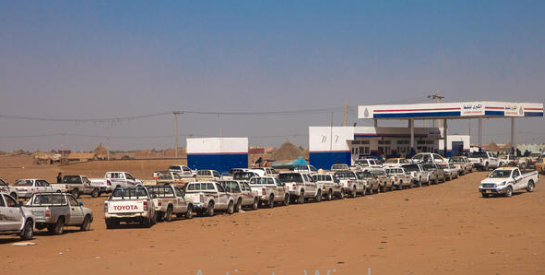
Sudan’s fuel crisis has deepened sharply in the capital, Khartoum, and several other cities, with prices reaching record levels and petroleum products disappearing entirely from many licensed filling stations.
The shortages have fueled a resurgence of the parallel market, where fuel is now being sold at exorbitant prices, placing an additional burden on already-strained households.
Fuel prices at official filling stations have exceeded 35,000 Sudanese pounds per gallon, while severe shortages in some areas have forced drivers and residents to turn to the parallel market, where prices are significantly higher.
Speaking to Radio Tamazuj, several residents expressed frustration over the sudden increases and the rapid changes in prices at filling stations, often with little or no warning.
Sami Al-Tayib, a resident who was waiting at a filling station, said he was shocked by the price increase.
“We, as ordinary citizens, honestly don’t understand why the price has gone up,” he said. “I was standing in the middle of the station when the gallon was 29,000 pounds. Before I even reached the fuel pump, the price had risen to 35,000.”
Kamal Salih said the crisis was having a direct impact on household finances.
“These petrol prices have put enormous pressure on our daily lives,” he said. “Fuel inevitably drives up the cost of everything in the market.”
Economic analyst Issam Al-Din Khidr described the current fuel crisis as “unprecedented”, attributing it to the cumulative and increasingly complex security and economic conditions facing Sudan.
“The fuel crisis was closely linked to the war and the resulting instability, as well as the loss of state control over large areas of the country and the diminished role of official institutions,” he explained. “These factors have created an environment of disorder that has undermined the efficiency of fuel distribution and regulatory oversight.”
At the macroeconomic level, Khidr attributed the continued rise in prices and the depreciation of the national currency to severe structural imbalances in Sudan’s trade balance.
He said exports had fallen sharply and now covered less than 20 percent of the country’s needs, as much of the productive, agricultural and livestock activity in conflict-affected regions had come to a halt.
He added that heavy reliance on imports of essential commodities and production inputs priced in US dollars—including fuel, fertilizers and pesticides—had driven up domestic production costs, contributing to successive waves of inflation that have severely disrupted market activity.
Khidr also warned of the risks posed by the movement of national resources outside official channels.
He said mineral exports, particularly gold—which he described as the country’s primary source of financing—were being undermined by a lack of transparency, persistent smuggling, and corruption networks amid the absence of effective state institutions.
According to Khidr, the loss of these revenues has deprived the public treasury of resources needed to secure fuel supplies, leaving ordinary citizens to bear the greatest burden through lost income, disrupted production and rising living costs.

 and then