



South Sudan’s Ministry of Finance and Planning has deliberately prevented the implementation of a landmark agreement signed nearly ten months ago, deliberately blocking a total of USD 27,397,769 in agreed payments to hotels that hosted parties to the 2018 revitalized peace agreement despite explicit presidential directives and pressure from the Office of the President, Radio Tamazuj has learned.
A source privy to the matter who spoke on condition of anonymity for fear of reprisals told this publication that the ministry’s brazen obstruction—sustained over nine months—represents a flagrant defiance of presidential authority, a deliberate breach of government commitments, and a calculated act of institutional insubordination that has devastated the hotel sector and undermined public confidence in the government’s financial accountability.
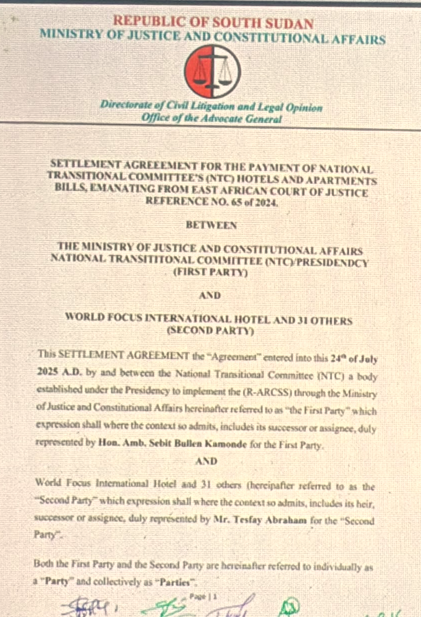
The settlement agreement, executed on 24 July 2025, was designed to resolve a protracted dispute regarding accommodation bills owed by the National Transitional Committee (NTC) to 32 hotels and apartment operators. The total government obligation under the agreement is USD 27,397,769, representing the full amount the government committed to disburse to resolve the matter conclusively.
The hotel operators agreed to the arrangement as a deliberate economic concession while considerate of South Sudan’s challenging fiscal circumstances. Rather than pursue full litigation through the East African Court of Justice, the claimants accepted a negotiated settlement, demonstrating extraordinary goodwill and economic patriotism, a source intimated. Government officials at the highest levels—including the Office of the President and the Ministry of Justice and Constitutional Affairs—actively supported, authorized, and championed implementation of the agreement as both a cost-effective resolution and a demonstration of the government’s commitment to honouring its obligations.
“Yet, the Ministry of Finance has inexplicably, deliberately, and obstructively blocked disbursement of the entire USD 27,397,769 for nine consecutive months, holding the cheques hostage and defiantly ignoring repeated presidential directives,” the source stated. “This represents not merely administrative negligence, but calculated institutional obstruction—a direct challenge to presidential authority and an egregious breach of Government obligation that no procedural rationale can justify.”
The settlement process originated from the Revitalized Agreement on the Resolution of the Conflict in South Sudan (R-ARCSS) implementation period, during which the National Transitional Committee (NTC) contracted with hotels and apartment operators to provide accommodation services. Outstanding invoices from this arrangement required formal resolution.
In November 2024, hotel representatives initiated formal discussions with the NTC. By March 2025, a framework for settlement had been reached. Following a meeting in the Office of the Minister of Presidential Affairs, senior government officials—including the Minister of Justice and Constitutional Affairs and the Chief Administrator of the Office of the President—directed legal teams to finalize the settlement.
The resulting agreement, signed on 24 July 2025, established the total government obligation at USD 27,397,769. Significantly, the hotel operators agreed to accept this settlement amount as a deliberate economic concession to South Sudan’s challenging fiscal circumstances. Rather than pursue protracted litigation, the claimants accepted this negotiated level—demonstrating extraordinary goodwill. All relevant parties executed the agreement and submitted it for implementation.
The ministry’s nine months of defiance
Advocate Wani Santino Jada, the legal counsel for the affected hotels, told Radio Tamazuj that the Ministry of Finance’s role in this crisis is unambiguous and that it is the architect of obstruction. He added that while multiple government agencies, such as the Office of the President, the Ministry of Justice and Constitutional Affairs, and the National Transitional Committee, collaborated constructively to negotiate and execute a comprehensive settlement, the Ministry of Finance has single-handedly sabotaged implementation through the deliberate withholding of payment authorizations for the full USD 27,397,769.
“The cheques were issued on 12 August 2025, and the Ministry of Finance has deliberately prevented their release. This is not an administrative delay. This is a calculated obstruction,” he explained. “The hotel operators made genuine economic concessions to facilitate this settlement. The Office of the President has explicitly directed the Ministry to process these payments—all USD 27,397,769 across six scheduled instalments. The Ministry has had nine months to execute routine authorization procedures. Yet the Ministry remains defiantly non-compliant.”
“The Office of the President understands the urgency and has convened multiple high-level meetings to demand compliance; unfortunately, the Ministry of Finance has chosen institutional rebellion over adherence to presidential directives,” Advocate Jada added.
The cost of the ministry’s obstruction
According to Jada, the finance ministry’s deliberate blockade of USD 27,397,769 has triggered a catastrophic cascade of crises that extend far beyond balance sheet considerations and into hotel closures, mounting debt burdens, landlord evictions, broken supply chains, wage arrears, and permanent emigration of skilled workers. Each month of Ministry obstruction compounds the damage. The hotel operators’ goodwill gesture—accepting a negotiated settlement despite fiscal challenges—has been repaid with systematic institutional punishment.
“Hotels that were once viable enterprises have been forced into permanent closure. The Ministry’s refusal to release agreed funds has left hotel operators unable to meet financial obligations, service outstanding debts, or maintain operations. Once shuttered, many of these establishments will never reopen, representing a permanent loss of economic capacity,” Jada said. “Hotel employees have borne the harshest consequences of ministry obstruction. Wage arrears have accumulated month after month as the Ministry refused to release funds.”
He added that skilled workers—already in desperately short supply in South Sudan—have been forced to abandon the sector or emigrate entirely in search of employment. This represents irreversible human capital loss directly attributable to Ministry inaction.
“Business partners throughout the supply chain—food and beverage suppliers, linen providers, service vendors, and logistics firms—have suffered devastating financial losses while the Ministry refused to authorize agreed payments. The ripple effects of Ministry obstruction extend throughout Juba’s business ecosystem,” the advocate stated.
Agreed payment schedule: USD 27,397,769 to be disbursed across six instalments
The settlement agreement established a structured six-instalment payment plan, designed to accommodate the government’s budgeting cycles while ensuring predictable cash flow for the hotel operators. Each instalment was explicitly tied to a specific deadline. The Ministry of Finance received the complete schedule and has had nine months to prepare for the first four instalments that have now become due.
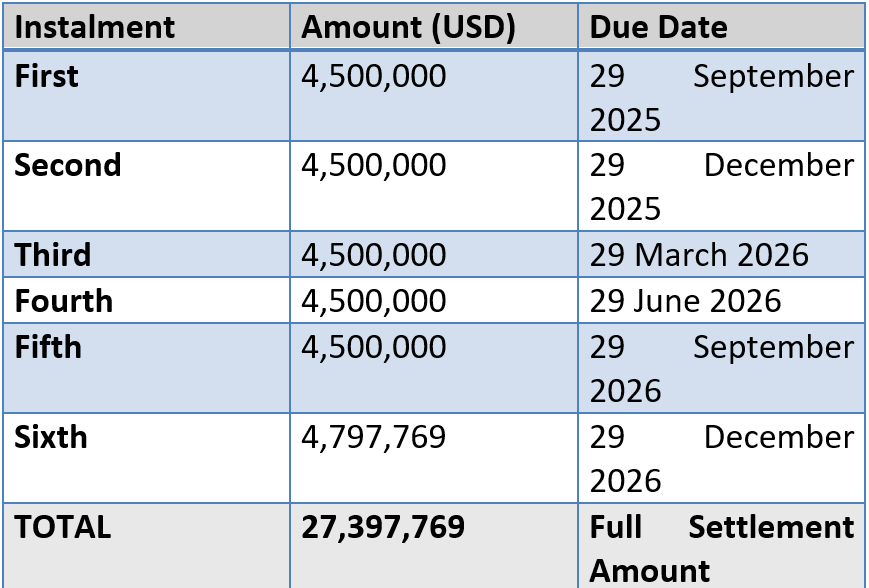
The complete settlement of USD 27,397,769 is to be released according to the instalment schedule above, with each payment tied to specific calendar dates.
As of July 2026, the Ministry of Finance has had nine months to prepare for and release the first four instalments. The first instalment of USD 4,500,000 was due on 29 September 2025—fully nine months ago. The Ministry has released none of these funds.
Implementation status: Nine months of the finance ministry’s inaction
The settlement agreement has been fully executed by all relevant government stakeholders. Cheques totalling USD 27,397,769 were issued on 12 August 2025—now nearly ten months ago. All necessary preparatory procedures were completed within weeks of the settlement’s execution. The Ministry of Finance received complete documentation, the detailed payment schedule, and explicit authorization to process routine disbursements of the full amount across the six agreed instalments.
“Yet the Ministry of Finance has inexplicably failed—or rather, deliberately refused—to process the necessary authorizations for nine consecutive months. The cheques representing the complete USD 27,397,769 remain trapped in the Ministry’s grasp, frozen in administrative limbo while the Ministry offers no substantive explanation,” a source said. “The Ministry has not identified procedural barriers that require resolution. The Ministry has not requested additional documentation. The Ministry has simply refused to act on any of the six scheduled instalments, despite explicit presidential directives.”
According to other sources familiar with the matter, the Chief Administrator of the Office of the President convened multiple high-level meetings specifically demanding the finance ministry’s compliance with the full settlement schedule. The Office of the President has explicitly—and repeatedly—directed the Ministry to process the complete USD 27,397,769 immediately according to the agreed instalment schedule. The Office of the President has made clear that implementation is a presidential priority. Yet the finance ministry has obstinately refused to release even a single instalment.
This is not bureaucratic sluggishness. This is deliberate institutional rebellion. The Ministry of Finance has chosen to defy the President’s direct orders regarding USD 27,397,769 in agreed Government obligations across a structured payment schedule. No other conclusion is defensible, an affected hotel owner who refused to give his name stated.
The Ministry of Finance’s inaction suggests one of three scenarios, none of which reflects acceptably on the institution:
- Lack of capacity: The ministry lacks the technical or administrative capacity to process authorized payments of USD 27,397,769 according to the agreed schedule. If true, this represents a fundamental failure of Government financial management.
- Lack of commitment: The ministry lacks commitment to honouring government obligations of USD 27,397,769. If true, this represents a betrayal of public trust and Government credibility.
- Deliberate obstruction: The Ministry is deliberately obstructing the settlement schedule for reasons it has never articulated. If true, this represents a serious breach of institutional discipline and defiance of presidential authority.
Whichever scenario applies, the Ministry of Finance has failed South Sudan. The hotel sector, Government credibility, and public confidence in financial accountability have all suffered as a direct consequence of the ministry’s obstruction of USD 27,397,769 in agreed obligations across six scheduled instalments.
The impact on the hotel sector
The hotel industry plays a critical role in Juba’s service economy and is essential infrastructure for commerce, diplomacy, and regional integration. Yet the Ministry of Finance’s deliberate blockade of USD 27,397,769 has created an unprecedented crisis that threatens the sector’s survival, a hotel owner said.
Hotel operators have been forced into dire straits by the ministry’s obstruction. Many establishments have drastically reassessed operations, reduced staffing to the bare minimum, and scaled back services. Some have suspended operations entirely—permanently closing their doors—because the Ministry refused to release the first instalment of USD 4,500,000 that was due on 29 September 2025, nor any subsequent payments. The cascade of hotel closures represents a permanent loss of economic capacity.
Workers have paid the heaviest price. Wage arrears have accumulated month after month as the ministry refused to disburse the agreed USD 27,397,769 across the scheduled instalments. Skilled workers—in desperately short supply in South Sudan—have been forced to leave the sector or emigrate entirely. This represents an irreversible human capital loss.
Critical supply chains and business relationships that took years to develop have been fractured. Once broken, these relationships may never be repaired, even after the ministry finally releases funds according to the payment schedule.
Stark contrast between the Office of the President of the Ministry of Finance
The sharp institutional contrast is striking and damning: The Office of the President has demonstrated genuine commitment to resolving the settlement of USD 27,397,769 through multiple high-level interventions and explicit presidential directives. The Office of the President has convened repeated meetings, facilitated negotiations, and demanded compliance with the agreed instalment schedule. The Office of the President has made clear that implementation is a presidential priority. The hotel operators made economic concessions in good faith based on presidential assurances.
Yet the Ministry of Finance—an institution that should serve the President’s directives—has chosen institutional defiance on the entire USD 27,397,769 obligation across all six scheduled instalments. This disconnect reveals a ministry that either cannot or will not honour government commitments and respect presidential authority. Either way, the ministry has failed catastrophically.
Final warning to the finance ministry
Advocate Wani Santino Jada of Pan African Law Chambers LLP, legal counsel for the hotel sector, has emphasized the hotels’ continued preference for cooperative resolution despite the ministry’s intransigence.
“The hotel sector values its partnership with the government and recognizes the importance of supporting national development,” he said. “We remain committed to working constructively with the Ministry to ensure implementation of the USD 27,397,769 settlement according to the agreed schedule.”
However, Jada was unambiguous about the limits of patience.
“The Ministry of Finance has had nearly ten months to process the first instalment of USD 4,500,000 due on 29 September 2025, along with payments explicitly authorized at the highest level across six agreed instalments totaling USD 27,397,769,” Jada said. “The hotel operators made economic concessions to facilitate this settlement; we accepted a negotiated amount despite the country’s fiscal challenges. The Office of the President has convened multiple meetings demanding compliance.”
“The hotel sector has demonstrated unlimited patience and reasonableness. Yet the ministry has simply refused to act on any of the scheduled payments. This is deliberate obstruction, not administrative delay,” he added.
Jada said that they recognize that proceeding with formal enforcement action would not serve the Office of the President’s interests, which has shown genuine commitment to resolution.
“Therefore, we are giving the Ministry of Finance a final opportunity: process the complete settlement of USD 27,397,769 immediately according to the agreed instalment schedule, beginning with the overdue first instalment of USD 4,500,000,” the advocate said. “The hotel sector will work cooperatively to resolve this matter. But the Ministry’s continued obstruction cannot persist indefinitely. The President has issued directives. Those directives must be obeyed.”
About the settlement agreement
The settlement agreement was executed on 24 July 2025 and was negotiated under the auspices of the Office of the Minister of Presidential Affairs, the Ministry of Justice and Constitutional Affairs, and the National Transitional Committee.
The signatories were Amb. Sebit Bullen Kamonde, then Chief Administrator, Office of the President, on behalf of the government, Mr. Tesfay Abraham, CEO, Radas Hotel, for the hotel operators, and legal counsel for the hotels was provided by Pan African Law Chambers LLP (www.palcllp.com).
The agreement resolved claims dating back to 2019, when hotels began accommodating NTC delegations under the R-ARCSS implementation framework. The total government obligation under the settlement agreement is USD 27,397,769, payable across six scheduled instalments—which the claimants accepted as a negotiated settlement in light of the country’s economic circumstances.

 and then