



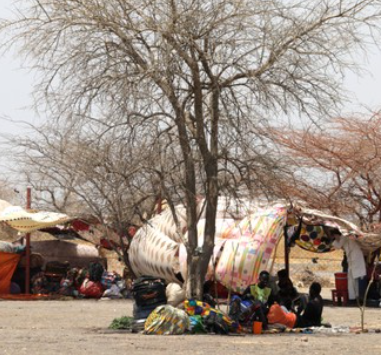
When Viviana Tombe fled the war in Sudan, she arrived in South Sudan pregnant, with few belongings and no relatives to depend on. Now at the Renk Transit Centre, the 36-year-old returnee faces another uncertainty: how she will feed herself when humanitarian assistance becomes harder to sustain.
“I do not have anything,” she says, explaining that she has no means of earning a living and no family to turn to. She said she goes to the market, buys food when she can, and waits for another day.
“But I am afraid of where I will get food,” she says when asked about her biggest fear and need after escaping the war.
Tombe’s uncertainty comes as the World Food Programme (WFP) warns that its food assistance pipeline for hundreds of thousands of refugees and internally displaced people in South Sudan could run out by the end of September if additional funding is not secured.
WFP said it could be forced to stop providing food assistance from October to about 650,000 refugees and nearly 200,000 internally displaced people in the country.
The warning comes as millions of people already struggle with food insecurity amid conflict, displacement, climate shocks and rising living costs.
WFP country representative Mutinta Chimuka said the agency was seeking about USD 86 million to sustain its operations until the end of 2026, while another 280 million dollars would be needed over the following six months for life-saving and resilience assistance.
For people like Tombe, however, the funding crisis is not an abstract humanitarian figure. It is about what happens after the food they depend on is no longer available.
Matthew Hollingworth, WFP’s Assistant Executive Director for Programme Operations, said many South Sudanese returnees and Sudanese refugees were arriving after journeys of hundreds of kilometres with very little money or belongings.
“They are coming tired, exhausted, in many cases traumatized,” Hollingworth said, adding that some families had also been separated from their relatives.
He said people fleeing Sudan were arriving in a country already facing its own humanitarian crisis, with millions of people experiencing food insecurity and millions more displaced.
For newly arrived families, WFP is currently prioritizing immediate assistance, providing about half a month’s ration in many cases through cash transfers.
But Hollingworth warns that such support could not necessarily continue for people who remain in South Sudan for longer periods.
“We cannot guarantee we can continue to do that as people spend more time in the country,” he said.
That leaves people like Tombe facing a difficult question: how do you rebuild a life when you arrive with little, have no family support and have no immediate means of earning an income?
The challenge is not limited to people arriving from Sudan.
In Pigi County of Jonglei State, internally displaced people are facing similar difficulties after losing farms, livestock and businesses to conflict and displacement.
Peter Maker, an internally displaced person in the area, said he was capable of working but had few opportunities to do so. He said flooding had affected access to farmland, while insecurity made fishing dangerous.
“If I try to go and fish somewhere, maybe I will face another problem there,” Maker said, warning that he could be killed because of insecurity.
Maker said he had also lost documents that could have helped him pursue employment opportunities.
Without the documents and with few jobs available, he said he was left relying on humanitarian assistance.
“I do not have anything to do,” he said.
For him, the prospect of reduced food assistance is particularly worrying because there are few livelihood alternatives available to displaced people.
He said that even if he was physically able to work, there was no guarantee that he could safely cultivate land or fish to support himself.
“If there is no land that I can cultivate on, that one can be very difficult for me also,” Maker said.
WFP says it is working with partners on both emergency assistance and longer-term resilience programmes, including agricultural activities intended to help communities produce food and generate income.
Chimuka said South Sudan had significant agricultural potential to become food-sufficient in the long term, but stressed that peace and security were essential for agricultural production and food self-reliance.
For displaced people such as Maker, however, the path from humanitarian dependence to self-reliance remains difficult when insecurity and flooding continue to limit access to livelihoods.
The pressure is particularly visible among children arriving from Sudan.
Jansuk Alex, a nutrition specialist based in Renk, said one in every five children screened at the transit centre was found to have severe acute malnutrition.
Outside the transit center, among about 64,000 people who have integrated into the host community in Renk town, screening showed that one in six children had severe acute malnutrition.
Alex said the situation was worse among people arriving from Sudan, with continuous arrivals placing additional pressure on existing services.
Climate shocks, high market prices, currency devaluation and disease outbreaks were also contributing to the vulnerability of mothers and children, he said.
The wider food crisis is already severe.
According to WFP assessments conducted with partners and the South Sudanese government, about 7.8 million people are currently facing food insecurity, while 2.2 million people are malnourished or at risk of malnutrition.
Hollingworth said the gap between humanitarian needs and available funding had become increasingly difficult to manage.
Five years ago, when he was WFP’s country director in South Sudan, it was normal for the programme to distribute more than 200,000 tonnes of food annually.
Going into 2027, he said WFP might, if it was fortunate, distribute only about 24,000 tonnes.
“That’s almost 10 percent of what we used to do,” Hollingworth said.
He said the reduced capacity came at a time when humanitarian needs were increasing because of conflict, high inflation, climate shocks and displacement.
In Renk, local authorities fear that the consequences of shrinking assistance could extend beyond hunger.
Deng Lual Ajak, Deputy Director for the Relief and Rehabilitation Commission in Renk, said criminal cases were occurring daily and warned that worsening economic hardship could increase pressure on both displaced people and host communities.
He said people who could not find food or employment could resort to stealing from vulnerable families and refugees living among host communities.
“When they don’t find any job, or they don’t find anything, then they come, and they sell from the host community,” Deng said.
For people already struggling to survive, the loss of humanitarian assistance could therefore create a chain of consequences—from hunger and malnutrition to deeper poverty, loss of livelihoods and insecurity.
For Tombe, however, the wider consequences remain secondary to the immediate question of where her next meal will come from.
She came to South Sudan seeking safety after the war in Sudan, but she arrived without family support, a livelihood or enough belongings to rebuild her life.
For Maker, the answer also cannot simply be to stop assisting and expect displaced people to become self-reliant.
He says he wants to work.
But the land is affected by floods, fishing can expose him to insecurity, and the loss of his documents has made it harder to seek employment.
As humanitarian agencies struggle to meet growing needs with fewer resources, displaced people across South Sudan are being left with an increasingly difficult question: what happens when the food runs out, but there is still nowhere safe to work, farm, or rebuild a life?

 and then