



South Sudan’s Ebola preparedness efforts are unfolding against a concerning regional public health situation, particularly with continued transmission in the neighboring Democratic Republic of the Congo (DRC) and reported cases in Kenya. According to surveillance figures attributed to the World Health Organization (WHO) and Africa CDC, the DRC had recorded 10,060 confirmed cases and 4,887 deaths as of 25 October 2026, while Kenya had reported nine confirmed cases and two deaths as of 26 October.
These developments reinforce the importance of vigilance, particularly in South Sudan’s border communities, where cross-border trade, displacement, family connections, and population movements create potential pathways for disease transmission. According to the United Nations Office for the Coordination of Humanitarian Affairs (OCHA), more than 5,000 people reportedly crossed into South Sudan from the DRC between July and mid-October, entering through Ibba County in Western Equatoria State. Many arrived with urgent humanitarian needs, further highlighting the intersection between population movements, humanitarian vulnerability, and public health preparedness.
Against this backdrop, South Sudan has continued to strengthen its Ebola preparedness architecture through the Ministry of Health, the National Public Health Institute, and partners across the humanitarian ecosystem. Efforts include surveillance, laboratory readiness, infection prevention and control, points-of-entry preparedness, and simulation exercises in Juba, Yei, and Yambio. The national toll-free alert line, 6666, also provides an important mechanism for reporting suspected cases.
These investments are indispensable. Yet even the most technically prepared health system remains critically vulnerable if the communities it serves are not equally prepared. A surveillance system may be ready to investigate a suspected case, but someone must first recognize and report it. A referral pathway may exist, but families must know when and where to seek care. Public health authorities may provide scientifically accurate guidance, but that information has limited value if communities do not receive, understand, trust, or act upon it.
This is why Risk Communication and Community Engagement (RCCE) must be recognized as a central component of Ebola preparedness and response, rather than merely a mechanism for disseminating public health messages. RCCE as a critical public health communication and social behavior change strategy bridges technical preparedness and community readiness by translating health information into practical action, addressing misinformation, strengthening trust, and creating opportunities for communities to share concerns that can inform public health decisions.
Trust, proximity, and reach as the three critical dimensions of effective RCCE
Effective Risk Communication and Community Engagement (RCCE) requires more than disseminating public health messages through multiple channels. It depends on building relationships with trusted community structures, understanding how people access and interpret information, and establishing mechanisms through which communities can meaningfully participate in preparedness and response.
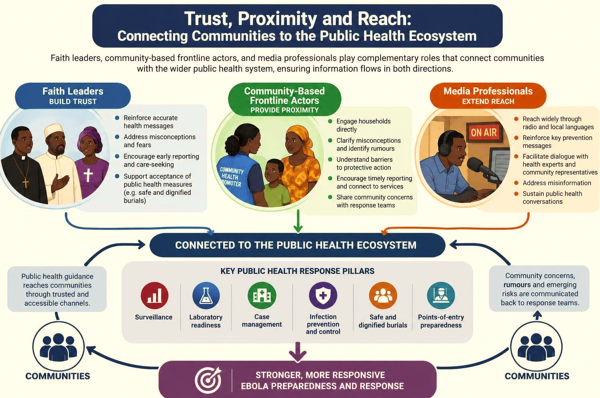
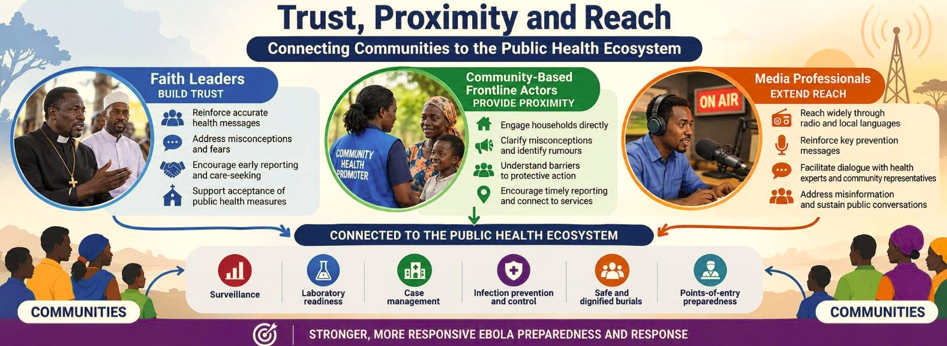
In South Sudan, where geographical barriers, linguistic diversity, population movements, and varying levels of access to health services influence public health communication, three groups play particularly important and complementary roles within the South Sudan ecosystem. These are faith leaders, community-based frontline actors, and media professionals. Together, they provide three critical dimensions of effective RCCE, which are trust, proximity, and reach.
- Faith leaders are integral in building trust and strengthening community confidence
Public health emergencies are often accompanied by fear, uncertainty, misinformation, and concerns about unfamiliar response measures. During such periods, communities do not rely exclusively on formal health institutions for information and reassurance, as has been the case in South Sudan. Many turn to pastors, priests, and other religious leaders with whom they have established relationships and whose guidance carries considerable influence. Based on this backdrop, faith leaders can serve as trusted intermediaries between communities and public health authorities. Through religious gatherings, pastoral visits, community meetings, and existing faith networks, they can reinforce accurate prevention messages, address misconceptions, encourage early reporting and appropriate care-seeking, and help communities understand the importance of recommended public health measures.
Through religious gatherings, pastoral visits, and community networks, faith leaders can reinforce prevention messages, address misconceptions, encourage early reporting and appropriate care-seeking, and promote understanding of public health measures. Their contribution is particularly important when response interventions intersect with religious and cultural practices, such as safe and dignified burial procedures – which have been one of the most contested response pillars in South Sudan. By engaging faith leaders, public health teams can better understand community sensitivities, address concerns, and encourage acceptance of recommended measures while respecting local beliefs and practices. Beyond communicating messages, faith leaders can also identify emerging concerns, facilitate dialogue, and help strengthen relationships between communities and formal response structures.
- Community-based frontline actors are all about bringing preparedness closer to households
While faith leaders contribute trust, community-based frontline actors provide the proximity and interpersonal engagement needed to translate public health information into practical action. Community Health Promoters (CHPs), Boma Health Workers, community mobilizers, church volunteers, traditional leaders, and representatives of women’s and youth groups are often embedded within the communities they serve. Their regular interactions with households position them to understand local circumstances, communication preferences, perceptions, and barriers that may influence protective behaviors.
Their contribution extends beyond delivering prevention messages. Through household visits, community dialogues, and other interpersonal engagement activities, they can clarify misconceptions, identify rumors, recognize emerging concerns, encourage timely reporting, and connect individuals with appropriate health services and referral mechanisms. Importantly, these actors can distinguish between different barriers to public health action. A household may have heard an Ebola prevention message but misunderstood its meaning. Another may understand the guidance but distrust the source. Others may accept the recommendations but face practical challenges, including distance, transportation costs, or limited access to services.
Receiving information does not necessarily mean understanding it, trusting it, or being able to act upon it. Community-based actors help bridge these gaps by engaging directly with people, identifying the underlying challenges, and communicating their findings to response teams. Their role should therefore extend beyond message dissemination to include community listening, feedback collection, rumour tracking, and referral of emerging concerns. This makes them essential links between household-level realities and the wider public health response.
- The media extends reach, reinforces messages, and sustains public health dialogue
Media provides the third critical dimension of effective RCCE by extending the reach and continuity of public health information beyond the physical presence of community mobilizers and frontline health workers. In South Sudan, radio remains particularly valuable for communicating with geographically dispersed populations, including communities in remote and difficult-to-access locations. Through multilingual programming, public service announcements, and regular broadcasts, radio can reinforce information about Ebola symptoms, prevention measures, early reporting, and available health services. Interactive radio programming provides opportunities for health professionals, faith leaders, public health practitioners, and community representatives to engage in meaningful conversations about emerging risks and concerns.
Through radio discussions and listener participation, technical experts can explain public health guidance, address community fears, and listeners can raise questions or share misconceptions requiring clarification. Such interactions also provide opportunities to identify recurring information gaps and emerging rumors that may require further community engagement. Media professionals themselves are important RCCE partners. Equipping journalists and radio presenters with accurate technical information and an understanding of responsible public health reporting can help reduce misinformation, avoid unnecessary fear or stigma, and strengthen the consistency of information reaching communities.
Connecting the three dimensions into the public health ecosystem
The greatest strength of trust, proximity, and reach lies in how effectively they connect communities with the wider public health system. Faith leaders build confidence, community-based actors facilitate household engagement, and media extends access to reliable information. Together, they create channels through which public health guidance reaches communities while concerns, rumours, and emerging risks are communicated back to response teams.
This integration positions RCCE as more than a communication function. It becomes an essential link between communities and key response pillars, including surveillance, case management, infection prevention and control, and points-of-entry preparedness, ensuring that community perspectives inform decisions and strengthen the overall effectiveness of the response.
The writer is a policy and development communications specialist building communication systems that matter in Africa. She can be reached via email at lpyugusuk@gmail.com.
The views expressed in ‘opinion’ articles published by Radio Tamazuj are solely those of the writer. The veracity of any claims made is the responsibility of the author, not Radio Tamazuj.

 and then