



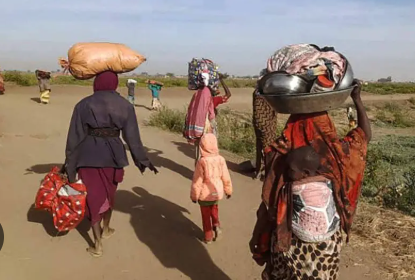
An estimated 50 families have been displaced to Al-Manar camp west of Ed Daein, the capital of Sudan’s East Darfur State, after their crops failed due to inadequate rainfall in Riyadh in the Al-Firdous locality, and in Tasabih and Kireyo in Al-Arab locality.
The families are now sheltering under trees in harsh humanitarian conditions.
Several displaced people told Radio Tamazuj that they had received no humanitarian assistance since arriving at the camp and were living without food.
Khidim Mohammed, a displaced woman, said that her family included several people with disabilities and had received no assistance since arriving at the camp.
“We have no blankets or bedding, and the only clothes I am wearing are what I have to cover my body,” she said.
Another displaced woman said the agricultural seasons over the past two years had failed, destroying the crops they had planted.
“We are now living in displacement camps, and we have children to support, but there are no men around,” she said.
She had expected to find better conditions after fleeing her home, but said she had instead encountered similarly difficult circumstances, with people in the area facing the same hardships.
Gidam Mahmoud, a blind displaced man, said he lost his sight a while back and is unable to provide for his family.
“When the farm on which we depended for food subsequently failed, we were forced to flee,” he lamented.
Another displaced man, Abdelrahman Hammad, described the hunger and lack of basic shelter facing his family. “We are living in severe hunger, and we have neither blankets nor bedding,” he said.
He also cited deteriorating environmental conditions in Kireyo, the area from which he had fled. Conditions at the camp were equally dire, he said, adding that he was living exposed to the rain without any covering.
Meanwhile, Yousuf Hassan Omar, a member of Al-Manar Camp Higher Committee, confirmed that new arrivals continued to reach the camp, where many were sheltering under trees without access to latrines.
“Health conditions are deteriorating sharply, with existing latrines becoming insufficient for the growing population,” he stated. “As a result, some displaced people have been forced to relieve themselves in the open, raising fears of a health crisis amid the presence of flies.”
Omar appealed for urgent assistance.
“I urge well-wishers and philanthropists, aid organizations, and civil society organizations to intervene and address this emergency,” he said. “We are in urgent need of support.”

 and then