



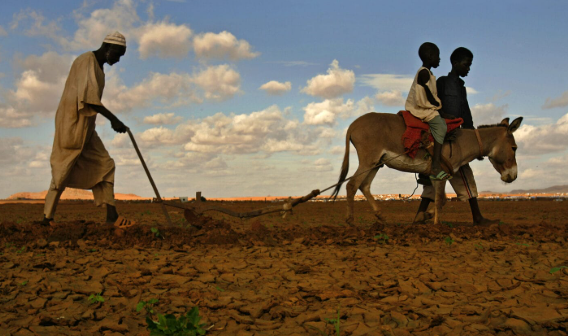
Several farmers across Sudan’s Darfur region have expressed fears of an imminent food crisis after large swaths of farmland were scorched this agricultural season due to insufficient rainfall.
Farmers in villages in Mershing and Nitega in South Darfur, Shangili Tobaya in North Darfur, and Sheiriya and Abu Karinka in East Darfur said their crops have been affected.
Hussam Abu Jassir, a farmer from Abu Karinka locality in East Darfur, told Radio Tamazuj that farmers had worked hard at the beginning of the rainy season despite the war and their limited financial resources. However, he said rainfall this season had been poor. He predicted that the region could face a food shortage in the coming days.
Mustafa Al-Mahi Ahmed, the mayor of the Al-Riyadh administrative unit in Al-Firdous locality, East Darfur, said the agricultural season was not promising because of the scarcity of rainfall.
“Farmers in the Al-Riyadh area were still holding on to their seeds because rain had not fallen in several villages,” he said. “I estimate that the area cultivated this year is less than 50 percent of last year’s total.”
Forestry and plant expert Hamid Rashid Ajjal attributed the current situation to several factors. He said rainfall levels had declined this year, resulting in lower soil moisture and what he described as severe agricultural drought.
“Sudan is among the countries most vulnerable to drought due to natural factors including changes in global atmospheric circulation, the El Niño phenomenon, rising temperatures, increased evaporation rates and changes in temperatures recorded at weather stations, all of which can affect cloud formation,” he explained. “There are also human factors contributing to drought, including excessive deforestation and the resulting degradation of vegetation cover, which can affect rainfall patterns, as well as the cultivation of water-intensive crops in arid areas.”
Meanwhile, Fatima Al-Noor Ismail, an activist with humanitarian emergency rooms, told this publication that rainfall had stopped several weeks ago, resulting in crop losses in the Sherisheri, Qamia and Al-Rayyan areas, as well as several other parts of Bahr Al-Arab locality.
“Crops had grown to a stage close to maturity but dried out after the rains stopped,” she said. “Some farmers became so discouraged by the losses that they abandoned their fields and returned home.”
“With grazing grass also in short supply, some farmers have been forced to sell their donkeys and horses,” Al-Nooer added.
The United Nations Food and Agriculture Organization (FAO) has warned of major risks facing Sudan’s agricultural season due to drought and declining rainfall in key farming states.
In a statement, the FAO said rainfall deficits had reached 30 percent in Gedaref and 20 percent in Sennar, warning that the situation could place further pressure on grain prices and food security.

 and then