



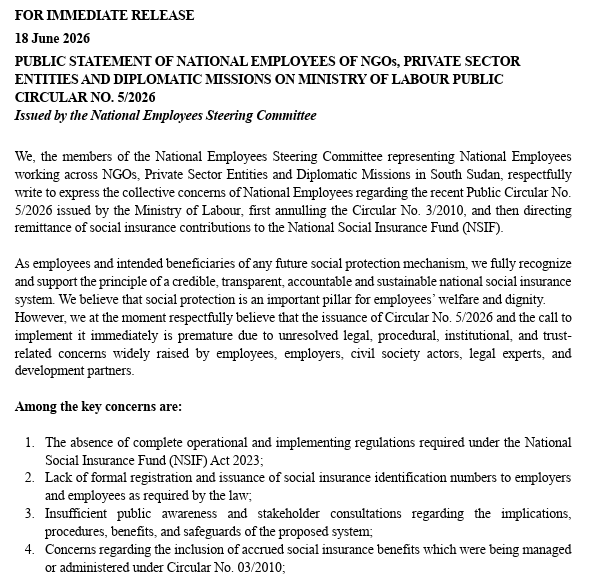
A newly formed body representing South Sudanese employees working for NGOs, private companies, and diplomatic missions has threatened legal action against the Ministry of Labour if it proceeds with enforcing mandatory remittances to the National Social Insurance Fund (NSIF) before key systems and regulations are put in place.
The South Sudan National Employees Steering Committee said it has instructed a legal team to review the National Social Insurance Act 2023 and prepare a court challenge against a recent labour ministry directive requiring employers to begin remitting employees’ social insurance contributions to the NSIF.
Speaking to Radio Tamazuj, the committee’s chairperson, Jacob Atem, said workers are not opposed to the establishment of a social insurance system but want the government to first establish safeguards to ensure transparency and accountability.
“The legal team has been instructed that if the ministry does not listen to our concerns and continues ordering employers to remit the savings, then we will take legal action to challenge the circular,” Atem said.
The committee was formed through a digital platform bringing together national employees from NGOs, the private sector, and diplomatic missions after the Ministry of Labour issued a circular directing implementation of the NSIF scheme.
According to Atem, workers are concerned that critical mechanisms required to manage employees’ contributions are not yet operational.
He said the NSIF has not yet established regulations governing the scheme, nor has it introduced a personal identification number (PIN) system that would allow workers to track their contributions when changing jobs or leaving employment.
“We are saying that before collection starts, the government should first put in place the systems that will safeguard workers’ savings,” he said.
The committee is calling for the suspension of Circular No. 5 and wants the government to continue applying an earlier arrangement under which employers hold employees’ savings and pay them upon termination of employment until the NSIF is fully operational.
Atem also questioned the government’s readiness to manage the scheme, pointing to long-standing concerns over pension payments in the public sector.
“We already have a pension fund for public servants, but many former government employees are still waiting for their pensions. This raises concerns about whether the management systems are ready,” he said.
The committee further demanded greater transparency in the establishment of the fund, including representation of workers on the NSIF board and merit-based recruitment of staff responsible for managing the system.
Atem said the committee is seeking a meeting with the Ministry of Labour and has also reached out to the Ministry of Justice for legal guidance.
“Our message is simple: put the system in place first, ensure transparency, and then begin collecting workers’ savings,” he said.
The Ministry of Labour had not immediately commented on the committee’s demands by press time.

 and then