



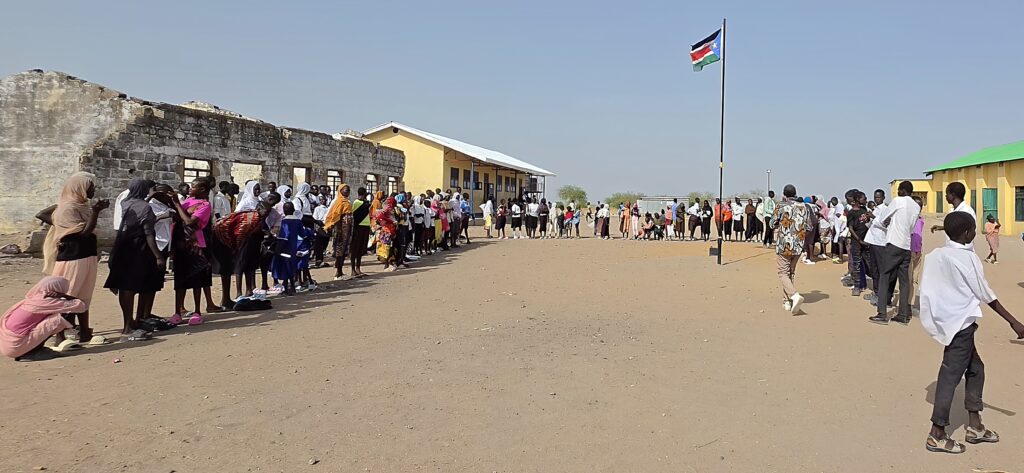
At 8 a.m., children assemble in the school compound for morning parade. There is no uniform code. Some wear oversized shirts, others faded dresses or mismatched clothing. Many are barefoot.
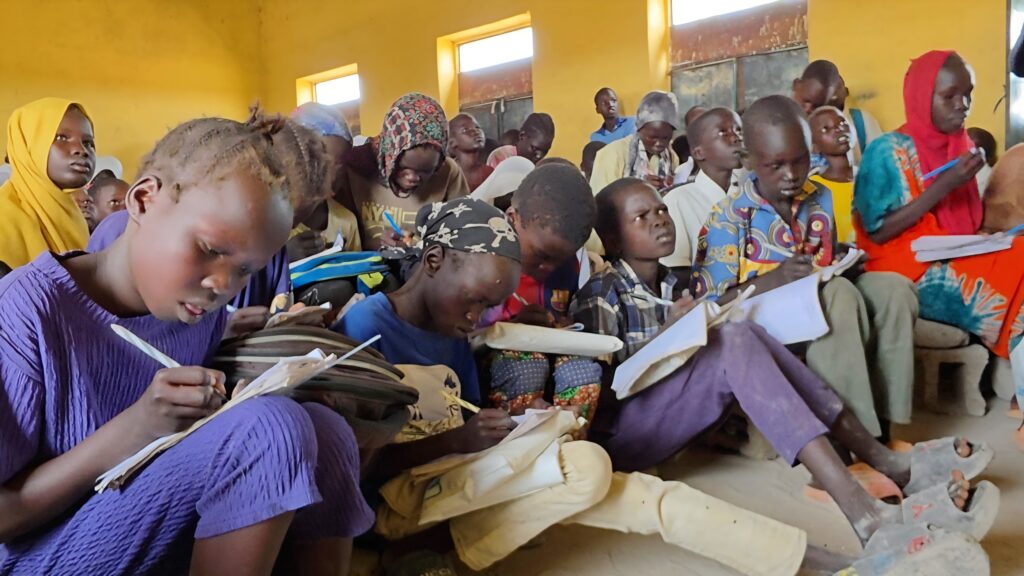
Behind them, Abukadra Primary School in Renk County, Upper Nile State, bears the scars of years of neglect and displacement. Walls are cracked. Some classrooms lack windows. Inside, children sit on floors, mats, or stones due to a lack of desks.
Yet every morning, they come.
Among them is Lena Emanuel, a Primary 7 pupil whose education has been disrupted twice by conflict.
Her family first fled South Sudan during the 2013 war and rebuilt their lives in Sudan. When fighting erupted there as well, they were forced to return in 2023.
By the time they reached Abu Khadra, she had been out of school for years.
She stayed at home for nearly two years before enrolling again in March.
“It is a very good feeling,” she said. “I cannot explain this feeling, but I am excited to be back to school.”
She wants to become a doctor.
“I like saving lives,” she said.
School reopening under pressure
Abukadra Primary School was largely non-functional for years after conflict displaced families and teachers.
Its reopening in 2025 came as increasing numbers of returnees and refugees arrived from Sudan, placing fresh pressure on already strained services.
Enrollment has risen from about 231 learners at reopening to more than 700 today, according to implementing partners.
“Renk County received a very big number of refugees and returnees,” said county education director Aleir Kur Chol. “This put a very great pressure on education, specifically on schools to absorb all the children who arrived from Sudan.”
He said authorities responded through multiple interventions.
“We conducted studies with UNICEF and partners,” he said. “We were able to absorb a very large number of children.”
Measures included reopening schools, establishing temporary learning spaces, radio-based learning in some areas and accelerated learning programmes for overage learners.
“But the biggest challenge,” he said, “was the language barrier. Some came studying Arabic, while here the system is English.”
Rebuilding a system around learning
The reopening of Abukadra Primary School is part of an education-in-emergencies response supported by the European Commission’s Humanitarian Aid department (ECHO), through UNICEF, and implemented by Community in Need Aid (CINA).
Support has gone beyond reopening classrooms. Pupils receive learning materials, teachers are trained in emergency education approaches, and psychosocial support is integrated into schooling for children affected by conflict and displacement. Child protection desks also provide counselling and referrals.
“When we reopened, there were about 231 learners. Now we have more than 700,” said Ayen Joseph Muker, project manager with CINA.
She said the increase reflects both returnee arrivals and growing community confidence in the school system.
Inside the classroom
In Lena’s classroom, nearly 200 learners share a single space.
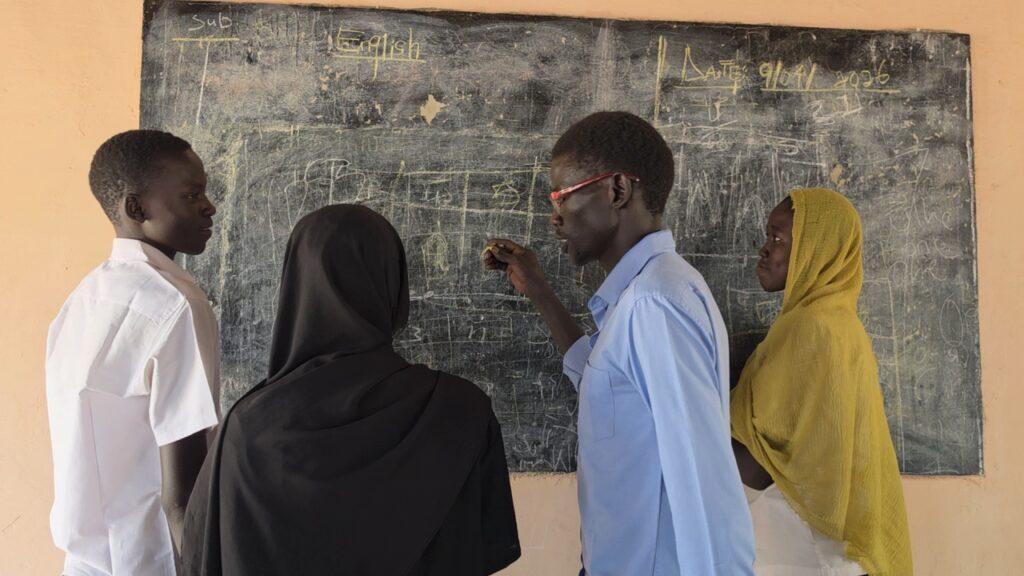
Teacher Puot Biel Nyak stands at the front, trying to maintain order.
“They are too many in one class,” he said. “Some make noise, some quarrel. But I am trying to manage them.”
He is among several volunteer teachers keeping the school running, often with limited or irregular support.
“We are sixteen teachers,” he said. “Only a few are supported. The rest are volunteers.”
Despite the conditions, he continues teaching.
“We are part of the community,” he said. “That’s why we are committed.”
He described overcrowding, limited learning materials and pupils sitting on the floor due to a lack of desks and chairs.
Learning in emergency conditions
Education officials say reopening schools is only the first step.
Children in Abukadra arrive with different learning backgrounds. Some studied in Arabic in Sudan, others dropped out entirely, and many are older than their grade level.
Authorities in Renk County, together with partners, have introduced accelerated learning programmes, temporary classrooms, teacher training, psychosocial support and distribution of learning materials.
“We were able to overcome many challenges,” said Aleir Kur Chol.
Some pupils have already completed primary examinations through the programme, he added.
“That is a success,” he said.
But he warned that challenges remain, particularly in remote areas where basic services such as water determine whether schools can function.
“In some places there is no drinking water,” he said. “Water is life.”
What parents see
For parents like Julia Nyuon, education is something she nearly lost.
After returning from Sudan in 2023, she spent a year in a transit centre caring for her sick mother, during which her children were largely out of school.
When she arrived in Abukadra, she feared she would not be able to afford school registration fees.
Her child was eventually enrolled.
“I am very happy because education is the future of my child,” she said.
Each morning, she prepares him for school.
“The least I can prepare is tea in the morning,” she said.
Fragile progress
Despite rising enrolment, significant gaps remain.
Desks are insufficient. Children sit on stones or floors. Water supplies are limited and sanitation facilities are overstretched. Learning materials remain inadequate.
Many teachers work as volunteers without stable incentives.
Officials warn that without sustained support, gains could easily be reversed.
Overcrowding could push children out of school. Volunteer teachers could leave. Girls could be driven into early marriage. Older learners could drop out again.
In fragile systems, progress remains uncertain.
A place to begin again
Still, every morning in Abukadra, children arrive.
They stand barefoot in formation, share books and study in crowded, unfinished classrooms under difficult conditions that reflect both hardship and determination.
Lena is among them.
Twice displaced by war, she is back in school because a classroom still exists for her to return to.
And for now, that is where she begins again.

 and then