



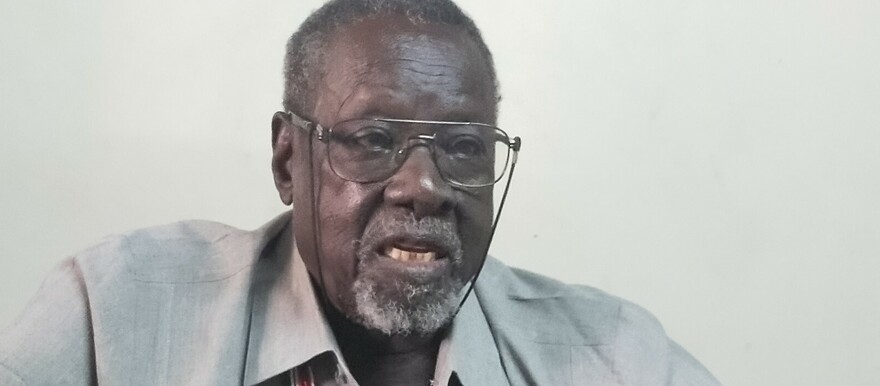
South Sudan’s Communist Party has described the ongoing inter-party dialogue in Juba as a government-controlled political process, saying it cannot provide meaningful space to address the country’s deepening political crisis.
The two-week Inter-Party Political Dialogue began in Juba on 24 September, ahead of elections scheduled for 22 December. President Salva Kiir has warned political parties against using the talks to delay or alter the electoral roadmap.
Speaking at the dialogue in Juba on Monday, Joseph Wol Modest, Secretary-General of the Communist Party of South Sudan, said continued political tensions and judicial proceedings against former First Vice-President Riek Machar had further narrowed the space for meaningful political engagement.
“The continued dissension and judicial proceedings against the First Vice-President have further narrowed the space for meaningful political action. The Communist Party is not a force for dialogue. It rejects a narrow, government-controlled dialogue whose outcome is effectively predetermined. South Sudan requires a broader national political system,” Wol said.
He says inclusive dialogue involves allowing people to speak openly about their concerns without being threatened or intimidated.
“This requires creating conditions in which people can agree without fear,” he said.
“The Communist Party recognises elections as an extension of democratic government. However, elections must be the outcome of a credible political and constitutional process, not a mechanism for ending the transition without resolving the woes that [the] right-wing community [faces]. It is not enough only to have political woes and the transition without the conflict being resolved.”
Wol said the political space created by the 2018 peace agreement had been progressively weakened by delays, unilateral institutional changes, political fragmentation and the dismantling of transitional power-sharing arrangements.
Lasuba Lodoru Wango, deputy chairperson of the SPLM-IO interim leadership led by caretaker Peacebuilding Minister Stephen Par Kuol, called for greater political and civic space ahead of the elections.
“I have no restrictions on political rallies and campaigns. The political parties that are registered are not supposed to be asking for security clearance to have meetings that are related to their parties in the elections,” Lasuba said.
“We also wanted to ensure that in this dialogue we have a transparent counting process and a conclusion of results with all political members present in that process.”
He said the dialogue should produce a written, implementable and time-bound roadmap to make the planned elections locally and operationally credible.
“Our position as SPLM-IO as we approach this Inter-Party Dialogue is to focus on consensus-building among member parties, to have guarantees, inclusivity and implementation of the last set of activities that drive us towards peaceful and credible elections,” he said.
“These major principles should guide the Inter-Party Dialogue to draw consensus and agreement on the peaceful and legal, security, funding and institutional conditions under which the people of South Sudan can participate freely and confidently in an election whose outcome is accepted as legitimate by the competing parties, as well as regional and international observers.”
Onyoti Adigo Nyikwec, chairman of the Democratic Change Party (DC), cautioned against holding elections before the necessary conditions were in place.
“We have to think critically about how to have a credible election. And what type of election we need, I think it should come from us according to the environment in which we are. Because we should not push things if they are not able to be done by us,” Adigo said.
“As we know, there are some places where some problems are mentioned by the presenters before.”
He said the political party dialogue provided a platform for political leaders to discuss their differences peacefully and negotiate lasting solutions to the political crisis.
“So it is good to think critically about how we make these things. Political party dialogue provides a platform for political leaders to share disagreement through peaceful discussions and negotiations,” he said.
“It creates an opportunity for parties to identify areas of disagreement, understand one another’s concerns, and take risks for political solutions without going to confrontation.”
Bishop Elias Taban Parangi, chief mediator of the Inter-Party Dialogue, said the mediation team would support political parties in finding their own solutions rather than impose decisions on them.
“We are mediators. We are not facilitators. First of all, we are neutral. We stay impartial and do not take sides in the argument. We help both sides to listen to each other without fighting. We assist people in finding their own solutions instead of forcing a decision on them,” Bishop Taban said.
He attributed South Sudan’s recurring conflicts to mediators whom he accused of imposing agreements without adequately considering the concerns and circumstances of the country’s people.
“One thing, if I can tell you, I am sorry to say this, in front of the international community, you know the fight in South Sudan has been caused by mediators. Our agreements that are impossible to implement are caused by mediators, because things are dictated to us, how we should be,” he said.
“We want to say today, by the grace of God, we will achieve a peaceful end. We will make sure that we have guided our political parties to reach a peaceful solution, peaceful elections, enough space for everybody, enough space for all the parties. There is no favouritism in mediation.”

 and then