



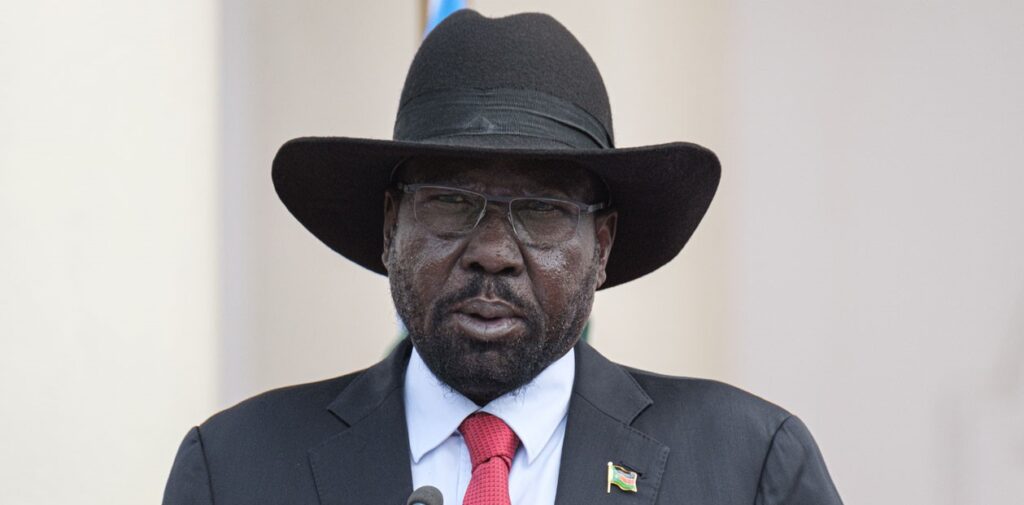
South Sudan President Salva Kiir Mayardit has warned political parties against using an ongoing inter-party dialogue to alter or delay the country’s path towards elections scheduled for 22 December.
The warning comes two days after Kiir dissolved the transitional unity government established under the 2018 peace agreement and appointed a caretaker administration, three months before the scheduled elections.
The two-week Inter-Party Political Dialogue, held under the theme “Towards Peaceful, Inclusive, Transparent and Credible Elections”, was launched at the National Legislative Assembly in Juba on Thursday.
Speaking at the opening on Thursday, Kiir said the inter-party dialogue should focus on election-related issues and should not become a platform for renegotiating the direction of the electoral process.
“This inter-party dialogue is not a place for negotiations and disagreement. It is not a place to shift the direction of the path that we have taken. It is not a place to hold us back. Instead, its main purpose is for all of us to agree on a path to a peaceful and reasonable result,” Kiir said.
He said preparations for the elections are based on four key areas: the legal framework, administration and logistics, security, and dialogue on election-related matters.
“The journey towards the general election consists of four critical roadmaps. One, the basic and legal roadmap, which has now been achieved. Two, the administrative and logistics roadmap, which is also progressing well. Three, the security roadmap, which is also progressing well. Four, this dialogue on election-related matters,” he said.
Kiir said the dialogue should help establish a clear roadmap for completing the electoral process while remaining within the framework of existing election laws.
“This inter-party dialogue must focus its value on election-related matters. It is an opportunity for all of us to create a clear roadmap for concluding the election,” he said.
He also thanked political party leaders for supporting preparations for the elections.
Dr. Martin Elia Lomuro, the rapporteur of the Inter-Party Dialogue, said the forum is intended to help political parties and other stakeholders build consensus on measures needed to hold the elections.
“The Inter-Party Dialogue provides a platform for South Sudanese political parties and stakeholders to engage with one another, address strategic issues, build consensus and agree on political measures necessary for the country to proceed towards peaceful, democratic and credible elections,” Dr. Lomuro said.
Dr. Issa Muzamil Sebit, chairperson of the National Patriotic Movement (NPM), said he expected the dialogue to address security arrangements for candidates and voters ahead of the elections.
“The issue of security. Because you know South Sudan’s situation, everybody knows that security is not guaranteed 100%. And there are certain places where you need to move, and in order to move, you need to be well equipped with security,” Dr. Muzamil said.
He said political parties should agree on security mechanisms for all candidates participating in the elections.
Edmund Yakani, executive director of the Community Empowerment for Progress Organization (CEPO), said the dialogue should address restrictions on civic and political space, the status of political detainees and the wider security situation.
“One, the issue of unrestricted civic and political space. If this dialogue can sanction that civic and political space, it is open, nobody will interfere with it. Two, the fate of the political detainees who have a political stake on this issue,” Yakani said.
“If they can be released, that will be, for me, a better issue. Fixing the security situation, if we can agree on how to stop the war and go back to ceasefire sustainability, that will be a very good thing that the dialogue can discuss,” he said.
The dialogue is being attended by representatives of several political parties in Juba, along with civil society groups. Regional and international figures were also invited, including representatives of the Community of Sant’Egidio.
However, representatives of major opposition groups did not attend the event.
 and then