



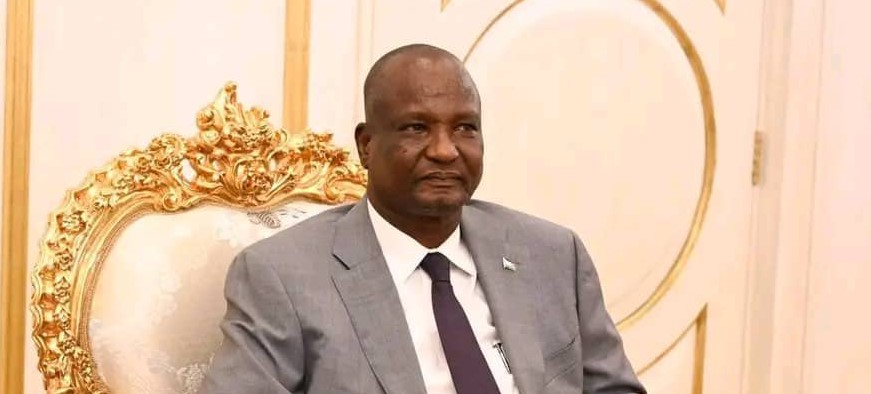
South Sudan Vice President Gen. Taban Deng Gai has admitted that the country suffers from a severe shortage of roads and energy infrastructure and reiterated support for building good roads along the Juba-Nimule and Juba-Nadapal corridors to facilitate trade and easy movement.
He made the remarks on Thursday at the conclusion of the 7th Edition of the Global Logistics Convention 2026 held at Pyramid Hotel in Juba.
“The Juba-Nimule and Juba-Nadapal roads are very important corridors to South Sudan, and my suggestion to the East African community is that they should help us develop roads in South Sudan. I know that roads are highly developed in Tanzania, Rwanda, and Burundi to some extent,” he said. “But in South Sudan we do not have roads; there are no roads because of a number of issues. We have not yet developed how to put our resources into real, effective areas for development like roads, energy.”
“We were wasting a lot of time from 2005 up to 2016. In 2016, there was a policy suggested by the president called oil for roads, which actually started very well, and that is why we developed the Juba-Bor Road,” Gen. Deng added.
He said the roads to Bor and Terekeka improved the livelihoods of people there and that businesses were thriving. He revealed that the government intends to invite investors to develop infrastructure under a public-private partnership (PPP) model.
“People can come and build and operate road tolls. If the oil for roads has become too small to build roads, why don’t we place these roads under road tolls? You don’t need to impose any new taxes,” he said. “The current taxes that are being paid by transporters; part of it can be taken to finance the roads. This is being discussed in the Ministry of Roads and with the investors.”
Gen. Deng gave the example of the weighbridge in Nimule, which he said was making a lot of money.
Regarding energy, the vice president said there is some power in Juba but that the other states do not have electricity.
“You get some light here in Juba, but if you go to Bor, you don’t get it. The same for Rumbek and other places. However, we plan to import more power from Uganda and also from Ethiopia,” Deng said.
He also highlighted the exorbitant price of fuel, especially diesel in South Sudan, saying it drives up other costs.
“The problem is that fuel is very expensive. Our fuel is supposed to be more expensive because we are landlocked and import it. You know, fuel is just like electricity; you cannot talk of developing the logistics and transport sectors and development in East Africa unless you also solve the issue of the price of power, energy, and also fuel. Diesel is also used in farming,” he said. “I think we need to adopt Uganda’s policy on the issue of refineries. I am happy that East African leaders are now discussing the Dangote refinery in Tanga. That is a very good idea. I hope it is built very soon.”
He added that South Sudan cannot rely on the importation of diesel from the high seas because of logistics disruptions at the Strait of Hormuz and Bab and Mandeb.
“We need to have refineries because South Sudan has enough fossil oil, and as I said then, we don’t think critically, and we are also wasting time,” he stated. “From 2005 up to today, we did not build roads, and we did not think of making a refinery, even a single one. I think this is the wrong policy.”
The vice president also faulted commercial banks in the country for not giving loans to locals and being selective in their business.
“Even my friend in KCB, I discuss with them because I am accustomed to them. I don’t think banks are financing young South Sudanese to go into business,” he said. “The Kenyan banks are financing their nationals in South Sudan, and the Ethiopian ones are financing their nationals. This policy is very dangerous.”
Vice President Deng also highlighted that another problem is that commercial banks want land as collateral, yet the land policy in Juba is faulty.
“I also discovered another issue through my discussions with the banks; if you want to get a loan from a bank, you have to provide collateral, and the collateral the bank always wants is land,” he stated. “There is a very flawed policy regarding land in Juba, and that is why I wish we would move the capital to Ramciel. This will change the land system. You cannot give an investor land as collateral for 20 or 30 years. Let us say they invest USD 10 million in your land; can a hotel recoup that huge investment in 20 years?”

 and then