



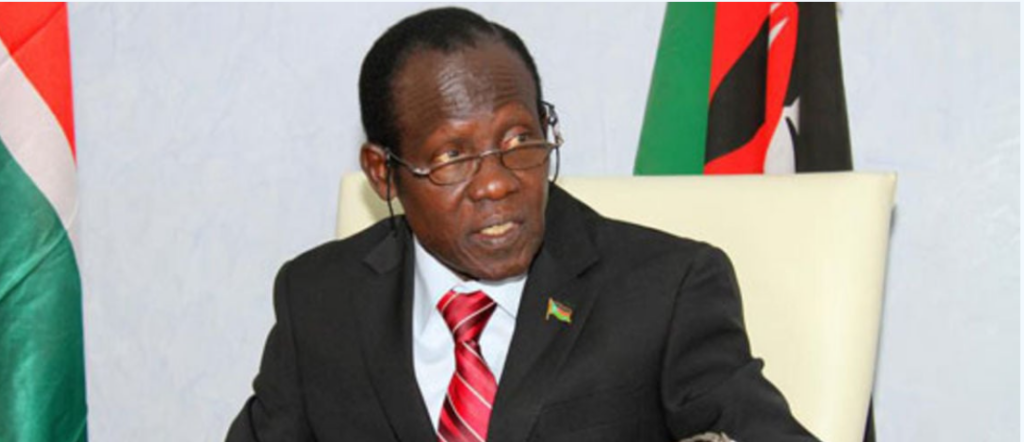
A high-level dispute has erupted within South Sudan’s government over control of national revenue systems after Vice President James Wani Igga overruled an order by the minister of trade to suspend a controversial digital payment company.
The confrontation centers on Crawford Capital, a firm that manages electronic service systems for the government and has been the subject of several investigations over transparency and its role in the country’s financial infrastructure.
The dispute began March 5, 2026, when Trade and Industry Minister Atong Kuol Manyang Juuk issued a directive halting the company’s operations. The minister ordered the “initiation of a 90-day administrative and technical review of the Crawford Capital digital payment and e-service system.”
In her directive, Atong cited operational failures as justification for the immediate “suspension of its licensing operations,” saying the government needed to address persistent “connectivity issues and staff training gaps” that were allegedly hindering trade.
Within 24 hours, Igga, who chairs the government’s Economic Cluster, issued a rebuttal in a letter dated March 6, 2026, seen by Radio Tamazuj.
The vice president, who is also President Salva Kiir’s deputy in the ruling SPLM party, told the minister that her unilateral decision violated the principle of “administrative order and the rule of law.”
Igga argued that the company’s contract had been approved through a collective government process.
“The engagement of Crawford Capital was not a unilateral decision, but the result of extensive deliberations by the Economic Cluster, which culminated in a formal Resolution No. 34/2024 of the Council of Ministers,” Igga wrote.
He added that because the resolution was “presided over by H.E. the President,” it “cannot be dissolved, omitted, or reversed by a single ministerial directive.”
The vice president also warned that interfering with the company’s operations could lead to “revenue leakages and legal liabilities for the Government of South Sudan.”
The dispute comes amid long-standing concerns from watchdogs over digital revenue collection systems in the country. While the government has presented such platforms as part of efforts to modernize public services, investigators have raised questions about how companies were selected and where the fees they collect ultimately go.
In reports to the United Nations Human Rights Council, investigators have previously warned about “politically connected companies” involved in digital revenue collection in South Sudan. According to those reports, some firms operate “e-gateways” that charge mandatory fees on imports and exports, which critics say bypass the central treasury.
Crawford Capital is linked to the CapitalPay platform, which also manages accreditation permits for oil buyers and fuel trucks.
CapitalPay’s ownership has been widely scrutinized. The platform is widely believed to be linked to Adut Salva Kiir, the daughter of President Salva Kiir. Previous UN investigations indicate that Crawford Capital Ltd was formed by Garang Mayom Kuoc Malek, who owns 68% of the company and 61.2% of CapitalPay, and Ruey Majok Guandong. Both founders have deep political lineage, and Malek and Guandong have a history of forming companies with politically connected individuals.
A recent investigation by Radio Tamazuj found that international oil traders were required to pay accreditation fees to Crawford-linked accounts, a process the U.N. has described as part of a “predatory” economic system.
There is also no publicly available record of a competitive tender process for the digital services contract awarded to Crawford Capital, despite requirements under South Sudan’s Public Procurement and Disposal of Assets Act of 2018.
Igga’s decision instructing the minister to “pause your order” and consult the Ministry of Justice effectively blocks the suspension for now.

 and then