



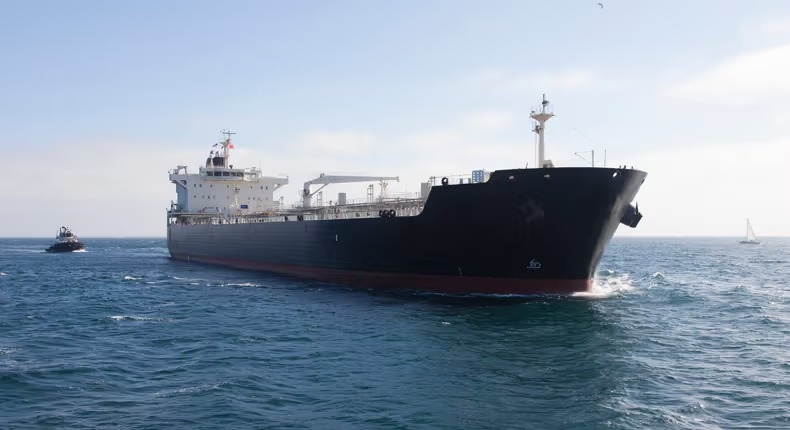
A private digital payment platform has become a mandatory checkpoint for South Sudan’s multi-million-dollar crude oil exports, quietly positioning itself to collect hundreds of thousands of U.S. dollars in fees that international traders must pay before loading crude onto tankers, according to investigations by Radio Tamazuj.
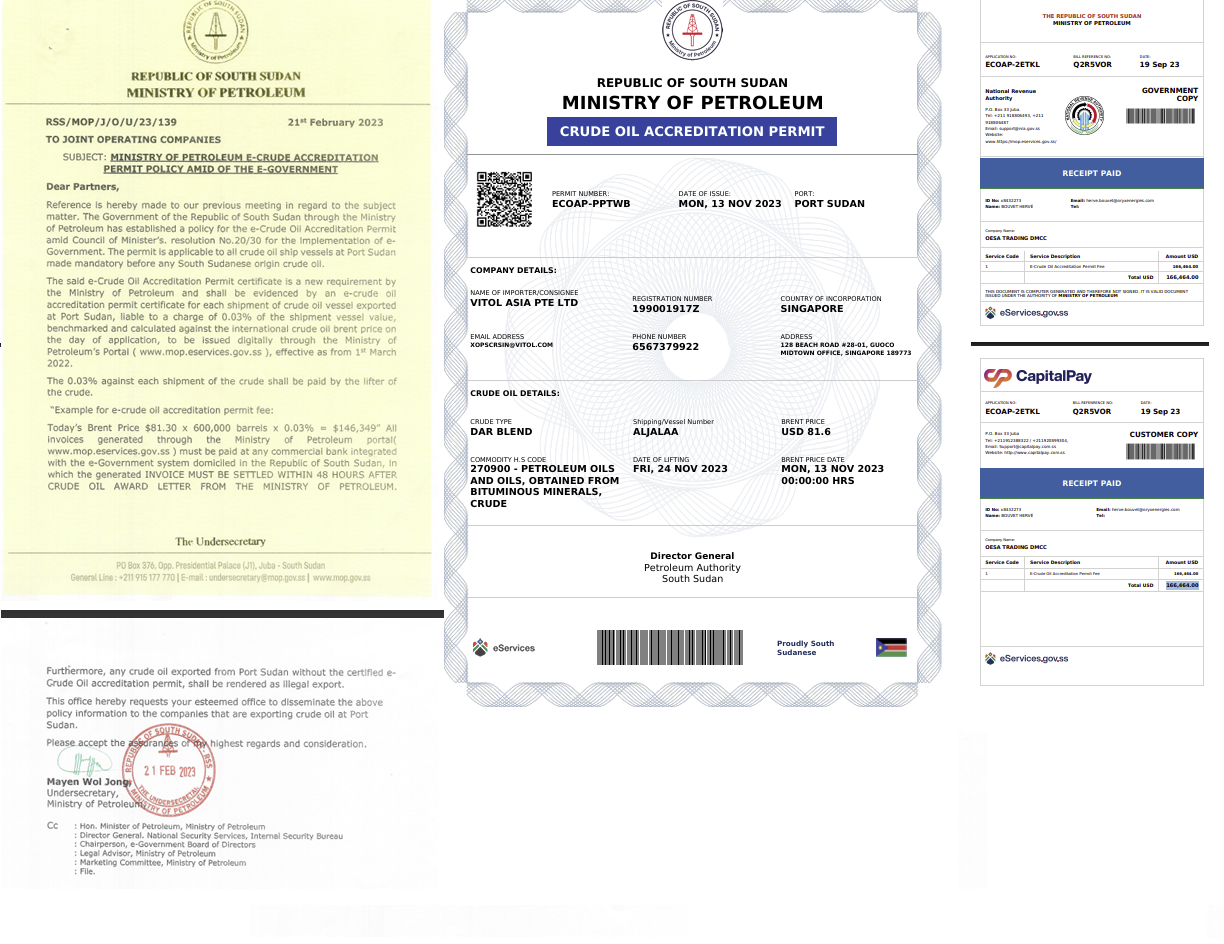
International buyers are required to obtain an e-Crude Oil Accreditation Permit (ECOAP) before cargoes can legally leave Port Sudan. Established by the Ministry of Petroleum under Council of Ministers Resolution No. 20/2023, the system is a mandatory requirement for all crude oil vessels at Port Sudan. Under a policy effective from March 1, 2022, failure to secure a certified e-permit renders exports illegal.
The ECOAP imposes a 0.03% charge on the total value of each shipment, calculated against prevailing Brent crude prices. Ministry documents signed by former petroleum undersecretary Mayen Wol Jong provide an example: a 600,000-barrel cargo priced at $81.30 per barrel generates a $146,349 accreditation fee.
Receipts reviewed by Radio Tamazuj confirm payments consistent with these calculations, with one September 19, 2023 receipt showing $166,464 paid by OESA Trading DMCC for a single shipment. With annual exports approaching 40–50 million barrels, the levy could generate several million US dollars annually.
The system operates through the Petroleum Ministry’s portal (www.mop.eservices.gov.ss) with payments processed via commercial banks. The primary technical interface, however, is CapitalPay, a private digital payment platform operated by Crawford Capital. Receipts bear the CapitalPay logo, directing users to process transactions through the Ministry’s e-services portal. Invoices must be paid within 48 hours of award letters to comply with Ministry directives.
Ownership and Political Links
CapitalPay’s ownership has been widely scrutinized. The platform is operated by Crawford Capital, believed to be linked to Adut Salva Kiir, the daughter of President Salva Kiir. Previous UN investigations indicate that Crawford Capital Ltd was formed by Garang Mayom Kuoc Malek, who owns 68% of the company and 61.2% of CapitalPay, and Ruey Majok Guandong. Both founders have deep political lineage, and Malek and Guandong have a history of forming companies with politically connected individuals. Other family members of political elites have also benefited from government procurements, including Air Afrik Aviation Limited, formed in 2013 with Mayar Salva Kiir.
Crawford Capital’s reach extends beyond crude oil. The company previously collected “E-petroleum permit fees” on fuel trucks entering South Sudan from Kenya, charging $0.03 per liter, though the levy was suspended in October 2024 following complaints from businesses and humanitarian agencies.
Compliance by Oil Firms
International and state-backed firms lifting South Sudanese crude oil are required to comply with ECOAP. These include Joint Operating Companies GPOC, DPOC, and SPOC; international partners such as China National Petroleum Corporation (CNPC), Petronas Carigali Nile Ltd, ONGC Videsh, and SIPC/SINOPEC; and state entities Nile Petroleum Corporation (NILEPET) and the South Sudan Trading Office (SSTO). Major traders like Vitol Asia Pte Ltd have received permits—for example, Permit ECOAP-PPTWB issued on November 13, 2023, for the vessel ALJALAA carrying Dar Blend at a Brent price of $81.6 per barrel.
To facilitate ECOAP rollout, the Ministry allocated dedicated office space in Port Sudan and Khartoum in 2023, authorizing Eng. Manuer Bol Cinkoc, Chief Coordinator in Sudan, to set up joint e-crude oil project offices with Petroleum and ICT officials.
Transparency and Oversight Concerns
Critics warn that routing public revenue through a private company risks obscuring the audit trail in a country struggling with fiscal transparency. The Ministry of Petroleum has not disclosed total revenue collected under ECOAP or the contractual terms of its arrangement with Crawford Capital. It is unclear what portion of the 0.03% fee is retained by CapitalPay versus government coffers, or whether the contract was subject to competitive bidding as required by South Sudan’s Public Procurement and Disposal of Assets Act, 2018.
While the Ministry frames ECOAP as part of broader “e-Government” implementation, the lack of public disclosure regarding Crawford Capital’s role continues to raise questions about transparency in managing South Sudan’s most vital revenue source.
The Ministry of Petroleum could not be reached for comment.

 and then