



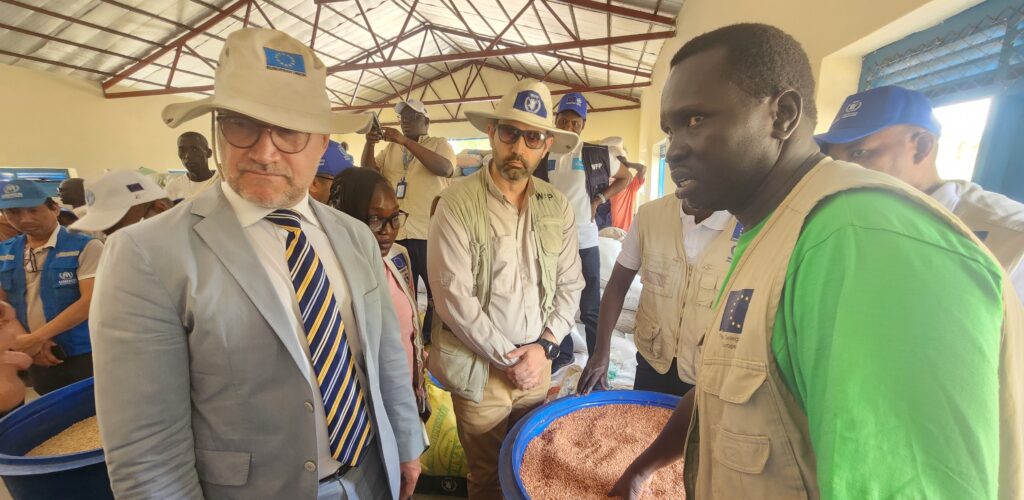
A 60-year-old farmer, Nyibol Okwai, who resides in Northern Bahr el Ghazal State’s Anyuopjong area, recalls years when survival depended as much on luck as on harvest. Crops could be lost to theft or fire, and reaching markets, schools, or health facilities often meant long, uncertain journeys along impassable roads.
Today, she says, the landscape of daily life is slowly changing.
“Before this program, our produce used to be stolen, and fire was always a risk because we had no safe place to store our goods,” she says. “Now we are not afraid of where to store our harvest.”
Her experience sits at the center of a wider transformation unfolding across Northern Bahr el Ghazal, where an integrated development initiative funded by the European Union and implemented by the World Food Programme and the Food and Agriculture Organisation is reshaping rural life through roads, markets, livestock services, and water systems.
For decades, many communities in Aweil were cut off during the rainy season, when roads turned into muddy barriers that disrupted trade and access to basic services. Now, newly rehabilitated feeder roads are changing that reality.
“These feeder roads have brought a lifeline to communities that were isolated for months during the rainy season,” said Abdulaziz Noman, WFP Head of Field Office in Northern Bahr el Ghazal.
He said improved connectivity now allows farmers to move goods, reach markets, and access services throughout the year.
“Now these communities are accessible 12 months a year, and farmers can sell their produce at any time,” he said.
Pelle Enarsson, the EU Ambassador to South Sudan, describes the infrastructure as central to rural transformation.
“These feeder roads improve connectivity, unlock agricultural potential, boost trade, and enhance security,” he said. “For many communities, they are a lifeline.”
Beyond roads, the project is helping farmers shift from subsistence agriculture to more structured, market-oriented production.
“We are supporting farmers not only to produce, but to store, aggregate, and access markets,” said Solomon Tilahun, WFP Head of Program in Northern Bahr el Ghazal.
He said more than 113 cooperatives and farmer groups have been established to strengthen collective production and marketing. Farmers are now able to store harvests and sell when prices improve rather than immediately after harvest.
“We have seen cultivated land per household increase from two feddans to five,” Tilahun said.
He added that the project is expected to benefit between 300,000 and 400,000 people directly and indirectly across the region.
In rural Aweil, livestock remains central to livelihoods, while access to water and animal health services continues to shape survival and stability.
“The project was designed to address conflicts along migratory routes where competition over water and pasture is common,” said Leslie Mhara, FAO Head of Field Office in Northern Bahr el Ghazal.
He said more than 600,000 livestock have been vaccinated across three counties, reducing disease-related losses and strengthening pastoral livelihoods.
A newly constructed water yard is also serving both people and animals, easing pressure on unsafe open water sources.
“Now they have access to clean water for households, livestock, and irrigation,” he said.
Local animal health workers say vaccination services have made a visible difference.
“Before the program, there was no medicine, and many animals died from diseases that spread quickly,” said vaccinator Mohamoud Ngong Aturjong. “Now we can vaccinate animals and reduce outbreaks.”
Officials say the project goes beyond physical infrastructure, focusing on long-term systems for sustainability and resilience.
“There is a strong sense of ownership among communities, who are now managing and maintaining these facilities themselves,” said WFP’s Abdulaziz Noman.
Community committees manage water points and collect small contributions for maintenance, while cooperatives increasingly invest in expanding agricultural activities.
EU Ambassador Enarsson stressed the importance of continuity.
“As we hand over these roads, authorities must take full ownership through proper management and regular maintenance so they continue to benefit communities for years to come,” he said.
For Nyibol, the changes are visible in everyday life—though challenges remain.
“Life is improving because we can now store our food, reach hospitals, and access markets,” she said. “We just ask for continued support, especially for building more classrooms for our children.”
Across Northern Bahr el Ghazal, communities are gradually shifting from isolation to connectivity, and from vulnerability to resilience, as roads, water systems, livestock services, and agricultural markets begin to function as a connected rural system rather than separate interventions.

 and then