



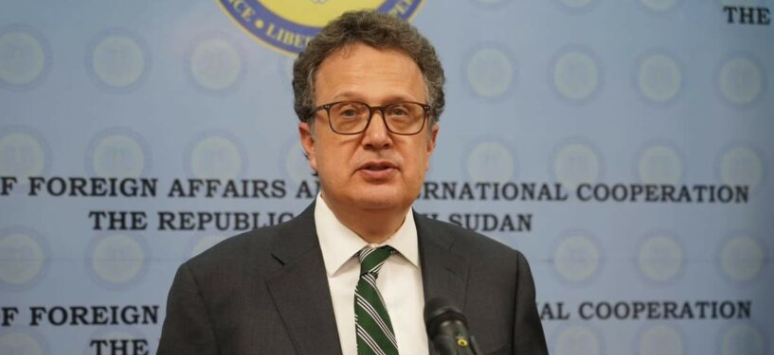
The Troika countries on Thursday said any changes to South Sudan’s 2018 peace agreement must be agreed through an inclusive dialogue involving all signatories, warning that the accord remains the foundation of the transitional government’s legitimacy despite its shortcomings.
Speaking on behalf of the United States, Britain and Norway during a meeting of the Reconstituted Joint Monitoring and Evaluation Commission (RJMEC), U.S. Ambassador to South Sudan Michael J. Adler said the peace agreement remains the legal basis for the transitional government despite repeated failures by its signatories to fully implement it.
“The agreement remains the basis for the legitimacy of the transitional government. Any changes must be made through dialogue involving all parties to the agreement,” Adler said.
The statement came a day after South Sudan’s parliament approved controversial amendments to the 2018 peace agreement, postponing the requirements for a national population census and the completion of a permanent constitution until after elections scheduled for December 2026, despite objections from the opposition.
Adler said meaningful political dialogue cannot take place while First Vice President Riek Machar, leader of the main opposition Sudan People’s Liberation Movement in-Opposition (SPLM-IO) and a signatory to the peace agreement, remained under house arrest and on trial.
“It is farcical to say that interparty dialogue is occurring” under such circumstances, he said, adding that peace in South Sudan required a return to genuine dialogue among all parties to the agreement.
While acknowledging that the 2018 agreement was imperfect and had repeatedly been undermined by a lack of political will to implement it, the Troika said any revisions should be negotiated through an inclusive process involving all signatories, including Machar.
The amendments are part of a broader government push to prepare for South Sudan’s first post-independence elections.
On Tuesday, the Political Parties Council granted full registration to five additional political parties, bringing the number eligible to contest the elections to 36.
The National Elections Commission announced on June 22 that voting would be held in December 2026, meeting the legal requirement to declare the election at least six months in advance.
The commission has, however, warned that funding shortages and legal inconsistencies could undermine preparations.
President Salva Kiir’s allies insist the elections will proceed as scheduled. But opposition groups, including Machar’s SPLM IO, argue that key provisions of the peace agreement, including security sector reforms, the constitution making process and the unification of armed forces, remain incomplete, raising doubts about whether the conditions for a credible election are in place.

 and then