



Upper Nile University has blamed an outdated agriculture curriculum for declining student enrollment, saying it has traditionally prepared graduates mainly for government jobs despite limited employment opportunities.
The university said on Monday it is seeking to modernize its agriculture training to emphasize entrepreneurship, practical skills, research, innovation and digital farming.
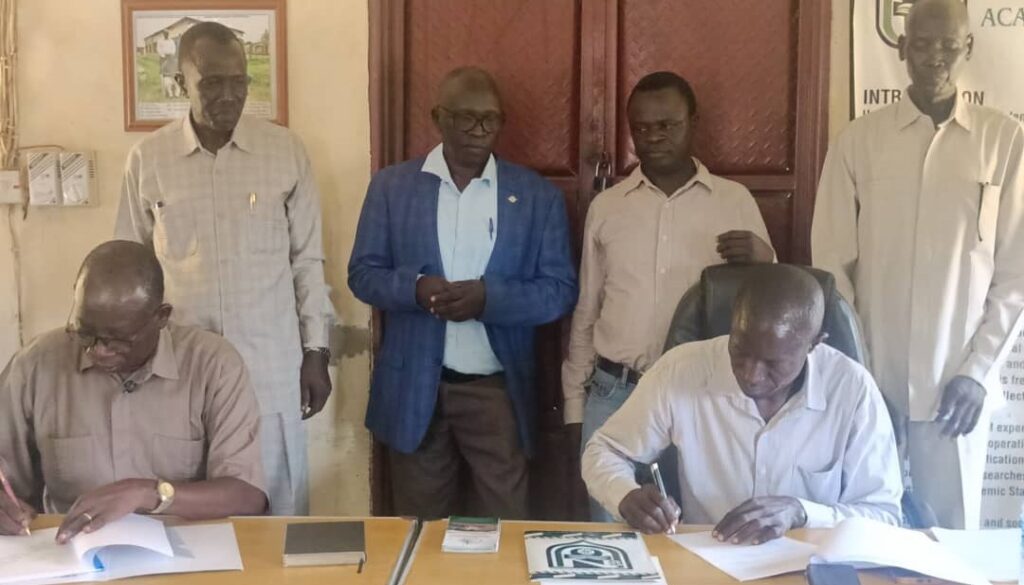
The move was announced during the signing of a memorandum of understanding between the university’s Faculty of Agriculture and Premium Agro-Consultancy Company in Juba.
Professor Ambrose Samuel Jubara, the university’s deputy vice chancellor for academic affairs, said the university has examined why enrollment in agriculture is falling.
“After we realized that the enrollment in the Faculty of Agriculture is becoming lower and lower, we thought, where is the problem?” Jubara said.
He said the university concluded that the curriculum was designed around the assumption that the government, particularly the agriculture ministry, would be the main employer of graduates.
“The low enrollment is exactly because the curriculum is that old. It was made in the way that the government is the only employer,” he said.
Jubara said the university wanted to introduce training that would equip students with practical skills and prepare them to create businesses and jobs rather than rely on government employment.
“We want a curriculum that will allow the student to graduate with training geared towards entrepreneurship and innovation, and that will allow the student to do research,” he said.
Lack of laboratories
The university’s vice chancellor, Professor Mamour Chuol Turuk, said the institution also faces a shortage of laboratories and demonstration farms after its displacement from Upper Nile state to Juba.
“Since we were displaced to Juba, we don’t have laboratories. We don’t have a field for demonstration for our students,” Turuk said.
“Despite the importance of theoretical knowledge, it will not bring food to our table. We need practical, we need hands-on skills,” he said.
Turuk said the university had asked the Ministry of Agriculture for permission to use two laboratories in Luri, outside Juba, which he said are currently not being used.
He said closer cooperation between universities, the government and private agricultural companies could help improve training, research and food production.
Private sector partnership
Premium Agro-Consultancy Company Chairman Ayiga Festo Amanda said the partnership would expose students to modern farming methods and practical training at demonstration farms.
Festo said his company has previously worked with the University of Juba to train students at its demonstration farm in Gumbo and also partnered with the University of Nairobi.
He said Premium Agro would work with Upper Nile University to develop an agricultural curriculum suited to South Sudan’s farming conditions.
“We thought as a private company it is very important for us to now team up with the university, so that the new knowledge that we have already been developing in the company” can reach students, Festo said.
He said students need practical experience alongside classroom-based learning.
Festo also called for greater use of digital agriculture in South Sudan, saying technology could help farmers access weather and climate information, agricultural advice and market data at lower cost.
He said the memorandum would also support the training of farmers, arguing that better-trained farmers were essential to improving food production.
“Our farmers cannot produce when they are not well trained,” Festo said.
He described food security as a national security issue and said South Sudan needs to empower local farmers to produce more.

 and then