



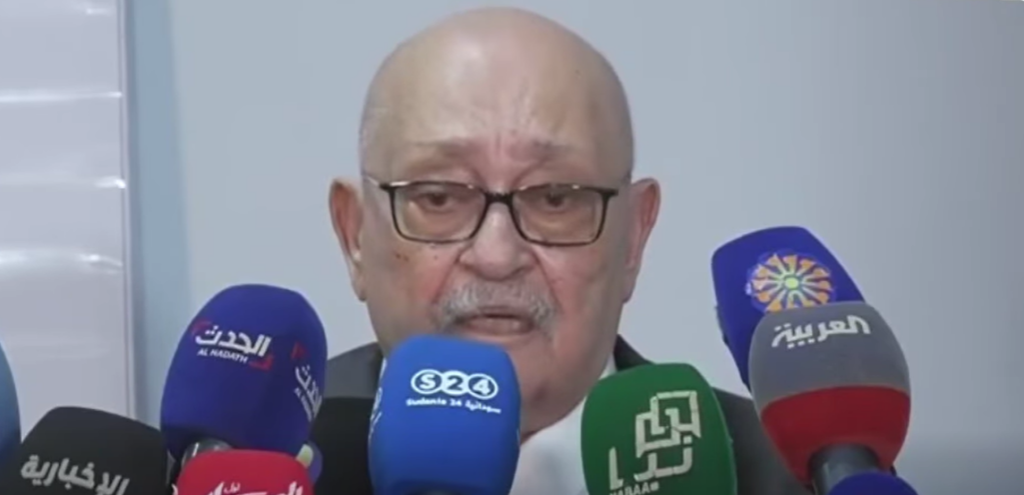
A Sudanese committee tasked with preparing for a political dialogue says it has started extending invitations to political parties and other groups ahead of a planned Sudanese-Sudanese dialogue conference.
The committee’s spokesperson, Osman Mirghani, said all political forces would be invited to take part in the consultations.
Speaking at a news conference in Khartoum on Tuesday, Mirghani said the committee would begin meeting political groups in the coming period.
A meeting with the Democratic Bloc is expected next week, followed by consultations with other political forces, he said.
The committee aims to reach the broadest possible agreement on preparations for the Sudanese-Sudanese dialogue, Mirghani said.
It would later summarise the results of the consultations and use them as a basis for the dialogue conference, he added.
Mirghani further said the preparatory committee is also maintaining contact with regional and international actors.
He said a meeting is expected this week outside Sudan with representatives of European Union countries and a committee dealing with Sudan, alongside contacts with other organisations and countries.
He expressed hope that the dialogue conference could be held before the end of the year.
How the initiative began
The committee emerged publicly in August after a group of Sudanese figures proposed an independent mechanism to prepare for an intra-Sudanese dialogue.
The initiative followed consultations by army chief and Sovereign Council Chairman Gen. Abdel Fattah al-Burhan with political and civil-society figures on preparations for a comprehensive Sudanese dialogue.
Reports of those consultations said participants discussed the creation of a preparatory committee and measures intended to create conditions for political dialogue.
On 14 August, Burhan said the government would provide legal, political and security guarantees to facilitate the dialogue.
He said the group proposing the initiative had stressed its independence and openness to all and had requested guarantees to enable participation and protect those taking part.
Burhan also said the government would not organise the dialogue or determine its agenda or outcome.
He said criminal proceedings against participants could be temporarily suspended while taking part in the dialogue, without affecting the rights of people who had filed complaints against them.
The committee says it is a civilian initiative and that its role is to prepare the ground for dialogue rather than determine its final agenda or outcome.
Who is being consulted?
The committee says its outreach is not limited to political groups inside Sudan or those who support the army-aligned government.
It says it is consulting political parties, civil society and blocs as well as community groups, including traditional administrations, Sufi orders, displaced people, refugees and victims of the war.
Its spokesperson has said the committee includes figures from inside and outside Sudan.
The committee also says it is in contact with regional and international organisations and countries as part of its preparations.
Why are some groups sceptical?
Some Sudanese civil society and political groups, particularly those involved in anti-war activities outside Sudan, have rejected or questioned the initiative.
They have raised concerns about the independence and inclusiveness of a dialogue being organised in Khartoum, where the Sudanese Armed Forces (SAF) is in control.
In August, a group of anti-war political and civil forces meeting in Addis Ababa rejected Burhan’s proposed dialogue and said they would not participate in it or recognise its outcome.
They argued that the process is being conducted in areas controlled by one side of the conflict and is not sufficiently independent.
Those groups have instead called for a political process linked to a ceasefire, humanitarian access and broader civilian participation.
Principles for dialogue
Nabil Adib, the committee’s political-track coordinator, said the committee’s role would end once the dialogue begins.
He said the committee had prepared two papers to help facilitate the talks.
One deals with proposed national principles and issues that should not be raised during the dialogue, while the other addresses decision-making within the process.
Adib said any proposal to divide Sudan should not be raised during the dialogue.
He also said the committee supports a decentralised system of government, which he said is suited to Sudan’s diversity while recognising the country’s different identities.
He said the committee also supports a democratic system of government.
Adib said decisions within the dialogue should be made by majority vote, while the participants themselves would determine the agenda.
He said the committee would continue contacting political parties and blocs, including the Somoud coalition led by former prime minister Dr. Abdalla Hamdok, as well as regional and international organisations.
He added that the committee had completed most of its preparatory work.
Wider consultations
Suleiman al-Amin, a member of the committee’s community track, said it had held extensive consultations with traditional administrations, community groups, Sufi orders, displaced people, refugees and victims of the war.
He said the consultations had received a positive response during visits to displacement camps and Sufi communities.
Al-Amin said the committee is also pursuing a separate track involving business owners, citing the role of factories in employing large numbers of workers who support thousands of families.

 and then