



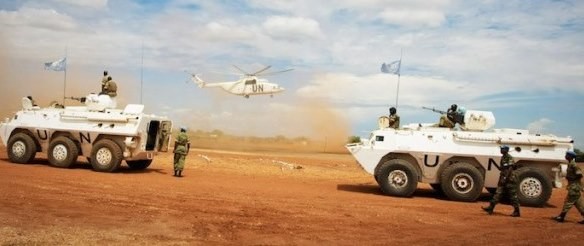
The United Nations Security Council on Friday extended the mandate of the UN Interim Security Force for Abyei (UNISFA) by one year, until November 15, 2027, while renewing its support for the Joint Border Verification and Monitoring Mechanism.
The 15-member council adopted Resolution 2838 (2026) by 13 votes in favour, with none against and two abstentions by China and Russia.
The resolution, adopted under Chapter VII of the UN Charter, also called for a prompt, impartial and thorough investigation into a drone attack against UNISFA personnel in Kadugli on December 13, 2025.
It further urged all parties to cooperate fully with the findings and recommendations of the Abyei Area Joint Investigation and Inquiry Committee into the killing of a UNISFA peacekeeper and the Ngok Dinka paramount chief, following the release of findings by the African Union Commission.
Council members were divided over the use of political benchmarks in assessing the mission’s future.
The United States welcomed the resolution, saying it built on benchmarks introduced last year that linked the mission’s future to measurable progress by Sudan and South Sudan.
“It states who must act, what they must deliver and how this Council will mark progress,” the US representative said.
Under the benchmarks, Sudan and South Sudan are expected to hold regular, results-oriented negotiations on Abyei’s final status and document their outcomes.
South Sudan is also required to honour its commitment to withdraw its forces from southern Abyei within a defined timeline, while Sudan must ensure its armed forces refrain from military operations in the area. The paramilitary Rapid Support Forces (RSF) are also expected to withdraw completely from Abyei.
The resolution further calls on Sudanese authorities and South Sudan’s transitional government to accelerate the establishment of the Abyei police service and expedite visas for all 640 authorised UN police officers.
The United Nations is expected to deploy the first formed police unit within six months and appoint a civilian deputy head of mission within three months.
“They will demand urgent and sustained action, not the slow incremental steps of the past,” the US representative said, adding that Washington would judge the parties by what they delivered.
France also supported the continued use of benchmarks, saying those introduced last year had helped preserve progress.
African members, China and Russia oppose linkage
The Democratic Republic of Congo, speaking on behalf of Liberia and Somalia, opposed linking future mandate renewals to political benchmarks.
“The future of a peacekeeping operation cannot be subjugated to political progress, which, as far as the lion’s share is concerned, is beyond the mission’s control,” the Congolese representative said.
He warned that such conditions could undermine civilian protection and urged the council to base its decisions on the security situation on the ground.
China abstained, citing concerns over linking future mandate renewals to political progress.
Its representative said the international community should respect the sovereignty and ownership of Sudan and South Sudan and exercise patience with both countries. He welcomed progress in political consultations and commended UNISFA’s efforts to protect civilians.
Russia also abstained, saying the resolution retained elements of last year’s text that had not received unanimous support.
The Russian representative welcomed the removal, during negotiations, of what she described as unrealistic deadlines for some benchmarks. However, she said the resolution still maintained a rigid link between the mission’s continuation and progress in meeting the benchmarks.
She also objected to provisions urging Sudan and South Sudan to accelerate the appointment of a civilian deputy head of mission, arguing that the matter should instead be addressed to the UN Secretariat.
Pakistan stresses civilian protection
Pakistan voted in favour of the resolution but cautioned against imposing conditions that could jeopardise UNISFA’s continued presence.
“Decisions concerning the mission’s future must remain guided by the security situation on the ground, civilian protection needs and its continuing stabilizing role,” Pakistan’s representative said.
South Sudan welcomed the resolution but expressed regret that it had not been formally consulted during the drafting process, despite being a host country.
Its representative also said some of Juba’s concerns had not been adequately reflected in the final text.
“Adding and expanding benchmarks in itself cannot guarantee progress,” he said. “The most important benchmark for all efforts should be the achievement of peace itself”.

 and then