



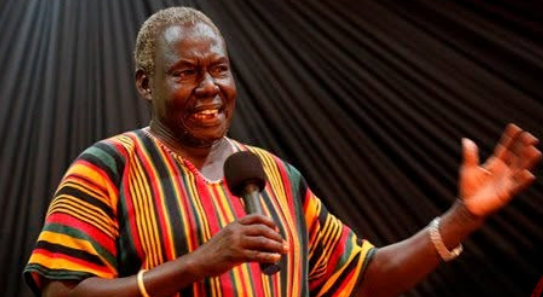
He was arguably the father of theatre in South Sudan. For the 83 years that he lived on earth until his passing on September 27, Joseph Abuk Diori made the world his stage. He was an actor, dramatist, poet, folklorist, storyteller, essayist, cultural activist, director of stage plays, a great conversationalist, entertainer, singer, dancer – all rolled into one.
His greatest love was drama. His humour was infectious. Whatever he said was tinged with dramatic humour. In spite of himself, he even dramatized his own invisible and physical pain. He had liberal views of life and of mortality itself. This was largely because of his expanded worldview.
Abuk fell into the bracket of South Sudanese born or raised in war and, alas, died when the ashes of war are still warm. He was among young Southern Sudanese students who sought refuge in Uganda in the early or mid-1960s. He was among a batch that was settled in Bombo, giving the urban refugee settlement a veritable moniker, Bombo Sudanese. To the young refugees, Bombo was like home away from home, as there was already a sizeable community of ex-Sudanese, also known as Nubi, descendants of southern Sudanese who were drafted by the British colonial administration into World War II.
His path might not have crossed with that of John Garang, who had proceeded to Dar es Salaam, Tanzania. But he certainly might have bumped into people such as the late Samson Kwaje Lukare, the late Jim Lemi Milla, and many compatriots who were later to shape the politics and civil service of the southern semi-autonomous regional government after the Addis Ababa Agreement of 1972 that ended the first civil war.
Abuk’s love for drama might have been nurtured during his exile days, and, to be precise, in Gulu in northern Uganda, the birthplace of celebrated Ugandan poet, Okot p’Bitek, who had pioneered the Gulu Cultural Festival in the late 1960s.
As a school teacher in Gulu, Abuk followed in p’Bitek’s footsteps by not only promoting drama and poetry in schools, but also by organizing successful cultural festivals.
When he returned to Juba before the collapse of the Idi Amin regime, he came with the fire of cultural awakening. The first war was over, and it was time for the cultural foot soldiers, so to speak, to pick up the mantle to fertilize South Sudan’s cultural environment and to disprove those who said South Sudanese had no culture.
He and other like-minded cultural luminaries such as the late Albino Okeny, Naomi Arona – who later joined the SPLA and was among the first female martyrs – pioneered the formation of Juba’s first drama group, Skylark, in 1978 (circa). The group performed before live audiences mainly in Juba. Skylark was a success among intellectual circles because they performed in English.
By then, Abuk was an employee of the Ministry of Information and Culture, and Director of the Nyokuron Cultural Centre. He made the Centre live up to its name, leaving a vibrant legacy.
During the liberation war, he remained in Juba and was outspoken on political matters, during which he had run-ins with the Khartoum regime operatives in the early 1990s. Although he was detained a few times, the worst would have happened to him, but the intervention of powerful church leaders by then, pressure groups, and his maternal uncle, Makelele Nyajok, who was a veteran police officer, secured his release and kept him away from the clutches of bloodthirsty army officers such as Colonel Ibrahim Shams Eldin.
Having lived through two debilitating civil wars and understanding the psychology of war or conflict, Abuk embraced drama for trauma healing and as a liberating force.
As a village boy in Tali, his uncle Makelele Nyajok requested that he be brought to stay with him in Juba in the 1950s. In the company of older relatives, poor Abuk trekked all the way from Tali to Juba to start school. He studied in Arabic and was equally fluent.
Influenced by Okot p’Bitek, Abuk relied on and borrowed largely from his ethnic Mundari oral tradition. Hence, his poetry was influenced by Mundari songs and epics of the cattle camps, fishing swamps, the traditional dance and wrestling arenas, etc.
Abuk’s long journey in life was adventurous, eventful, but also wrought with political upheaval. He used to produce and host a cultural program on national television, gave seminars to budding actors at the University of Juba, and gave radio interviews.
During this year’s Mundari Cultural Festival in Terekeka, he was an animator and keynote speaker about Mundari culture – which was more or less like his last word. In his spare time, even as he was slowed down by illness, he wrote poetry, plays, and drama skits. He must have left a trove of unpublished manuscripts.
A few months before the declaration of South Sudan’s independence, there was a call for South Sudanese writers and poets to submit poems that could be adapted as the national anthem of the new country. Abuk and a team of prominent poets and musicians were selected to oversee the process. Emphasis must be made here that the national anthem was a collaborative work of various poets. Abuk’s team fine-tuned the final anthem.
One of his greatest successes came in 2012 with the translation into Juba Arabic of William Shakespeare’s romantic play, Cymbeline, which was performed at the Globe Theatre in London. He and the late Derek Uya Alfred of the Kwoto Cultural Group directed the play.
Abuk influenced and inspired generations of actors, dramatists, and other visual and creative artists.
The country has lost a giant who will be sorely missed. Go well, Matat Abuk.

 and then