



Elections are often portrayed as the ultimate expression of democracy, as if simply casting a vote is enough to give a government legitimate political authority. This assumption, however, is deeply flawed. Democracy goes far beyond the ballot box. It depends on political freedom, institutional accountability, genuine political competition, and respect for constitutional arrangements. When elections take place in an environment marked by repression, political exclusion, and deliberate manipulation of institutions, they cannot be taken as evidence of genuine democratic progress. Instead, electoral processes risk becoming tools that authoritarian governments use to create an appearance of legitimacy while maintaining the very conditions that prevent democracy from taking root. This is precisely what President Salva Kiir has been doing in South Sudan.
This authoritarian contradiction is evident in Kiir’s approach to the September 2018 Revitalized Peace Agreement. Since its signing, his government has repeatedly undermined the agreement through inadequate funding of peace implementation mechanisms, unilateral political decisions, and the removal or replacement of opposition-nominated officials without the consultations and consensus required under the agreement. Having weakened the very framework intended to facilitate a peaceful political transition, Kiir had sought to proceed with elections scheduled for December 2026 even as opposition leaders, including suspended First Vice President Dr. Riek Machar, faced prosecution on charges that most ordinary South Sudanese have characterized as politically motivated.
The government’s subsequent cancellation of the planned elections has exposed the fragility of its electoral ambitions and raised even more fundamental questions about the country’s political future. The question, therefore, is no longer simply whether South Sudan will hold elections, but why the government pursued an electoral process under conditions that raised serious questions about its credibility, only to abandon the planned vote. Elections and their cancellation risk becoming part of a wider political crisis that deepens the country’s political divisions, insecurity, and ethnic tensions.
Political manipulation often disguises itself as constitutional progress. In September 2026, Kiir’s government dissolved the transitional unity government and replaced it with a caretaker administration, while amendments to the National Elections Act removed important prerequisites for holding elections, including the completion of a permanent constitution and a national census. These decisions were not made to advance peace or democratic elections; rather, they reflect the practices of authoritarian rule. They also raise fundamental questions about the purpose of the transition and whether electoral preparations are being prioritized over the commitments that originally justified the peace agreement. Removing institutional safeguards does not resolve political disagreements; it merely creates conditions under which those disagreements can become more dangerous. A government cannot claim democratic legitimacy by dismantling the very political arrangements designed to guarantee an inclusive transition.
The cancellation of the elections makes these concerns even more consequential. Rather than resolving the political disagreements that undermined the electoral process, the government’s decision leaves South Sudan facing renewed uncertainty over the direction and duration of its political transition. It also raises questions about whether the institutions responsible for organizing credible elections were ever adequately prepared to fulfill that responsibility. The central problem is that the government appeared determined to move toward an electoral outcome without first addressing the political and institutional weaknesses that threatened its legitimacy. The cancellation has therefore exposed a contradiction that existed long before the announcement: the pursuit of elections without the political conditions necessary to make them meaningful.
The prosecution and detention of opposition leaders further undermine the credibility of the proposed elections. Political competition requires that opposition figures be free to organize, campaign, criticize government policies, and present alternative political visions without fear of persecution. When prominent opposition leaders are detained and prosecuted while the government prepares for elections, the distinction between political competition and political elimination becomes difficult to ignore. Machar’s continued detention has also become a major obstacle to meaningful dialogue, with his political movement insisting that his release is necessary for participation in negotiations. An election that excludes significant political actors cannot credibly claim to represent the collective will of the South Sudanese people.
The cancellation of the elections does not, however, resolve the political crisis or exclusion that had already undermined the proposed process. The ongoing militarization of opposition-controlled areas raises further concerns about the government’s intentions. Reports and accounts from citizens in areas surrounding various Sudan People’s Liberation Army-in-Opposition (SPLA-IO) strongholds describe strategic deployments of the South Sudan People’s Defence Forces (SSPDF), heightening fears that military positioning is becoming part of the broader political crisis surrounding the abandoned electoral process. Residents in these areas, particularly in Jonglei, Upper Nile, and Unity states, express concern that government forces could be used to intimidate communities and compel participation in elections they neither trust nor consider legitimate. Some citizens believe the government is determined to impose an electoral process that enjoys little confidence beyond its own supporters. If these fears materialize, the broader political crisis could further undermine public confidence in the possibility of a peaceful transition. An election cannot be considered democratic when citizens fear the consequences of refusing to participate or questioning the legitimacy of the process.
On November 11, 2026, this author was informed by three sources residing in Nyirol and Akobo counties, Jonglei State, that units of government forces had positioned themselves near locations close to SPLA-IO bases. “There are clear signs of preparations and fighter mobilizations on both sides. It is now only a matter of time before war breaks out,” one resident declared. In addition, on November 7, 2026, a resident of Leer County, Unity State, told me that the war was already underway, asserting that government forces and their militia-aligned groups had been exchanging fire with forces loyal to the SPLA-IO.
These accounts illustrate the security concerns that were already emerging as the government pursued its electoral plans. The cancellation of the elections does not automatically eliminate the danger of renewed armed confrontation. Indeed, the continued presence of opposing forces, combined with the absence of a credible political settlement, leaves communities vulnerable to further violence.
One confidential source within the National Security Service (NSS) told me that elections will likely proceed, given the government’s determination to secure its own electoral victory and claim legitimacy. This argument deserves consideration, particularly in light of the frustration of citizens who have waited years for democratic representation. However, bringing a prolonged transitional period to an end is not the same as achieving a legitimate political settlement. Elections held without political consensus, adequate security arrangements, independent institutions, and meaningful opposition participation would merely transfer unresolved political disputes to the electoral arena, with little prospect of resolving them.
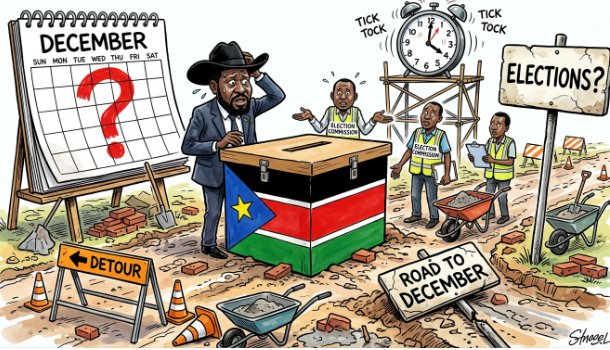
Kiir’s eventual cancellation of the planned elections also demonstrates why the assumptions surrounding the electoral timetable deserved closer scrutiny. The determination to proceed, as described by my source, did not necessarily translate into the institutional capacity or political consensus required to make elections possible. The gap between political ambition and practical preparedness was one of the central weaknesses of the proposed process.
The United Nations Commission on Human Rights in South Sudan has warned that elections held without essential safeguards and genuine dialogue could fuel renewed conflict and atrocity crimes. Similarly, the United Nations Mission in South Sudan (UNMISS) has raised concerns about the security situation, logistical preparations, political participation, and outstanding commitments under the peace agreement. These warnings cannot reasonably be dismissed as opposition propaganda or hostility toward democratic progress. Rather, they reflect realities that ordinary South Sudanese have long recognized.
The cancellation of the elections makes these local, regional, and international concerns relevant. It reinforces the need to address the political, security, and institutional obstacles that had cast doubt on the credibility of the electoral process. The cancellation should not be treated as an isolated administrative decision; it must be understood within the broader context of an unfinished peace agreement, persistent political divisions, and the failure to establish the conditions necessary for a credible democratic transition.
The consequences of a contested election in South Sudan extend far beyond political disagreements in Juba. The country remains burdened by armed confrontations, displacement, humanitarian suffering, and deep mistrust among political communities. When political institutions fail to provide credible mechanisms for resolving disagreements, communities become increasingly vulnerable to the consequences of elite political competition. The uncertainty created by the cancelled elections could further deepen these divisions, particularly if significant political actors and segments of the population lose confidence in the possibility of an inclusive political settlement.
The danger is not that elections inherently produce violence, but that elections conducted under conditions of exclusion, insecurity, and institutional distrust can become another source of confrontation. South Sudan has already paid an enormous price for political failures; its citizens should not be made to pay yet another price for the authoritarian decisions and political blunders of Salva Kiir.
The cancellation of the December 2026 elections should therefore be understood not as a resolution of South Sudan’s political crisis, but as another indication of how deeply the country’s transitional arrangements have deteriorated. The immediate question is no longer how the government will secure an electoral victory, but how it intends to restore political confidence, rebuild consensus, and prevent the continuing crisis from degenerating into another cycle of armed conflict.
If Salva Kiir is determined to proceed with his government’s preferred political arrangements, he must also confront the bloody history and consequences of the political crisis that has defined his rule. December 2013 was written in blood; nearly thirteen years of conflict, displacement, and human suffering have added countless more chapters to that tragedy. He cannot pretend that an election can erase this history, silence legitimate grievances, or manufacture public consent where political trust has long collapsed. Nor can the cancellation of an election erase the political grievances that made the proposed process so contentious in the first place. The question is not simply whether Kiir can organize elections, but whether he can demonstrate that the people he claims to represent actually want them under the prevailing political conditions.
If he genuinely believes that South Sudanese citizens are eager for elections, he should begin by explaining the extraordinary rejection reportedly experienced by his own SPLM-IG candidates during recent party primaries in Upper Nile, Jonglei, and Unity states. Reports that some candidates received as few as one vote while many others were rejected raise serious questions about the party’s grassroots support and the credibility of its claims to popular legitimacy. Why should a government that cannot convincingly demonstrate the confidence of its own party supporters presume to speak for an entire nation?
Elections are not a substitute for public consent, and a ballot box cannot manufacture legitimacy. South Sudan does not need another political exercise designed to preserve power while leaving the causes of war unresolved. It needs an inclusive political settlement, genuine reconciliation, and a credible path toward peace. No election is worth sacrificing another generation of South Sudanese to violence.
The fundamental problem, and perhaps the central contradiction in Kiir’s approach, is that his government appears determined to pursue an electoral outcome while neglecting the political conditions necessary to make that outcome meaningful. Peace agreements are not ceremonial documents to be invoked when convenient and disregarded when they constrain those in power. Their legitimacy rests on implementation, consultation, compromise, and accountability. A government cannot systematically weaken a negotiated political framework and then expect elections conducted under the altered conditions to command universal acceptance. That is not a democratic transition; it is the political consolidation and management of power under the guise of constitutional legitimacy. In essence, it is tyranny dressed in democratic clothing.
South Sudan does not merely need elections; it needs elections that can genuinely deliver democratic accountability, political inclusion, and lasting peace. The cancellation of the December 2026 elections should serve as an opportunity to reconsider the country’s political priorities rather than as an excuse to prolong the existing crisis without a credible roadmap. Political opponents remain marginalized, peace commitments remain unfulfilled, and security arrangements remain incomplete. Unless these challenges are addressed, any future attempt to organize elections risks reproducing the same political divisions and institutional weaknesses that contributed to the failure of the December 2026 electoral timetable. The people of South Sudan have endured enough war. Millions remain displaced in refugee camps in Sudan, Ethiopia, Uganda, and Kenya, while hundreds of thousands continue to live in UN-run sites within the country. Any reasonable leader should understand the gravity of this situation. South Sudan’s nearly 13-year-old conflict is not just a South Sudanese crisis; it is an East African problem. Yet President Kiir appears determined to protect his hold on power by perpetuating the very crisis that continues to devastate the country.
Democracy cannot be manufactured through electoral ceremonies, nor can peace be secured through the exclusion of political rivals. The cancellation of the December 2026 elections must not become another opportunity for entrenched political power to evade accountability while ordinary citizens continue to bear the consequences of political failure.
When dictatorship wears democratic clothing, the ballot box risks becoming an instrument of political deception rather than a genuine expression of popular sovereignty. South Sudan’s greatest challenge is no longer simply the failure to hold elections; it is the failure to build the political conditions under which elections can become a credible expression of the people’s will.
The writer, Duop Chak Wuol, is an analyst, critical writer, and former editor-in-chief of the South Sudan News Agency. He is a graduate of the University of Colorado and writes on geopolitics, security, and social affairs in South Sudan and the broader East African region. His work has appeared in leading regional and international outlets, including AllAfrica, Radio Tamazuj, The Independent (Uganda), The Arab Weekly, The Standard (Kenya), The Chronicle (Ghana), Addis Standard (Ethiopia), and Sudan Tribune. In 2017, the Ethiopian Broadcasting Corporation highlighted his article on Meles Zenawi’s role in Ethiopia’s economic transformation. He can be reached at duop282@gmail.com.
The views expressed in ‘opinion’ articles published by Radio Tamazuj are solely those of the writer. The veracity of any claims made is the responsibility of the author, not Radio Tamazuj.

 and then