



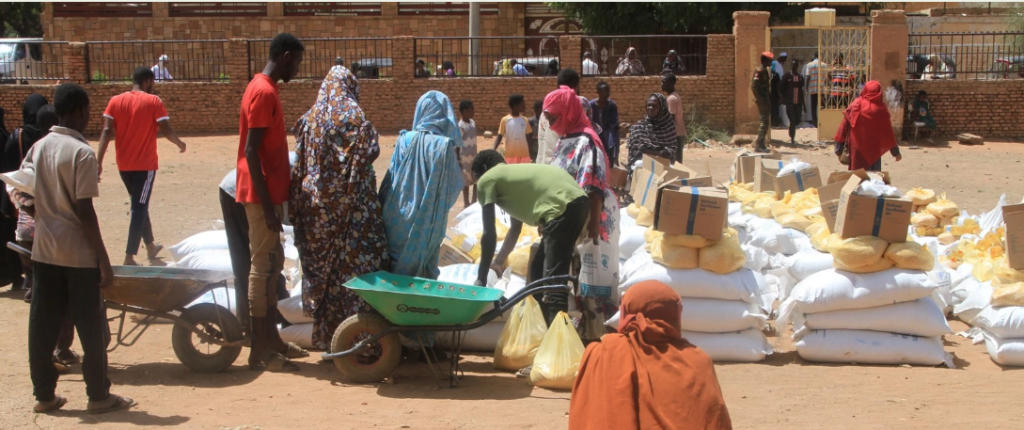
Humanitarian aid supplies in Sudan could run out within weeks because of a lack of funding, the International Organization for Migration (IOM) has warned.
The agency said on Monday that shelter, sanitation and emergency household supplies could be depleted by the end of September, leaving hundreds of thousands of displaced people without essential assistance amid continuing fighting and heavy rains.
“We simply can’t turn our back on the people of Sudan when they need us most amid raging conflict, increased displacement and the impact of heavy rain,” IOM Director General Amy Pope said.
“The entire humanitarian system could collapse within weeks if we don’t act now. Without new funding, we won’t be able to get help where it’s needed most,” she added.
The IOM said 8.6 million people remain internally displaced across Sudan, while 4.9 million people have returned to their areas of origin, according to its Displacement Tracking Matrix.
Nearly 70% of internally displaced people are living with host families or in informal settlements, the agency said.
Fighting, flooding and heavy rains have damaged shelters and forced some displaced people to move again.
The IOM-managed Common Humanitarian Pipeline has provided emergency supplies to 2.84 million people since July 2023.
However, the number of people receiving assistance has fallen as funding has declined. More than one million people received support through the pipeline in 2024, compared with 804,000 in 2025. So far this year, about 330,000 people have received shelter and emergency household kits.
The IOM said its warehousing and operational capacity could be maintained only until December without additional funding.
The Common Humanitarian Pipeline is a shared logistics system used by the UN and other humanitarian organisations to deliver emergency supplies through more than 100 registered partners.
The agency warned that an interruption could significantly reduce the ability of aid organisations to respond quickly to people affected by the conflict.
The IOM is seeking $15m to maintain the pipeline at its minimum 2026 capacity for 12 months, which would support about 305,000 people.
It says $27m would restore assistance to approximately 2025 levels and reach about 570,000 people, while $42m would allow it to provide emergency support to up to one million people.
The agency also warned that inadequate shelter increases the risks faced by displaced families, including exposure to extreme weather, disease, insecurity, gender-based violence and further displacement.
Sudan has been at war since April 2023, when fighting broke out between the army, led by Gen Abdel Fattah al-Burhan, and the paramilitary Rapid Support Forces (RSF), commanded by Gen Mohamed Hamdan Dagalo.
The conflict has displaced millions of people and created one of the world’s largest humanitarian crises.

 and then