



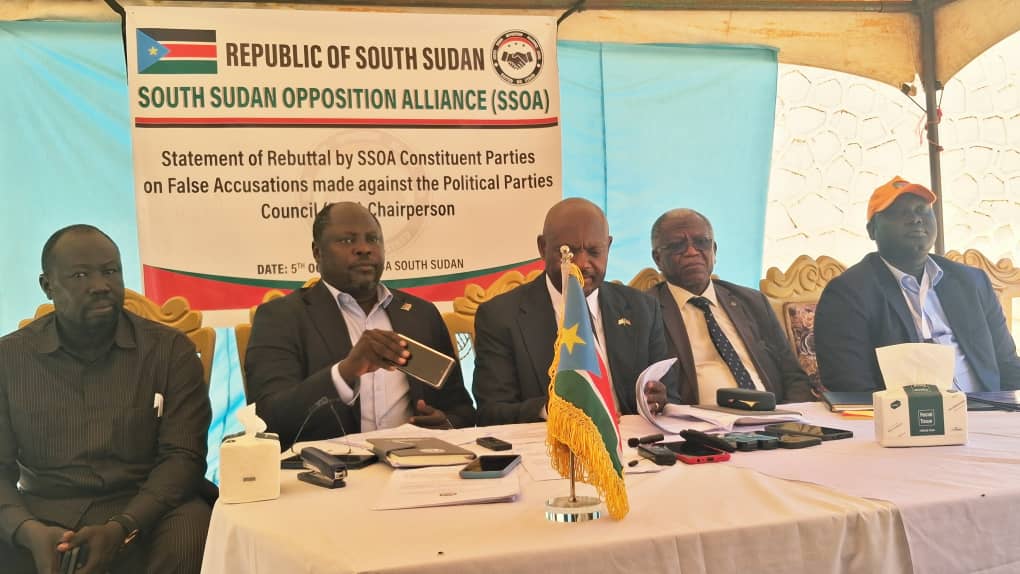
A faction of the South Sudan Opposition Alliance (SSOA) has defended the registration of seven of its constituent political parties, saying their leaders had relinquished military command and met legal requirements to operate as civilian organisations.
The faction accused rival SSOA groups of seeking registration with the Political Parties Council (PPC) without meeting the same requirements.
The SSOA is divided into two main factions, with several splinter groups aligned with either side. One faction, led by former Vice President Hussein Abdelbagi Akol, is widely seen as being close to the ruling Sudan People’s Liberation Movement (SPLM), while the other is led by former Vice President Josephine Lagu.
The dispute follows accusations by the National Democratic Movement (NDM), led by Lam Akol, and the South Sudan National Movement for Change (SSNMC), led by Moro Isaac Genesio, that the PPC had fraudulently altered their registration records and registered other parties without meeting legal requirements.
NDM and SSNMC are among the constituent parties of the SSOA faction led by Lagu.
Speaking on behalf of the seven parties, SSOA faction Secretary-General Changkuoth Bichiock said in Juba on Monday that the groups had begun and substantially completed their registration with the PPC before the June 30, 2026, deadline.
The seven parties include the South Sudan Patriotic Movement (SSPM), SSNMC, Federal Democratic Party (FDP) and National Salvation Front (NASF), led by Gassim Barnaba Kisanga, among others.
Bichiock said the registration process had been delayed because some of the parties had previously been associated with military wings and their leaders first had to relinquish military command before the groups could operate solely as civilian political organisations.
“The seven political parties in question have complied fully with this requirement and have clearance from the authority concerned that indeed their forces have been received and integrated into regular forces under one central command,” Bichiock said.
He said the leaders of the seven parties relinquished military command in December 2025 and surrendered their forces to the commander-in-chief of the regular forces.
Bichiock cited Section 26 of the Political Parties Act of 2012, as amended in 2022, which prohibits political parties from establishing covert or military formations, armed forces or paramilitary forces.
He said the PPC had not arbitrarily added the seven parties to the register after the deadline, but had completed registration processes that had been delayed by what he described as a legal impediment.
Bichiock accused groups associated with Lam Akol and Moro of failing to meet the same requirement, alleging that they continued to maintain independent military structures while seeking registration as political parties.
“The law does not discriminate. It applies to all,” he said.
He called on Lam Akol and Moro to relinquish their military structures and comply with the law if they wanted their political organisations registered.
Clement Juma Mbugoniwa of the SSNMC said the seven parties had followed the legal procedures required for registration under South Sudan’s laws and the 2018 peace agreement.
“There are legal requirements that you must follow, and one of those legal requirements is governed by the R-ARCSS itself, the Political Parties Act and the Constitution,” Mbugoniwa said, referring to the Revitalised Agreement on the Resolution of the Conflict in South Sudan.
“We are committed to civil politics because that’s what the South Sudanese people are demanding from us,” he said.
Gassim Barnaba of the National Salvation Front said his group had also transitioned from a military movement into a political organisation.
“If you don’t relinquish your forces, they will not be cleared,” Barnaba said.
He said political parties should not retain military wings because doing so could intimidate civilians.
“Everybody who has a military wing should not practice politics because it is, in a way, intimidating your people,” he said.
The dispute comes as South Sudan prepares for elections scheduled for Dec. 22, after years of delays under the country’s transitional political arrangements.

 and then