



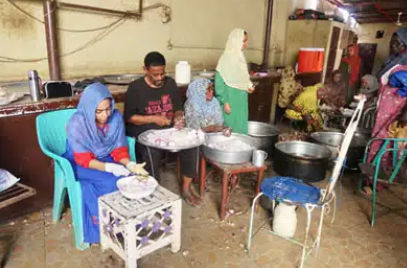
Humanitarian activists and community representatives in Sudan’s Blue Nile Region have called for the resumption of operations of local Emergency Response Rooms (ERRs), whose activities were suspended earlier this year by the region’s Humanitarian Aid Commission (HAC).
The calls are prompted by mounting humanitarian needs and fresh waves of displacement, which are placing increasing pressure on already overstretched relief services.
The suspension has raised concerns about a widening gap in humanitarian assistance, particularly amid growing complaints over shortages of food supplies, drinking water and shelter materials, while other local initiatives struggle to respond to the escalating needs of displaced communities.
Jamal Abdallah, a volunteer with the Geissan Emergency Response Room, told Radio Tamazuj that the initiative had previously provided a range of humanitarian services, including food baskets, shelter materials, assistance tailored to women’s needs and mental health support.
“Volunteers were taken by surprise when the Humanitarian Aid Commission in Damazin ordered the suspension of the emergency rooms’ activities last April, without adequately assessing the potential consequences,” he said. “The decision has had serious repercussions for displaced people and other communities that previously relied on the services.”
“The suspension exacerbated the suffering of displaced families, particularly those sheltering in forests and open areas, whom volunteers had been able to reach because of their mobility, flexibility and close connections with local communities,” Abdallah added.
He expressed hope that the initiatives would be allowed to resume their operations soon.
The appeals come as the Blue Nile Region experiences renewed displacement from areas affected by military confrontations, including villages and communities in Bau and Kurmuk localities.
Among the affected areas are Jam, Bau, Soda, Balang, Samsour and Residential Villages 12 and 10, amid fears that continued fighting could trigger further displacement and intensify pressure on the region’s limited shelters and humanitarian initiatives.
At one displacement center in Damazin, families are struggling with deteriorating living conditions as humanitarian assistance continues to decline.
Ali Abdin, a displaced resident from the Al-Keili area in the northern part of the region who is currently sheltering at Al-Karama 3 camp, told this publication that the war had inflicted considerable suffering on his family.
“My children remained in areas controlled by the Tasis Alliance, and I have lost contact with them,” he lamented. “My family is experiencing hunger following the suspension of humanitarian assistance, while the scarcity of employment opportunities has made it increasingly difficult for me to provide their basic needs.”
Meanwhile, Ayman Ahmed, an activist, criticized the Humanitarian Aid Commission’s decision to suspend the Emergency Response Rooms, saying the authorities had failed to provide what he considered a convincing explanation.
He stressed the importance of allowing the initiatives to continue delivering essential services to displaced communities and facilitating the distribution of humanitarian assistance.
“The volunteers possess extensive experience in humanitarian work and have played an important role in supporting conflict-affected populations, drawing on their familiarity with local communities and their ability to reach people in need quickly,” Ahmed stated. “The regional government should authorize the reactivation of the Emergency Response Rooms and draw on their experience to accelerate humanitarian operations and improve the distribution of relief supplies.”
He also referred to reports suggesting that relief supplies were available in the commission’s warehouses.
In a related development, the commissioner of Bau locality had previously issued a decree authorizing the resumption of activities by the locality’s Emergency Response Room amid an increasing influx of displaced people.
Radio Tamazuj was unable to obtain a response from the Blue Nile Region’s Humanitarian Aid Commission regarding the reasons for suspending the emergency rooms or its position on growing calls for their reactivation.
The locally led initiatives have previously played a significant role in reaching vulnerable communities and delivering essential assistance, prompting renewed appeals for stronger coordination and a humanitarian response commensurate with the region’s growing needs.

 and then