



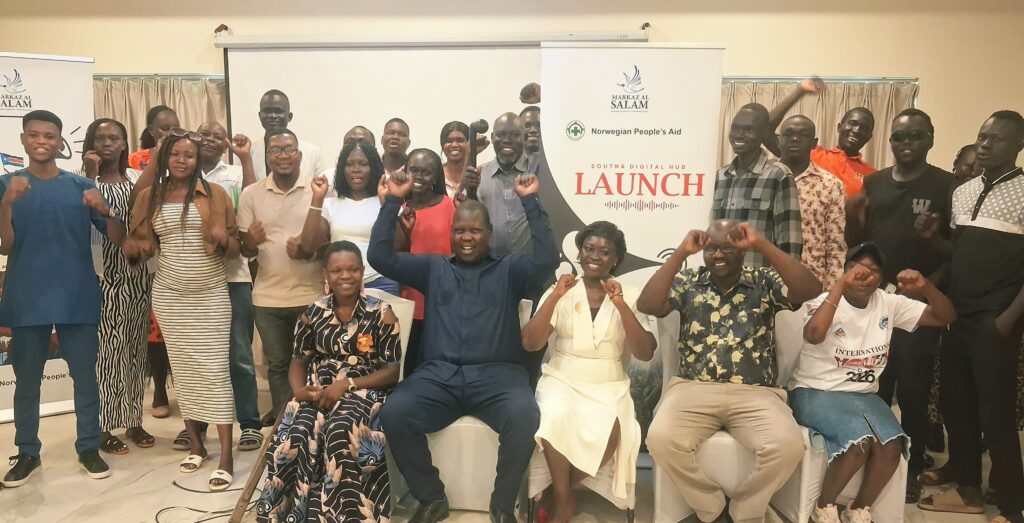
Youth-led organisation Markaz Al Salam has launched an online platform, SOUTNA, to promote the participation of women and young people in peaceful elections through digital engagement and storytelling.
The platform, available at https://soutnasouthsudan.info/, aims to provide women and young people with a space to share their experiences, challenge harmful narratives and contribute to peaceful elections in South Sudan.
Speaking at the launch in Juba on Friday, Markaz Al Salam Executive Director Florence Agiba said the initiative would help young people and women use digital platforms to promote peace, social cohesion and responsible civic engagement.
“SOUTNA is more than a project. It’s an opportunity to reclaim our digital spaces, amplify our voices, and use the power of storytelling to promote peace, social cohesion, responsible civic engagement, and inclusive participation,” she said.
Agiba said social media had become an influential space for shaping public opinion, particularly among young people, but warned that it is also being used to spread misinformation, hate speech and divisive messages.
“SOUTNA seeks to change that narrative. Through youth-led digital engagement, fact-checking, responsible content creation, and peace building, we want to demonstrate that young people can be part of solutions rather than merely spectators in the challenges facing our country,” she said.
She said the initiative would use digital content, including short videos, podcasts, photographs and social media posts, to promote peace and encourage responsible civic engagement.
With South Sudan approaching another important period in its democratic journey, Agiba called for greater participation by women and young people in the country’s political processes.
“As South Sudan approaches another important period in its democratic journey, women and young people must not remain spectators. Their voices must be heard, and their participation must be meaningful,” she said.
She urged stakeholders to continue advocating for the 35% affirmative action for women and the 20% youth representation target provided for in the National Youth Development Policy.
“These are not simply numbers. They represent the need for inclusive leadership and equal opportunities in shaping our country’s future. This is why SOUTNA matters,” she said.
Agiba also challenged South Sudanese social media influencers and established content creators to support local initiatives and collaborate with young people to promote homegrown talent.
“However, influence should come with responsibility. We cannot continue preaching support for local talent while making collaboration difficult for every initiative that is trying to create opportunities for others,” she said.
She encouraged young people to attend networking events, training sessions and public dialogues, saying such opportunities could help them develop skills and build professional relationships.
“Sometimes the greatest opportunity is simply being in the room,” she said.
Agiba thanked Norwegian People’s Aid (NPA) for supporting the initiative and investing in young people’s contribution to peacebuilding through innovation and digital engagement.
“Your support is helping us create spaces where local talent can grow, where young people can use their voices constructively,” she said.
She called on South Sudanese to support local talent and initiatives, saying collective efforts were necessary to build a peaceful and inclusive society.
“We cannot keep asking the world to recognize our talent when we are not willing to recognize, support, and invest in one another,” she said.
NPA Project Coordinator Michael Gorjin urged young people to use the platform to advocate for the 20% youth representation target outlined in the National Youth Development Policy.
“Now, what is left is the implementation of the youth policy. The youth policy called for 20% allocation of youth in all levels of government,” Gorjin said.
He urged young people to avoid hate speech and use peaceful engagement to demand their rights, saying confrontation would not help the country move forward.
Meanwhile, South Sudan National Youth Union Deputy Chairperson Motwakil Awol Mamour encouraged young people to register as voters ahead of the upcoming elections.
“As a youth, we constitute more than 72% of the population. If youth and women vote wisely, they can decide the future of this country,” Mamour said.
He urged content creators to use social media responsibly and positively, saying: “Your phone is stronger than a gun.”
Mamour also called on young people to promote peace and avoid messages that could fuel hatred and division.
South Sudan has a predominantly young population, with about 73% of its people under the age of 30, according to government population projections. The National Youth Development Policy, passed in October 2025, provides for 20% youth representation in national and state governments.

 and then