



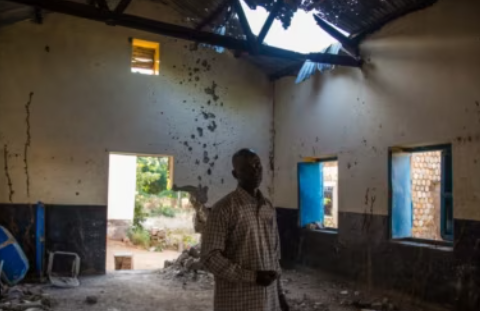
Despite ongoing conflict, insecurity and widespread displacement, a total of 3,728 pupils from Sudan’s Nuba Mountains region have sat their primary school certificate examinations in neighbouring South Sudan, according to regional education authorities.
Jamal Abdallah Kalo, Director-General of Education in the Nuba Mountains Region, said schools reopened for the first term on 1 October 2026. However, schools in Heiban County remained closed because of deteriorating security conditions and displacement that began in May.
He explained that schools had been completely shut down in the Kauda and Debi payams, while those in Kambor and Heiban had experienced partial closures.
In an exclusive interview with Radio Tamazuj, Kalo said the regional education administration had managed to register 3,794 pupils for the primary school certificate examinations despite the difficult circumstances.
“The registered candidates included 1,913 boys and 1,815 girls. Of the total registered candidates, 3,728 sat the examinations, while 66 were absent, including 25 boys and 41 girls, as a result of the ongoing insecurity in Heiban County,” he stated. “The examinations were administered at nine centers in South Sudan’s Ruweng Administrative Area, including five centers in Pariang and four in Yida.”
The examinations began on 16 November and concluded on 20 November 2026, with mathematics as the final subject.
He identified delays in holding the examinations according to the original timetable as one of the principal challenges facing pupils.
Turning to secondary education, Kalo said 1,213 students from the Nuba Mountains Region had registered for South Sudan’s secondary school certificate examinations, scheduled to begin on Monday, 23 November 2026.
The candidates comprise 687 boys and 526 girls drawn from 15 schools across the region’s 14 counties.
He added that the Nuba Mountains Region currently has 346 primary schools and 29 secondary schools.
Kalo said the regional education administration continued to face substantial challenges in maintaining educational services, particularly shortages of school supplies and teaching materials, many of which had been destroyed during the events in Kauda.
He also highlighted the urgent need for teacher capacity-building, noting that teacher training institutes across the region had ceased operating.
Other challenges include inadequate learning environments, with many schools constructed from locally available materials, as well as difficulties in providing financial incentives for teachers.
Despite these constraints, Kalo said the regional education administration, working in collaboration with several organizations, had established a number of schools to accommodate pupils and students displaced from Heiban County by intercommunal conflict.
The schools were opened in Tobo, Agiri Camp in Anbong County, Al-Hilu Camp in Dalami, and Kain Camp in Heiban County.
He added that the education authorities had developed a plan to address the needs of pupils and students affected by the conflict across Heiban County’s payams.
Kalo urged pupils and students to persevere with their education despite the prevailing hardships.
He also called on teachers to remain dedicated and impartial in carrying out their responsibilities, emphasizing their fundamental role in nurturing future generations and providing leadership within their communities.
He appealed to parents to support teachers and urged humanitarian and development organizations to contribute towards improving school infrastructure and providing essential educational supplies.
Kalo expressed appreciation to the regional government and county commissioners for facilitating the transportation of more than 4,000 primary and secondary school candidates to examination centres in South Sudan’s Ruweng Administrative Area.
He also thanked the Government of the Republic of South Sudan for its hospitality and support in hosting students from the Nuba Mountains who are sitting this year’s examinations.

 and then