



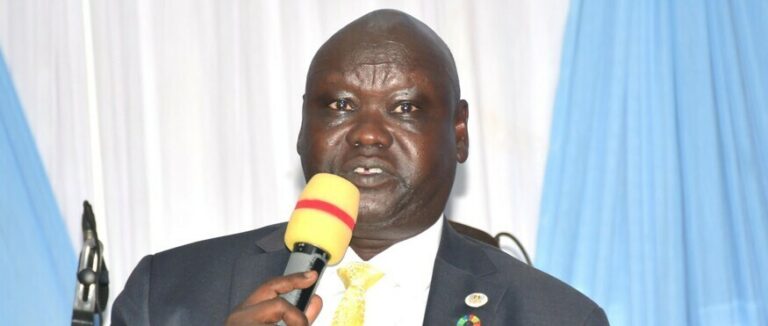
The SPLM-IO Interim Leadership in Juba, led by Caretaker Peacebuilding Minister Stephen Par Kuol, on Friday rejected the decision by the National Elections Commission (NEC) to postpone general elections by nearly two months, describing it as unlawful and warning that it could reconsider its participation in the polls.
The NEC has rescheduled the elections from Dec. 22, 2026, to Feb. 11, 2027. The SPLM-IO, one of the registered political organizations in South Sudan, becomes the fourth party to reject the revised timetable, after parties led by Kornelio Kon, the African National Congress (ANC) and the Union of Sudan African Parties (USAP).
Speaking at a news conference in Juba, SPLM-IO Interim Leadership Deputy Chairperson Lasuba Loduro Wongo said the commission had failed to provide sufficient legal grounds for changing the election date.
“The SPLM-IO therefore categorically rejects the National Election Commission’s decision to change the South Sudan general election from the original date stated timeframe of 22 December 2026,” Wongo said.
He described the decision as “unilateral, deceptive, and unlawful”.
The NEC has cited provisions of the amended Election Act, including Sections 57(1)(c) and 60(1), which provide for postponement under specified circumstances, including imminent danger that makes polling impossible or a state of emergency declared under Article 189 of the Transitional Constitution.
Wongo said neither condition had been met.
“So far, there is no imminent threat or any declaration of a state of emergency that can justify any alteration of the set election date,” he said.
He said the party’s expanded leadership had discussed the revised timetable at a consultative meeting on Nov. 16 attended by political bureau members, national leadership advisers and state chairpersons.
Wongo called on President Salva Kiir to initiate inclusive political dialogue involving parties to the 2018 revitalised peace agreement, the NEC, the Political Parties Council and other relevant institutions.
The party also demanded that the commission publicly explain the legal basis for changing the electoral calendar and disclose details of consultations held before the decision.
“The SPLM-IO maintains that election in a post-conflict society such as South Sudan must be founded on broad political consensus, mutual trust, and confidence among political stakeholders. The elections are not merely an administrative exercise,” Wongo said.
Participation concerns
Despite rejecting the revised timetable, Wongo said the party remained committed to participating in elections, provided the process complied with the law.
“We are not rejecting the elections. We wanted to ensure that we have the rule of law,” he said, adding that respect for the law was essential to maintaining peace and stability.
Wongo accused the NEC of making a “gross mistake” by intervening in electoral laws.
He also raised concerns about restrictions on the movement of some SPLM-IO Interim Leadership members, saying the matter should be resolved without disrupting voter registration or determining the election timetable.
“All South Sudanese must go and register. That’s one activity of the Electoral Commission, which they announced recently. We all support it. It must continue. But the date for the election is illegal, and then we need that to be addressed,” he said.
Wongo warned that the party could reconsider its participation if its concerns remained unresolved.
“The SPLM-IO will not endorse or participate in an electoral exercise that is inadequately prepared, legally questionable, or incapable of producing legitimate democratic outcomes,” he said.
He also questioned the commission’s authority to make unilateral decisions, arguing that its establishment under the 2018 peace agreement required consultation with the parties to the accord.
“The National Election Commission cannot act independently because it was constituted under the terms of the revitalized agreement. So we cannot change that without consulting the parties to the agreement,” he said.
Asked about the African Union’s technical support to the NEC, Wongo declined to comment on the body’s position, saying he could not speak on its behalf.
At the news conference, the SPLM-IO Interim Leadership called for peace, constitutional governance and credible elections, warning against another political crisis.
“South Sudan needs peace, not another political crisis, constitutional governance, not indefinite transition, and the people of South Sudan want credible elections, not merely elections on elections,” he said.
The party also urged regional and international guarantors, particularly the Intergovernmental Authority on Development (IGAD), the African Union and the United Nations, to support implementation of the 2018 peace agreement and a peaceful democratic transition.
Wongo said the party was prepared for elections but wanted restrictions affecting some of its members resolved.
“We are highly prepared because we know that elections are going to be there on that day,” he said.
The rejection is politically significant because Par Kuol’s faction had previously cooperated with Kiir’s administration in implementing the 2018 peace agreement.
The interim leadership emerged in April 2025 following the detention of SPLM-IO chairman Riek Machar in March. Par Kuol subsequently led the faction and retained his position as peacebuilding minister after Kiir dissolved the transitional government on Sept. 22.
South Sudan’s elections, initially scheduled for Dec. 22, 2026, were expected to mark the end of the transitional period established under the 2018 peace agreement. The revised timetable has moved the vote to Feb. 11, 2027, amid continuing political disagreements over preparations for the polls.

 and then