



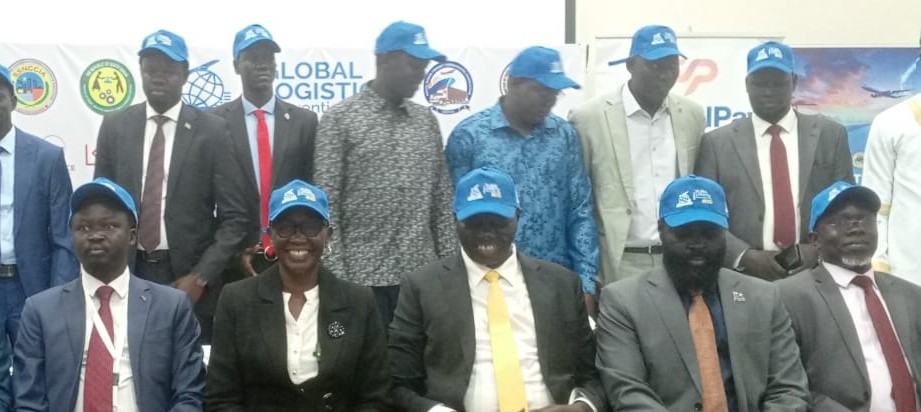
South Sudan will host the Global Logistics Convention (GLC) for the first time in August, bringing together about 1,000 trade, transport and logistics stakeholders from Africa and beyond to discuss investment, regional integration and trade facilitation, organisers said on Wednesday.
The three-day event, scheduled for Aug. 25–27 in Juba, is expected to attract freight forwarders, policymakers, investors, researchers and development partners seeking to strengthen transport and logistics networks across the continent.
“This is our time to shine as the South Sudanese business community,” said Deng Daniel Ayuen, president of the South Sudan Freight Forwarders Association, during a media briefing in Juba.
Ayuen said the convention would provide a platform for governments and the private sector to explore trade opportunities, address logistical bottlenecks and develop policies to boost cross-border commerce.
He said participants would also discuss ways to improve regional trade corridors, including export routes from South Sudan to neighbouring countries such as the Democratic Republic of Congo.
The convention is being organised in partnership with the Federation of East African Freight Forwarders Associations (FEAFFA), a regional body representing customs agents and freight forwarders across East Africa.
FEAFFA official Elias Bakulu said the annual event rotates among member states, adding that South Sudan is the only country in the federation that has not previously hosted it.
“We want to use this event as one of the marketing tools for the Republic of South Sudan to the rest of the world,” Bakulu said.
He said the convention will include policy discussions, business networking sessions, exhibitions and regional logistics awards recognising excellence in the sector.
South Sudan’s Minister of Trade and Industry, Dr. Labanya Margaret Mathya Ugila, said the logistics sector is a major source of employment for young people and that the conference would help showcase the country’s economic potential.
“South Sudan requires that,” she said, adding that such international conventions help improve the country’s image and signal that it is open for business and investment.
Mathya said logistics and trade remain central to economic growth in a country heavily dependent on imported goods and services.
She also highlighted government efforts to modernise trade systems through digitisation and streamlined border procedures, including the rollout of a one-stop border post supported by international partners.
Minister of Energy Agok Makur called for increased investment in the energy sector, saying reliable electricity is critical for industrial growth and trade.
“Our policy from day one is that we encourage and invite investors,” Makur said.
He said South Sudan currently generates only a fraction of the electricity required to meet national demand, pointing to the country’s hydropower and solar potential as key investment opportunities.

 and then