



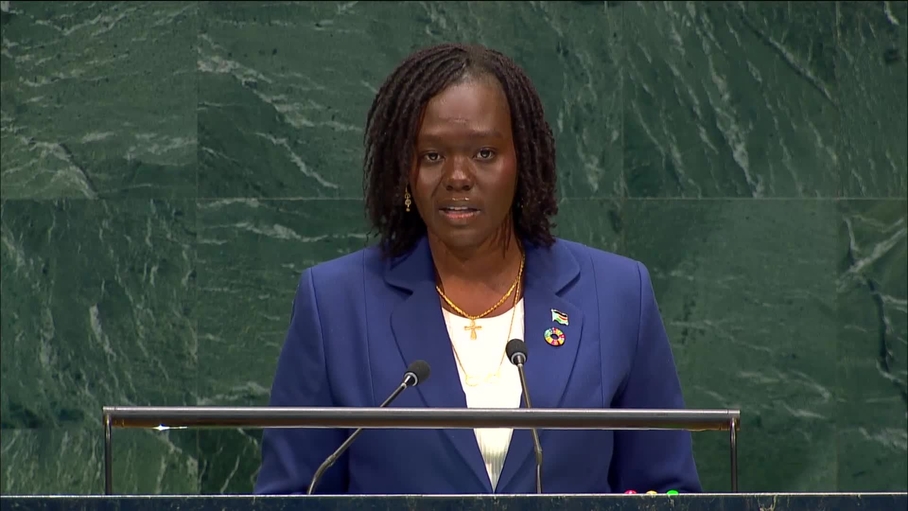
South Sudan has reaffirmed its commitment to holding general elections on 22 December, describing the planned vote as a key step towards ending the country’s prolonged political transition.
Cecilia Adut Manyok, chair of South Sudan’s delegation to the United Nations General Assembly and caretaker foreign minister-designate, told the 81st session of the assembly in New York on Monday that President Salva Kiir Mayardit remains committed to holding the elections.
She said the government recognises that significant work is still required, including voter registration, political dialogue, security preparations and civic education.
“These elections are intended to mark the conclusion of the transition period and provide the people of South Sudan the opportunity to choose democratically their own leaders,” Ms Manyok said.
Her address came less than a week after President Kiir dissolved the transitional unity government and appointed a caretaker administration, reshaping the country’s political landscape ahead of the planned vote.
Election pledge
Manyok said the South Sudanese government is committed to creating conditions for peaceful political competition.
“Political competition must never again become armed confrontation. The ballot must replace the bullets,” she said.
She acknowledged that electoral institutions needed adequate resources and that political dialogue and security preparations had to continue.
“Civic and voter education must reach communities,” she added.
She also called for the meaningful participation of women and young people, as well as refugees and internally displaced people.
“An environment must be created in which political competition can occur peacefully,” she said.
The National Elections Commission (NEC) has been preparing electoral materials and procedures, including voter registration forms and registration books. However, voter registration had not begun when Manyok addressed the assembly.
The planned election would be the first national vote since South Sudan became independent from Sudan in July 2011.
Caretaker rule
Manyok’s speech came days after President Kiir dissolved the transitional government and national legislature and replaced them with caretaker administrations.
The move followed parliament’s passage of amendments to the National Elections Act, which Kiir signed into law.
The amendments provide a legal framework for the elections to proceed while caretaker institutions run the country during the electoral period.
Kiir has said he will remain in office until an elected president is sworn in.
The dissolution ended the power-sharing structure established under the 2018 peace agreement between Kiir’s government and opposition groups.
The agreement was intended to end years of conflict and establish a transitional government leading to elections.
The transition has been repeatedly extended because of delays in implementing key provisions of the peace agreement, including constitutional, security and electoral reforms.
The government now presents the December vote as the next stage of that process.
Political talks
Political parties and other groups are continuing discussions on the conditions for the elections.
An inter-party dialogue is under way in Juba, with participants discussing electoral and political issues ahead of the December vote.
The talks come amid differing views among political actors over the timing and conditions of the election.
The government has maintained that the election should proceed on 22 December, while some opposition figures and political groups have questioned whether the necessary conditions are in place.
Ms Manyok did not address individual calls for a further postponement but said dialogue remains essential to resolving political disagreements.
“Political disagreement must be addressed through dialogue,” she said.
Election challenges
Despite the government’s commitment to the December timetable, significant challenges remain.
Voter registration is one of the key outstanding steps. Electoral authorities must register eligible voters across the country’s 10 states and three administrative areas before polling can take place.
The government and electoral authorities also face logistical challenges in a country where infrastructure remains limited and large numbers of people have been displaced by conflict and natural disasters.
Manyok said refugees and internally displaced people should not be excluded from the political process.
She also highlighted the need for civic and voter education and adequate resources for electoral institutions.
Security is another major concern.
South Sudan has struggled to implement provisions of the 2018 peace agreement relating to the unification and professionalisation of security forces.
Ms Manyok said the government wants to strengthen national security institutions while ensuring civilian oversight and respect for the rule of law.
Peace process
South Sudan gained independence after an overwhelming vote for separation from Sudan in a January 2011 referendum.
The referendum followed the 2005 Comprehensive Peace Agreement, which ended decades of civil war between Sudan’s government and southern rebels and provided for a referendum on self-determination.
However, independence was followed by renewed internal conflict in December 2013, when fighting broke out between forces loyal to President Kiir and those aligned with his then-deputy, Riek Machar.
A peace agreement signed in 2018 eventually led to the formation of a revitalised transitional government in February 2020.
The agreement originally envisaged elections at the end of the transition, but the timetable has been repeatedly extended.
The government now presents the December vote as the next stage in that process.
Ms Manyok described the planned elections as part of a long journey from the liberation struggle to independence, conflict, peace and, ultimately, democratic governance.
“Our journey therefore continues from liberation struggle to comprehensive peace agreement, to the referendum, to independence, from conflict to peace and now from transition towards democratic governance,” she said.
Kiir’s message
Much of Ms Manyok’s speech presented the election as part of President Kiir’s broader effort to prevent a return to armed conflict.
She said Kiir belongs to the generation that fought for South Sudan’s independence but now faces a different responsibility: consolidating peace and creating conditions for citizens to determine their political future through democratic means.
“The liberation struggle sought to give the people of South Sudan the right to determine their destiny,” she said.
“The responsibility today is to consolidate peace, strengthen institutions and create conditions through which the people of South Sudan can once again determine their political future through democratic means.”
She repeatedly stressed that political disagreements should be settled through dialogue rather than violence.
“South Sudan must not return to war,” she said.
Women’s role
Manyok said women should have a meaningful role in the country’s political future.
She referred to the 2018 peace agreement’s provision for 35% representation for women in public institutions and said the government is working to translate that commitment into participation at different levels.
She also called for women to participate fully in the electoral process.
Youth focus
Ms Manyok said young South Sudanese should inherit opportunities rather than the conflicts of previous generations.
With South Sudan having one of the world’s youngest populations, she highlighted education, vocational training, technology, entrepreneurship, agriculture and sport as areas that could provide opportunities for young people.
She also said refugees and internally displaced people should be included in the country’s political process.
Beyond the election, Manyok outlined the government’s vision of moving South Sudan from humanitarian dependence towards greater economic self-reliance.
She said South Sudan had substantial agricultural land, water resources, livestock, fisheries and natural resources that could support economic development.
The government, she said, was focusing on agriculture, infrastructure, education, healthcare and economic diversification.
“For a farmer, a road to a market is development. For a child, a functioning school is development. For a mother, access to healthcare is development. For a young person, employment is development,” she said.
She invited international partners and investors to look beyond South Sudan’s current challenges and consider its economic potential.
Diaspora role
Manyok also called on South Sudanese living abroad to contribute their skills and resources to the country’s development.
She cited the national basketball team, the Bright Stars, as an example of how members of the diaspora could come together under one national identity.
She said South Sudanese doctors, engineers, academics, entrepreneurs and technology professionals abroad could contribute through investment, skills transfer and mentorship.
“South Sudan needs you,” she told the diaspora.
“Bring your knowledge home. Bring your experience home, bring your investment home and bring your networks home.”
Sudan war
Manyok also expressed solidarity with Sudan, which has been at war between the Sudanese Armed Forces and the Rapid Support Forces since April 2023.
She said South Sudan and Sudan share historical, family and economic ties, adding that South Sudan supports efforts to achieve a negotiated peace in Sudan.
She also called for peaceful engagement over unresolved issues arising from the Comprehensive Peace Agreement, including border questions and the final status of Abyei.
UN reform
Manyok used the address to call for reforms to the UN Security Council, arguing that its composition doesn’t adequately reflect current global realities.
She reiterated South Sudan’s support for the common African position on Security Council reform, including greater African representation in both permanent and non-permanent categories.
She also called for developing countries to have a stronger voice in international financial institutions and decisions concerning development finance, debt, climate and technology.
Manyok said South Sudan continued to face serious humanitarian consequences from climate-related shocks, including flooding, drought, displacement and food insecurity.
She called for more predictable climate financing, investment in adaptation and resilient infrastructure, renewable energy, agriculture and technology transfer.
She argued that climate commitments need to be matched by implementation.

 and then