



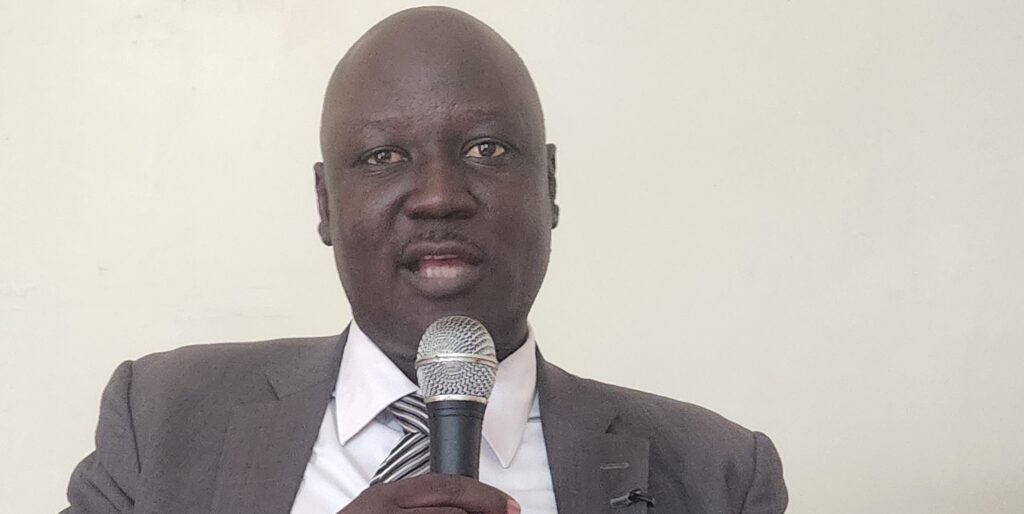
South Sudan has laws that protect freedom of expression, assembly and association, but their implementation remains a major challenge, the president of the country’s journalists’ union said on Tuesday.
Oyet Patrick Charles, president of the Union of Journalists of South Sudan (UJOSS), said security restrictions and differing interpretations of the law are undermining rights guaranteed by the transitional constitution and other legislation.
“South Sudan has progressive laws, very good laws. But the issue comes now,” Oyet said during an expert panel discussion organised by the South Sudan Human Rights Defenders Network (HRDN) in Juba.
He said journalists face restrictions even when exercising their right to associate, citing a requirement for UJOSS to obtain a “letter of no objection” from the Media Authority before holding meetings.
According to Oyet, the clearance process is effectively linked to the National Security Service, meaning journalists cannot freely organise without government scrutiny.
He said restrictions had at times extended beyond political activities, recalling that security clearance had previously been required even for private social gatherings such as marriage ceremonies.
Oyet also criticised what he described as selective enforcement of the right to peaceful assembly, saying demonstrations supporting government positions are treated differently from protests over governance, high prices and unpaid salaries.
He cited the arrest of members of the People’s Coalition for Civil Action (PCCA) after they planned demonstrations, as well as the detention of journalists covering protests.
The restrictions are particularly concerning as South Sudan prepares for elections scheduled for Dec. 22, Oyet said, with about three months remaining on the election timeline.
He said fear of repercussions is discouraging South Sudanese from openly discussing the elections and making journalists more cautious about what they publish.
“Many people say election will not take place. But if you say, can I record this? People say, no, no, you cannot record it,” he said.
Oyet said he had written opinion articles about the elections but had sometimes been advised by colleagues not to publish them because they could expose him to problems.
He rated freedom of assembly and association at two out of 10, saying the laws are good but poorly implemented. He gave the same rating to freedom of expression.
Ayaa Irene Lokang, executive director of the Association for Media Development in South Sudan (AMDISS), also said the country’s laws are progressive but their interpretation and implementation remain problematic.
Lokang said conflicting interpretations of legislation had created difficulties for civil society and media organisations. She cited the suspension of AMDISS and UJOSS over registration with the Media Authority.
She said a lawyer had initially advised the organisations that AMDISS is not required to register under the Media Authority Act, but later gave the Media Authority a different interpretation of the same law.
“I think institutions who want to bypass the law or they want to run away from the law and they don’t want to be accountable, they have a way of misinterpreting the law,” Lokang said.
She also raised concerns about journalist accreditation, saying the Media Authority Act does not require journalists to register but that accreditation had increasingly become a condition for covering some official events.
Lokang said journalists without accreditation could be excluded from events, citing a recent Ministry of Information event where journalists were reportedly told that only accredited journalists would be invited.
She also linked restrictions on freedom of movement to freedom of expression, saying people who openly criticize authorities are more likely to face restrictions.
“People who speak out on critical issues, they are the ones restricted from movement,” Lokang said.
She cited restrictions imposed on Vice President Rebecca Nyandeng as an example of how freedom of expression, association and movement could be interconnected.
Lokang said organisers of media and civil society events also face scrutiny over participants and speakers, with security officials questioning invitations to political figures, particularly those from opposition groups.
She said such practices can intimidate organisers and interfere with their ability to freely associate with others.
On freedom of expression, Lokang said journalists face difficulties reporting on sensitive issues including corruption and human rights violations.
She said some critical stories are removed before publication, while journalists investigating sensitive issues can face threats, including threats to their lives.
“If you follow the media, because as a journalist, you cannot write critical stories,” she said, adding that fear also affect civil society members consulted on sensitive issues such as the elections.
Lokang said journalists had also been arrested and detained while carrying out their professional duties, sometimes being released after several days without charges or having statements taken.
She said releasing detained journalists is not enough and called for accountability and justice in cases of unlawful detention.
Both speakers acknowledged progress in establishing legal frameworks protecting fundamental freedoms but said the main challenge is ensuring that those laws are respected and applied consistently.

 and then