



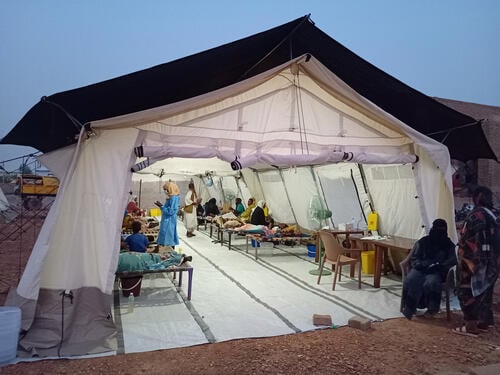
The medical charity Médecins Sans Frontières (MSF)/Doctors Without Borders has said that the humanitarian situation in El Obeid in Sudan’s North Kordofan State, home to around 500,000 people, is very dire and miserable. The charity said that during a recent field visit, their teams witnessed firsthand how the conflict is affecting people’s daily lives.
Liesbeth Aelbrecht, MSF Emergency Coordinator, said during an interview that the frontline is less than 40 kilometers from the city and that drone strikes have increased in recent weeks, targeting El Obeid.
and the main road leading to the city. These attacks are adding a lot of
pressure on already weak essential services, increasing fuel and transport costs, and making it difficult for people to access safe drinking water, shelter, and lifesaving care.
Below are edited excerpts:
Q: Why is El Obeid attracting attention now?
A: The vast Kordofan region, in south-central Sudan, has remained one of the most volatile and active conflict zones of the three-year-long war in Sudan. North Kordofan state is at the centre of the hostilities, and its capital, El Obeid, with about half a million inhabitants, has become a refuge for about 100,000 displaced civilians fleeing violence elsewhere. This is coupled with being one of the least accessible regions for humanitarian organisations.
The frontline is less than 40 kilometres away. In June, the UN sounded alarms on the potential consequences of a large-scale attack by the Rapid Support Forces (RSF) following reports about the mobilisation of troops. Drone attacks by the RSF have intensified in recent weeks in and around the city. According to data from the International NGO Safety Organisation (INSO), North Kordofan has been the state receiving the highest number of drone strikes in 2026, with at least 141 recorded attacks until 8 July. More than half of these attacks (51%) have taken place since June, and the vast majority hit El Obeid, followed by the main road leading to the city from the east.
Q: How is the situation in the city?
A: There is a real sense of fear among people in El Obeid. Drone strikes are not limited to military targets. They very often hit civilian areas, killing and injuring civilians. Since June, strikes have hit schools, a market, fuel stations and supplies, water points, and the main power station of El Obeid, causing major disruption to the city’s electricity supply and blackouts, although the network has somehow been reestablished.
Drone attacks are impacting basic services, raising transport and fuel costs, and limiting access to safe drinking water and healthcare. There are almost no remaining functional fuel stations, and the price of one litre of gasoline has reached nearly 15 USD, and it can be even higher on the black market. The water situation is also critical, with many people waiting for hours to collect water, and the prices of the barrels are skyrocketing too. El Obeid now depends mainly on seasonal dams and a small number of urban boreholes. In one of the camps for displaced people I recently visited, families are surviving on a little over one litre of water per person per day, and there are too few latrines and widespread open defecation.
People are struggling to afford even basic healthcare. Hospitals running without reliable backup power are suffering from power rationing and are at risk of having to close some life-saving services. They are in need of more generators and depend on fuel, which is no longer available. In addition, they also suffer from a lack of water. Access to medicines remains a challenge and is costly; the referral of patients can be difficult because of insecurity, transport costs, and delays in seeking care, which often result in patients arriving in a more severe condition.
The repeated attacks are making humanitarian operations increasingly difficult. Insecurity limits the ability of teams to move safely, and restrictions on travel permits and road movements can cause further delay.
Q: Are people leaving El Obeid?
A: We observe that regular bus movements are still running and that the road remains passable. However, many people cannot afford to leave or are possibly afraid to move because the main road out of the city is frequently targeted by drones.
We are not currently observing a large-scale movement of people leaving El Obeid towards neighbouring White Nile state, situated about 100 kilometres away. However, should people decide to leave El Obeid, they must be granted safe passage and access to shelter, safety, and medical care whenever they need it.
Q: What is MSF concerned about?
A: The situation is very difficult, especially for displaced people. Many families are struggling to meet their basic needs and live in crowded places with poor shelter and very little access to water and sanitation, leading to poor hygiene. We are particularly worried about access to safe drinking water, as many people are using unsafe water sources.
With the rainy season starting, conditions will get worse, and the risk of diseases like cholera will increase. Cholera was first reported in neighbouring West Kordofan state in late May. In North Kordofan, dozens of suspected cholera cases have since been reported, raising serious concerns that the outbreak may be spreading into the state. Malnutrition is already high, especially among children, making people more vulnerable to illness.
The recent escalation once again places civilians in the middle of the conflict. After more than three years of violence, displacement, and loss, people are simply exhausted. In one of the camps, I met a lady who had fled from El Fasher last year. She walked 21 days to reach El Obeid. She arrived barefoot after witnessing unimaginable suffering along the way, and now she is again on the brink of an extremely difficult situation here. Her story is just one of many stories of this unbelievable, incredible resilience, but it is also a reminder of the immense human cost of this conflict.
As fighting intensifies in and around El Obeid, we call on RSF and the Sudanese Armed Forces to ensure the protection of civilians, as well as of aid workers trying to support the population.
Q: What is MSF doing in response?
A: We are coordinating with the Sudanese authorities to strengthen outbreak response and scale up emergency activities. We have been able to bring in a new emergency team over the last few days that will focus on making water available as people urgently need safe drinking water and on enhancing the Ministry of Health’s cholera response, among other activities.
Between April and May, North Kordofan experienced a measles outbreak that was brought under control through case management and a vaccination campaign. MSF supported the isolation centre at the Teaching Hospital, the referral of patients from displaced camps, and health promotion.
MSF teams are ready, and supplies are prepared, to expand the response in El Obeid, as well as in other areas across the Kordofan, as needs evolve. Humanitarian organisations need safe access so they can continue providing life-saving assistance, which is so desperately needed. MSF is also preparing for a possible large arrival of displaced people in White Nile state if the situation worsens.

 and then