



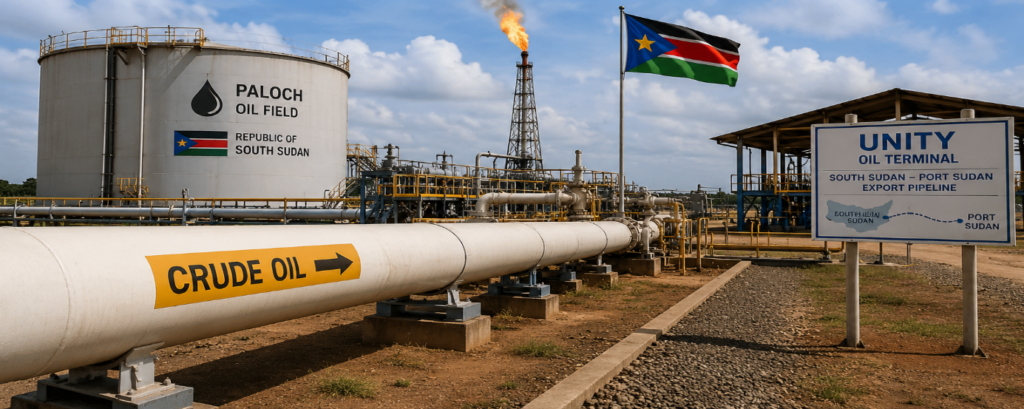
A recent partial settlement between the Government of South Sudan and commodities trader BB Energy has eased restrictions imposed by the London High Court, which had barred South Sudan from entering new oil-backed loan agreements until a US$140 million debt to BB Energy was repaid. The injunction had significantly constrained the government’s ability to secure fresh financing using future crude oil production as collateral, increasing pressure on an economy already heavily dependent on oil revenues. The settlement therefore marks an important turning point in South Sudan’s oil-backed financing dispute, temporarily easing legal constraints that threatened crude exports while exposing the government’s continued reliance on future oil production to meet its financial obligations.
Oil remains the backbone of South Sudan’s economy, accounting for most of the government revenue and export earnings. Yet the BB Energy settlement demonstrates that the country’s greatest challenge is not producing oil—it is retaining enough of its value.
At current production levels of between 70,000 and 100,000 barrels per day, South Sudan is expected to produce approximately 8.5 to 12.2 million barrels between August and November 2026. While these figures may appear encouraging, gross production tells only part of the story. It creates the impression of substantial national wealth, yet only a fraction ultimately becomes government revenue.
Before the government earns a single dollar, International Oil Companies (IOCs) recover their contractual investments through cost oil and receive their share of profit oil under Production Sharing Agreements. Depending on the applicable contracts and field economics, these entitlements may account for an estimated 35–45 percent of total production. Sudan also receives substantial pipeline, processing, and transit fees for every barrel exported through its territory. These obligations leave the Government of South Sudan with only a fraction of the value generated by its own natural resources.
The three cargoes allocated to BB Energy are estimated to be worth between US$120 million and US$130 million at current market prices. Yet this represents only the gross value of the oil. Once contractor entitlements, pipeline charges, transit fees, and other contractual obligations are deducted, the amount available to the national treasury is significantly lower. The settlement therefore highlights the complex web of financial commitments that continues to constrain South Sudan’s public finances.
Importantly, the settlement also serves as a warning. The 1.8 million barrels committed to BB Energy represent roughly 15–21 percent of the country’s projected production during the repayment period. Every cargo allocated to debt repayment is a cargo unavailable to finance the national budget, infrastructure, healthcare, education, or other essential public services. In other words, while the country can physically produce and export the oil, a growing share of its future production has already been committed to meeting past financial obligations.
The broader lesson is clear. South Sudan’s economic future will not be secured simply by increasing oil production. Sustainable prosperity requires greater transparency in petroleum contracts, prudent management of oil-backed borrowing, diversification of the economy, and investment in sectors beyond oil. It also requires stronger parliamentary oversight of petroleum revenues, greater public disclosure of oil-backed financing arrangements and fiscal policies that prioritise long-term national development over short-term borrowing. Otherwise, rising production will continue to enrich contractors, creditors, and transit partners long before it improves the lives of ordinary South Sudanese.
The BB Energy settlement may resolve one legal dispute, but it should also inspire a broader national conversation about how South Sudan manages its most valuable resource. As the country prepares for a new political chapter, policymakers have an opportunity to strengthen fiscal governance and ensure that oil wealth serves the national interest rather than perpetuating cycles of debt. Ultimately, South Sudan’s success should not be measured by how many barrels it produces, but by how much lasting prosperity those barrels create for its citizens.
The writer is a South Sudanese activist currently living in the UK. He can be reached via warillewarille@yahoo.co.uk.
The views expressed in ‘opinion’ articles published by Radio Tamazuj are solely those of the writer. The veracity of any claims made is the responsibility of the author, not Radio Tamazuj.

 and then