



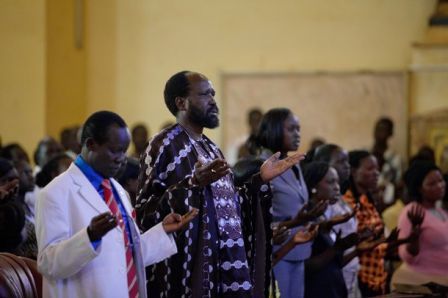
South Sudan’s parliament plans to convene a National Parliamentary Prayer Breakfast in Juba on July 7–8, 2026, under the theme, “One Nation, One People, One Future: Seeking God’s Wisdom for Peace and Elections in 2026.” According to Speaker Joseph Ngere Paciko, the event aims to foster national unity, reconciliation, moral accountability, and divine guidance ahead of the country’s general elections scheduled for December 2026.
On the surface, the initiative appears noble. Few citizens would object to prayers for peace, unity, or a credible electoral process. Faith remains deeply important to many South Sudanese, and religious reflection can play a constructive role in promoting ethical leadership and national healing. Yet beneath the language of spiritual renewal lies a deeper political question: why is a parliament presiding over unresolved electoral challenges turning to symbolic religious performance at the very moment when institutional credibility remains under scrutiny?
The issue is not prayer itself. Rather, it is whether prayer is being elevated as a response to problems that are fundamentally political, legal, and institutional in nature.
Parliament’s stated objective is to seek divine guidance for credible elections. Yet credibility is not something that emerges through declarations, ceremonies, or public displays of faith. Electoral credibility depends on transparent legal frameworks, functioning institutions, security guarantees, public trust, and equal political participation. These are matters of governance, not theology.
The contradiction becomes apparent when the prayer breakfast announcement is examined alongside the realities surrounding the electoral process.
South Sudan is preparing to hold its first general elections since independence in 2011. The vote has been repeatedly postponed because critical provisions of the 2018 Revitalized Peace Agreement remain unimplemented, security arrangements remain unresolved, and constitutional reforms remain incomplete. Political disagreements over the implementation of the peace process also persist. Even the National Elections Commission has acknowledged legal inconsistencies and funding shortages that could undermine preparations for the December 2026 elections.
This tension raises a fundamental question: can divine guidance substitute for institutional readiness?
Let us assume that the organizers are entirely sincere in their intentions. Let us also assume that every participant attends with genuine concern for peace, unity, and democratic progress. Even under those assumptions, the underlying institutional problems remain unchanged. Prayer may inspire moral reflection, but it cannot harmonize contradictory electoral laws or resolve unilateral executive decisions under President Kiir’s administration, nor can it complete delayed constitutional reforms. Prayer may strengthen personal conscience, but it rarely substitutes for the administrative and political preparations required to conduct a credible national election.
The distinction matters because political systems facing crises of legitimacy often rely increasingly on symbolic acts. South Sudan’s current political environment exhibits many of these characteristics. When institutions struggle to inspire public confidence, leaders frequently turn to rituals, public commemorations, and moral performances that project unity and purpose. Such symbolism may temporarily reassure supporters, but it cannot eliminate the structural problems that gave rise to public concern in the first place. South Sudan’s political challenges extend far beyond the question of whether elections will take place in December 2026. Without meaningful progress on the unresolved provisions of the peace agreement, elections alone are unlikely to resolve the deeper crisis facing the country.
In this sense, the proposed prayer breakfast functions as more than a religious gathering. It is also a political event taking place within a highly contested electoral environment. Its timing, therefore, is impossible to ignore.
The country’s political leadership is under growing pressure to demonstrate that the elections, set for December 2026, will be peaceful, credible, and broadly accepted. Yet questions remain regarding security conditions, legal preparedness, institutional capacity, and political consensus. In this context, the language of divine guidance risks serving a political purpose rather than a purely spiritual one. It offers an image of moral seriousness and national unity at a moment when South Sudanese citizens’ confidence in the electoral process remains deeply uncertain.
This reflects a broader pattern that extends beyond South Sudan. Throughout history, governments facing institutional weaknesses have often sought legitimacy through symbolism. National ceremonies, patriotic narratives, public prayers, and appeals to collective identity can all serve important social functions. Symbolic politics becomes attractive precisely because it projects unity without requiring institutional compromise. However, symbolic politics becomes problematic when it begins to substitute for the difficult work of institutional reform. The planned prayer breakfast risks becoming an example of this tendency—the use of symbolic gestures at a time when institutional reform remains incomplete.
The danger is not that citizens gather to pray, but that the event functions primarily as a political performance rather than a meaningful response to the institutional challenges facing ordinary South Sudanese citizens. Framing political performance in religious terms does not resolve underlying problems; it risks obscuring them.
The parliament should recognize that national unity cannot be proclaimed into existence through a theme or slogan, and reconciliation cannot be produced through a two-day gathering alone. Public confidence in elections cannot be manufactured through symbolic displays of moral commitment. These outcomes emerge from consistent political action, inclusive governance, and institutions that citizens trust to deliver fairness and accountability.
The theme of the prayer breakfast—”One Nation, One People, One Future”—captures aspirations that many South Sudanese share. Yet aspirations and realities are not the same thing. A nation becomes united not because leaders declare it united, but because citizens experience equal treatment, security, representation, and trust in public institutions. A shared future is not created through rhetoric alone; it is built through policies and institutions capable of sustaining it.
The deeper issue, therefore, is not whether parliament should pray for peace and credible elections. Few would oppose such aspirations. The question is whether the regime, including Parliament, is confronting the institutional realities that continue to threaten those very goals.
From a broader East African perspective, South Sudan’s repeated obstruction of peace implementation is neither new nor unnoticed. Regional governments, mediators, and observers have spent years witnessing delays, broken commitments, and the selective implementation of agreements designed to stabilize the country and advance a sustainable peace process. Viewed in this context, the parliamentary prayer breakfast risks being seen not as a genuine effort toward national renewal, but as another political tactic by President Salva Kiir’s administration to divert attention from the unresolved governance failures, stalled reforms, persistent insecurity, and institutional weaknesses that continue to undermine peace and drive the country deeper into political and economic crisis.
The credibility of the elections will ultimately be judged not by the sincerity of prayers offered in July, but by the integrity of the processes conducted in December. Citizens will evaluate the elections not by the symbolism surrounding them, but by whether the legal framework is coherent, whether political competition is fair, whether security conditions permit meaningful participation, and whether the results reflect the genuine will of the electorate. Political symbolism can complement institutional preparation, but it cannot replace it.
If the country’s democratic future depends primarily on prayer breakfasts, themes, and declarations of unity, then South Sudan’s challenges run far deeper than electoral logistics. But if peace, credibility, and national cohesion truly remain the objectives, then the focus must return to the institutions responsible for delivering them.
The challenge facing South Sudan today is not a shortage of divine guidance, but the persistence of institutional weakness, incomplete political reforms, social fragmentation, and declining public confidence in the state’s ability to deliver peace, accountability, and credible elections. Symbolism alone can no longer substitute for the hard work of building democratic institutions that citizens can trust.
Salva Kiir’s regime has repeatedly demonstrated a capacity for political deception; it would therefore not be surprising if it seeks divine guidance while simultaneously continuing to obstruct the very reforms and processes it claims to be praying for.
The writer, Duop Chak Wuol, is an analyst, critical writer, and former editor-in-chief of the South Sudan News Agency. He is a graduate of the University of Colorado and writes on geopolitics, security, and social affairs in South Sudan and the broader East Africa region. His work has appeared in leading regional and international outlets, including AllAfrica, Radio Tamazuj, The Independent (Uganda), The Arab Weekly, The Standard (Kenya), The Chronicle (Ghana), Addis Standard (Ethiopia), and Sudan Tribune. In 2017, the Ethiopian Broadcasting Corporation highlighted his article on Meles Zenawi’s role in Ethiopia’s economic transformation. He can be reached at duop282@gmail.com.
The views expressed in ‘opinion’ articles published by Radio Tamazuj are solely those of the writer. The veracity of any claims made is the responsibility of the author, not Radio Tamazuj.

 and then