



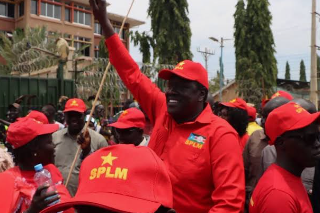
The death of General Joseph Lagu has brought South Sudan face to face with the passing of a generation that gave much of its life to liberation. In its condolence message on 30 October, the Sudan People’s Liberation Movement (SPLM) paid tribute to Lagu for unifying the Anyanya movement and helping lay the groundwork for the 1972 Addis Ababa Agreement. His struggle preceded the SPLM/A’s formation. That distinction matters because South Sudan’s liberation drew on successive generations and movements, and its legacy belongs to the country as a whole. SPLM
Within the ruling SPLM, a different kind of departure is underway. Some wartime veterans have lost senior party positions, others have returned, and new leaders have risen through the ranks. With general elections scheduled for 22 December 2026, these changes raise a question that goes beyond who occupies an office at SPLM House. Can the party turn the authority it inherited from the liberation struggle into a mandate freely given by voters? Radio Tamazuj RJMEC
In May 2025, President Salva Kiir replaced James Wani Igga as the SPLM’s first deputy chairperson with Benjamin Bol Mel. Daniel Awet Akot and Kuol Manyang Juuk were also removed from their senior party positions. By November, Bol Mel himself had been removed, and Igga had returned as first deputy chairperson. Radio Tamazuj reported that four people held the office of secretary-general in 2025. The party defended the changes as an exercise of authority granted to its chairman and said they were part of its strategy to address national problems. Radio Tamazuj
By July 2026, the party’s leadership summit brought together Igga, deputy chairpersons Mary Apai Ayiga and Simon Kun Pouch, and Secretary-General Akol Paul Kordit. That line-up shows how veterans and newer leaders can serve together. The harder question is how much authority party members have over who leads them. The rapid rise and removal of Bol Mel showed how quickly an appointment can change the balance at the top. A credible process for choosing candidates would show whether members in the states and counties have a meaningful say in what comes next.
The SPLM enters the electoral period with advantages built over decades. It has a familiar name, a national organization, and the visibility that comes with governing since independence. Its vulnerability comes from the same history. A young voter looking for work, a displaced family weighing whether it is safe to return home, and a parent struggling to keep a child in school will judge the party by what it has done in government and what it can credibly deliver next. The new leadership’s first task is to answer those voters in terms they can assess. Radio Tamazuj
The first test is how the SPLM chooses its candidates. The party announced plans for a national convention and primaries in the run-up to the elections. Clear nomination rules, meaningful participation by women and young people, and a credible way to appeal disputed decisions would give members a stake in the outcome. When local branches can influence who carries the party flag, candidates have a stronger reason to answer to the communities they hope to represent. Radio Tamazuj
The second test is whether opponents can campaign freely. An incumbent demonstrates confidence by accepting the same rules for public meetings, media access and campaign security that apply to its rivals. Citizens should be able to attend an opposition rally, question an SPLM candidate or decline to join a campaign without fearing consequences. A quiet polling station tells us little about freedom if fear has already kept people away. In October, the Reconstituted Joint Monitoring and Evaluation Commission (RJMEC) warned that unresolved political disputes, incomplete security reforms and stalled peace agreement commitments could undermine the credibility of the December elections. RJMEC
The third test is what the party does when voters reject one of its candidates. An SPLM victory in a genuinely competitive election could give its leaders a fresh mandate. Losses in individual races would also carry a democratic mandate, and the party would have to respect them. That means taking disputes through lawful channels and allowing duly elected opponents to assume office. If the elections are postponed, the party’s credibility will depend in part on whether it works with other signatories to agree publicly on the outstanding steps, who is responsible for them and when they will be completed. RJMEC
South Sudan can honour its liberation veterans while asking searching questions of the party that emerged from their struggle. The new faces at SPLM House have an opportunity to give members a real voice in choosing candidates, put a programme before the country and defend the right of citizens to vote for someone else. The clearest sign that a new generation has taken responsibility will come when the party accepts the public’s verdict, even where that verdict costs it power.
The writer is a researcher and writer specializing in humanitarian and development issues in South Sudan. He holds a degree in Sociology and Political Science from the Catholic University of Eastern Africa and a Master’s in Peace and Development Studies from the University of Juba. He can be reached via moggaloloyo@gmail.com.
The views expressed in ‘opinion’ articles published by Radio Tamazuj are solely those of the writer. The veracity of any claims made is the responsibility of the author, not Radio Tamazuj.

 and then