



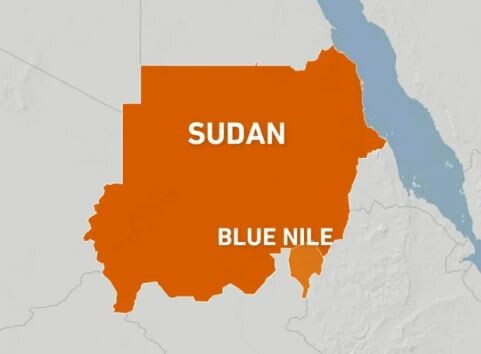
The humanitarian situation facing displaced people in Sudan’s Blue Nile region is deteriorating as military operations intensify and fighting spreads across several localities, amid growing complaints about inadequate basic services and shelter supplies.
Meanwhile, questions have emerged over the management of humanitarian assistance following reports that relief items intended for displaced families were seized after allegedly being offered for sale in local markets.
Activists circulated reports on Facebook claiming that the Blue Nile Police Investigation Department had seized equipment and relief supplies intended for displaced people while they were being offered for sale at a local market. No official clarification has yet been issued regarding the nature of the seized items or who was responsible for their alleged diversion.
Civil society activist Ihab Al-Sir told Radio Tamazuj that police investigators had seized humanitarian aid packages bearing the logo of the King Salman Humanitarian Aid and Relief Centre (KSrelief) at the Grand Market near Al-Rabee neighborhood in Damazin.
“The reported incident, based on information circulated by activists and local sources, warrants an explanation of how the supplies ended up at the market, an examination of the distribution mechanisms and an investigation into whether any irregularities had occurred,” he stated.
Al-Sir stressed that those responsible should be held accountable if wrongdoing was established, while ensuring that humanitarian assistance reached its intended beneficiaries.
The allegations come as displaced families complain of deteriorating services and shortages of food, drinking water, medicines and shelter materials, raising concerns that assistance is not reaching the most vulnerable communities in sufficient quantities.
Describing the humanitarian situation, displaced persons’ coordinator Suleiman Al-Mardi told this publication that conditions were “extremely critical,” with large numbers of women, children, older people and persons with disabilities among those affected.
“Displaced families face severe challenges, particularly the lack of safe drinking water and acute shortages of plastic sheeting, blankets, sleeping mats, mosquito nets, medicines and food,” he said.
Al-Mardi appealed to the authorities and humanitarian organizations to intervene urgently, provide essential supplies and help displaced communities cope with the worsening humanitarian crisis.
The deteriorating conditions coincide with escalating military operations in Kurmuk, Geissan and Wad Al-Mahi localities, triggering further waves of displacement. The latest arrivals include people fleeing Al-Kakli, Dandaro and surrounding areas in Kurmuk locality following fighting in the Sali area.
Some residents were forced to flee their homes on foot in search of safety, facing difficult humanitarian conditions and shortages of food, drinking water and shelter materials. The influx has placed additional pressure on host communities and areas receiving displaced people.
Abdallah Ramadan, a displaced resident, told Radio Tamazuj that he and others had reached the Bau area after an arduous journey, only to encounter difficult living conditions, compounded by widespread mosquitoes and the approaching winter season.
Ramadan appealed to government officials and humanitarian organizations to provide urgent assistance, including essential shelter and protection supplies.
As displacement continues to rise, concerns are mounting over the effectiveness of the humanitarian response, transparency in aid management, and whether assistance is reaching those most in need. Questions have also been raised about the responsibility of the relevant authorities to prevent the diversion of relief supplies and ensure their distribution in accordance with established standards.
Ayman Haider, an activist and humanitarian affairs observer, told this publication that Damazin police investigators had seized a substantial quantity of relief supplies belonging to the King Salman Humanitarian Aid and Relief Centre.
Haider claimed the incident was not the first of its kind, citing previous reports of humanitarian aid being sold in local markets without effective legal action being taken against those allegedly involved.
He said large numbers of displaced people had not received the assistance they needed, arguing that reports of relief supplies being traded in markets warranted investigation and closer scrutiny.
Haider called on judicial authorities to take firm action if violations were established and urged tighter oversight of humanitarian aid distribution.
He also appealed to humanitarian organizations and other relevant bodies to ensure that relief supplies reached their intended beneficiaries, emphasizing the importance of the media in monitoring such cases and exposing shortcomings.
Radio Tamazuj was unable to obtain a comment from the relevant authorities on the reported seizure of relief supplies or allegations that humanitarian assistance had been diverted to local markets by the time this report was prepared.
As displacement spreads and access to essential services deteriorates, thousands of displaced people face renewed hardship that extends beyond fleeing conflict to the daily struggle to secure food, water and shelter.
The worsening situation underscores the urgent need for an effective humanitarian response, alongside stronger oversight and accountability mechanisms to ensure transparency in aid distribution and that assistance reaches those for whom it is intended.

 and then