



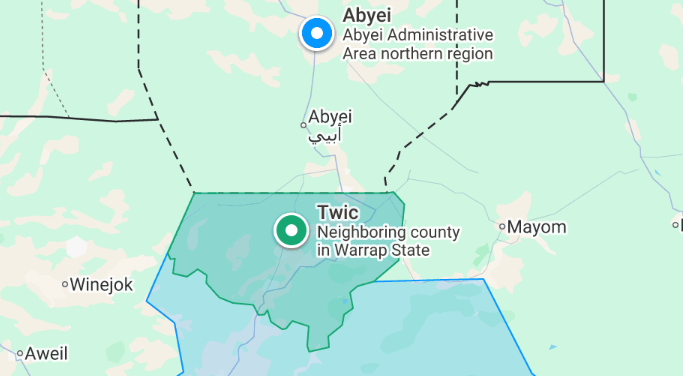
On two different occasions in Juba, South Sudan, two political leaders, in the persons of Vice-President of the Republic of South Sudan, His Excellency Taban Deng Gai, and Hon. Adau Deng Kuol, made similar statements on the controversial issue of the boundary between the Abyei Area in Kordofan, Sudan, and Twic County in Warrap State in South Sudan.
In a public statement to the media on 31 August 2026, as reported by Eye Radio, Vice President Taban Deng said: “Go to court, not war”. He urged Members of Parliament and community leaders from Twic County and Dinka Ngok of Abyei to stop using war rhetoric and resolve their border disputes through peaceful and legal means. He further described the ongoing conflict between Ngok and Twic over the land as a senseless war. This conclusion is misleading in describing the war over ownership of the land as a senseless war, yet it is the same land dispute between North and South Sudan that led to the war of 21 years with the successive regimes in Khartoum. It is this land value that caused the lives of more than five million people in defense of the land, peoples, and resources during the 21 years of liberation struggles.
Similarly, on 7 September 2026, during the funeral rite of the late Mawien Machok, Hon. Adau Deng Kuol made her comments as reported by Twic Media Reports (TMR), and she urged “Twic Mayardit and Ngok Deng Kuol to take their long-running land dispute to court, saying a judicial ruling could help end the conflict. She further lamented that “the two communities should prepare their respective files with evidence and allow the court to determine ownership of the disputed land.
Hon. Adau, in her legal wisdom, which is not supported by any substantive legal or policy provisions or provided in any of the Rules of the Court, believed that “the legal process could take about seven months before a decision is reached on whether the land belongs to Twic or Ngok”.
In light of these two statements coming from two supposedly well-informed political leaders, including the second most senior person in the country, one is left with mixed reactions or the feeling that both of them either lack knowledge of the case of Abyei as provided for in the Comprehensive Peace Agreement (CPA) 2005, as well as the report of the Abyei Boundary Commission (ABC), which was contested in 2009 by two principal parties-the Government of Sudan and the SPLM and finally the arbitral award by the Hague-based Permanent Court of Arbitration (PCA).
The contested issues on the final status of Abyei, including boundaries between Abyei in Kordofan and some areas South of the Kiir River in Bhar el Ghazal, were contained in these legal references mentioned above. In the ABC report, for example, there was no dispute on the Southern border between Kordofan and Bhar el Ghazal, which remained as of January 1st, 1956, because there was no demarcation or delimitation of the area. Equally important, it is to be noted that even after disagreement by the parties (GoS and SPLM) on demarcation and delimitation of the northern, eastern, and western boundaries of Abyei and the matter was referred for arbitration, the PCA confirmed the decision of the ABC Experts because they did not exceed their mandate and there was no disagreement on the Southern Border between Kordofan and Bhar el Ghazal.
Historically, the Republic of South Sudan today stands on the colonial geographic borderline with all neighboring countries as of January 1st 1956. It is therefore unfortunate for the two leaders not to know such historical and political evolution of our country and claim to be leading people with whom they have not understood the cause of war in the first place.
On the question of the court, to which the two leaders referred the two communities for determination on the contested land dispute, it is another failure for them to urge communities to take legal action when there is no cause of action for determination. First, many questions remain to be answered: which court do they mean to lodge the petition with? Is it the South Sudan National Court, a Regional Court, or a Global one such as the Permanent Court of Arbitration or the International Court of Justice?
Second, the disputed borderline was not a communal issue between Ngok Dinka of Abyei in Kordofan and Twic Dinka of Warap in Bhar el Ghazal, but it was a border between Kordofan and Bhar el Ghazal, which is an international transboundary dispute, as clearly provided in the colonial map that is not disputed by any party.
Accordingly, the ABC Experts and the PCA award both confirmed the southern border between Kordofan and Abyei to be as of January 1st, 1956. The fact that Abyei geographically lies north of the Kiir River, which is currently part of Kordofan in the Sudan, remains to be a matter for resolution in the final status of Abyei as agreed by the two parties.
As a result, during this interim period before the final status of Abyei, there is no court to which the matter can be referred by the two communities because there is no cause of action for determination, or any issue left undecided by the ABC Experts and the PCA final award. In our observation, the ongoing conflict between Ngok Dinka of Abyei and Twic Dinka of Warrap State is not due to lack of a competent court or a matter of an undecided case on the border between Kordofan and Abyei, but it is rather a calculated move by those who have the intention to grab the land of others, or those who have little knowledge of the dispute, or have no time or interest to address the dispute.
An example of leaders with little knowledge of the dispute in question is Vice President Taban, who, during the 8th governor’s forum held in Juba, referred to Athony Airport as part of the Abyei Area. That reference was viewed as ignorance of the highest order from the Vice President, who happened not to know the existing geographical areas and boundaries in his country.
Last but not least, the objective of this response to the two leaders and for the benefit of the general public is that a leader must always have the right information and updates on any given issue of concern, particularly on matters related to territorial claims such as these contradictory statements made so far by the two leaders.
The writer is a researcher on politics and governance and can be reached via hakimchol@gmail.com.
The views expressed in ‘opinion’ articles published by Radio Tamazuj are solely those of the writer. The veracity of any claims made is the responsibility of the author, not Radio Tamazuj.

 and then